Wednesday, February 7, 2018

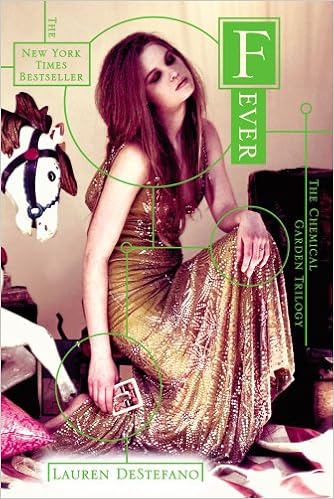
Fever by Lauren DeStefano

I have this pet theory. My theory states that in a trilogy, the middle book or movie is always the weakest. In most cases, the first book which covers the beginning of the over arching plot and the last book which covers the overarching climax and wrap up are better paced and written. Middles in narratives are notoriously difficult to write so the middle book in a trilogy often struggles a bit. Usually it's an issue of pacing and the individual climax of the book gets muted and lost in events that build the overall plot. Sometimes it is a big issue. Sometimes it is just a small matter of degree.

I go into all of this because it is rare for me to rate a middle book in a series higher than its predecessor. I rated Fever higher than Wither. I suspect now that source of my lackluster review for Wither  is sourced here. Something about it didn't quite pop. I'm not sure now what it was, but despite being a good premise, with a solid protagonist, and good writing, it just didn't quite come together.

Fever doesn't have that problem. In some ways it is a weaker storyline. However, DeStefano tackles a number of problems introduced in the first book. First, she spent so much time developing the sister-wives and characters in the mansion that it felt strange to discard them all for the rest of the series. From the beginning of fever, I was on the lookout for Rhine's return to the mansion in Florida. Frankly, I kind of dreaded it because her escape was such a goal in Wither. The only way I could see her going back was another kidnapping and that gets old. Thankfully that isn't what happens.

Second, this whole twin business. We know that Rhine has a twin in the first book but we never meet him. However, he does provide a rather compelling reason for her to be despite to escape such a pleasant captivity. At least on the surface. In Wither, Rowen, the twin, is a kind of non character. He is defined almost entirely by Rhine's desire to get back to him. Which is fine if he never shows up in the narrative. The moment Rhine escapes, it becomes clear the Rowen is going to be a focus in Fever and will need better development. While still mainly in his absence, Rowen's character gains depth over the course of the novel and it's not entirely sunny.

Third, DeStefano toys with the idea of an unreliable narrator when Rhine gets severely ill. It can be annoying when a character spends a third of the book half-delirious. DeStefano pulls it off though and mainly because Rhine never becomes truly unreliable and holds on to a sense of what is real. All of this serves to deepen the idea of Vaughn, the house master, as a villain. He goes from sinister in Wither to downright vile in Fever. In the process, the lack of apparent surveillance in Wither is explained even though it's never even raised as a question in the first novel.

On the negative, Rhine's relationship with Gabriel is a bit of a mystery to me. I never really buy it in Wither and it gets more seemingly ambivalent in Fever. This doesn't present too much of a problem but it tears down any sort of apparent love angle. It really seems more like a relationship of mutual reliance. If anything, it almost seems like Rhine loves Linden after all.

Over all, a better read with excellent pacing but extremely grim.

Tuesday, February 6, 2018

The Joys of Teaching

So, I teach this young man who struggles in school, not because he can't do the work, but more because sometimes life is a little hard to face outside of a pillow and blanket. He misses a lot of school and as a consequence gets behind in his school work.

However, when he is at school, he does very well. I particularly enjoy talking books with him. For a teenager, he has odd taste in books. So far this year, he's read the collected works of Lovecraft, Mary Shelly's Frankenstein, The Wreck of the Whaleship Essex by Owen Chase, and assorted Forgotten Realms novels. He likes the language in the older works but at this point he's mainly rereading the same classics that he's read many times before. It has been one of my goals this year to get him started on some new authors. I tried him on the works of the Brontes and Hiassen. No go.

Finally, I talked to my dad about it and he suggested A. Merritt. Well that worked. In fact, I keep catching him reading it when he should be doing my work.

*Sigh* I'm going to have to start using novels as bribes.

Monday, February 5, 2018

Daily Blog Flaw

One of the big issues with having a daily blog is having something to write every day. Every. Single. Day. I'm actually surprised it doesn't come up more often, but when I'm on a reading jag, there are plenty of books to write about and filling in the gaps is no real problem. It only really comes up at times like this when I've decided to take a break.

Incidentally, these small breaks are also what tend to derail the blog altogether.

I'm determined this time around, to find a way to take a break from reading without also taking a break from blogging. It's tough though, I end up sitting her forlornly staring at a blank page and feeling utterly devoid of interesting thought. This, I think, must be what my students feel when I ask them to journal without giving them a topic. They sit there, almost panicked, watching the minutes tick away. And so do I.

Of course, the trick is to just write. . . anything. Anything at all. I could start transcribing the lyrics to "I'm the very model of a modern major general," and that would do the trick because writing is, on some level, only a really elaborate free association exercise. I could follow the modern major general to the Despicable Me 3 movie where the minions sing a version in minionese and that my son absolutely loves. The writing becomes a post about Thomas and being a parent. I could also follow the same modern major general to a memory of meeting my husband who tells the story of being cast as a copper in "Pirates of Penzance" despite his long piratey hair because he's a baritone. Suddenly, I'm writing a post about my husband. Or I could follow it to the time I saw it with my father as a kid...I think we were at Stratford, Ontario's Shakespeare festival. A post about my childhood.

See, free association. Our brains are such neat places.


Sunday, February 4, 2018

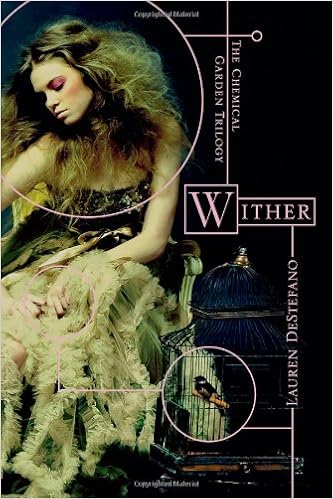
Wither by Lauren DeStefano

It's an odd thing. Sometimes I read a book and I don't end up with much to say. Even if I like the book too. I suspect it's a sign for me to take a small break in reading. No matter how much I love books, I can get saturated.

Wither is a good book. It is another dystopian set up. In this near future version of the world mankind has conquered most disease and genetic engineering. In fact, so successful that about 70 years before the beginning of the book, there was a whole generation of babies that were artificially conceived. That whole generation - the first generation - was completely healthy. However, 50 years after, or so, it turns out that the children of the first generation are all susceptible to a mysterious virus that kills all the men at age 25 and all the women at 20. There are no survivors and the virus works like clockwork.

This of course all has a rather immediate effect on society. There are large numbers of orphans floating around. Women are stolen from their families to become part of polygamous marriages for the wealthy with the hope of producing more offspring. Rhine is one such young woman. She might be stolen and married off, but she has no intention of idly accepting her fate and immediately starts to plot an escape.

There is a large cast of characters including Rhine's two sister-wives, her husband and her husband's father, and all the servants and attendants. The interesting thing is that the vast majority of the characters are likable and that includes the husband, Linden. As much as this is sci fi, it's the psychological aspects of the narrative are the most interesting. One gets the sense that it's really the world that is pushing events more that it is evil acts. Mind you, the bad guy is super creepy.

I'm looking forward to seeing how the narrative develops in the second book.

Saturday, February 3, 2018

A Day Like Today...

Some days need to be returned to the temporal factory as defective. Today was such a day. Pragmatically, I know that it is a result of the unusually long marking interval. The kids were squirrely and just cantankerous. I kept walking around the corner into situations that I had to deal with. I wrote a total of three pink slips (our highest level disciplinary documentation for the teaching staff). That's a lot for me.

Additionally, I alerted on two more situations that ended up in the kids going home with their parents. I'm not sure if they ended up in suspension or not, but it's not a good sign by any stretch.

All I want to do now is hide under my blankets until the sun comes fully up tomorrow which means sleeping in two hours.


Friday, February 2, 2018

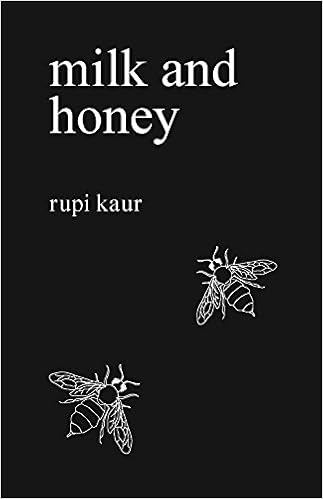
Milk and Honey by Rupi Kaur

This book has started a small controversy at my school. In August, one of my seniors chose Milk and Honey as her independent reading book. Coincidentally, a different student requested our media center specialist buy a copy for the school. Since, it was a best seller and appeared on several lists, she bought a copy without thinking much about it.

My student, when she realized that she would have to do a book talk on it, alerted me to some concerns about how to present on it appropriately. I flipped through her copy and immediately saw the issue, but she and I talked it through and she successfully (and appropriately) presented it to the class. Less than a day later, the media center specialist called me over to ask about the book. In the way these things tend to happen, the book had first been delivered to the middle school by mistake. So by the time it made it up to the high school, both principals at the middle school had flipped through it and had grave concerns. These concerns were shared with the High School principal and the media center specialist. At this point, it was time to ask the resident bibliovore for an opinion and that's me.

Milk and Honey is a collection of diary style poetry and prose having to do with the Kaur's first 21 years. She had a rough time of it. She experienced abuse and pain, but she also experienced love and healing. There are many references to sex and some of the line drawings are a bit suggestive. In several places Kaur expresses her experiences graphically.

There's nothing wrong with this book. It's memoir. These poems are this woman's experiences. It might make me wince in places but it didn't feel like shock value to me, just the expression of a woman who refuses to feel shame for what happened to her. In terms of theme, this is an excellent book for young women to read as it is very much a book about healing and finding strength in experience.

The problem, as far as I can tell, is that there is a sizable group of people out there that insist this is a YA title. It isn't. Just because the author was of the same age as the YA set while going through the events of the memoir doesn't mean that it's aimed at the YA audience. Conversely, that also doesn't mean young adults in their late teens and up shouldn't read it either. There is value in texts like this in that it models response to horrible situations and provides insight. We could all do with more insight.

I am uncomfortable with the idea of censorship which is why I worked with my student so that she could present Milk and Honey to the class. Censorship empowers the thing that is censored. If an idea is seen as dangerous that makes it more appealing to most people. That is just human nature. I'd rather face such things head on and talk them through. I am however sensitive to the position of parents and school administrators.

Our media center serves both the high school and middle school. A book like this is not appropriate for younger audiences, and I support the decision to keep it off the media center shelves. However, as a compromise she gave the book to me for my classroom collection. My collection is something that I have more control over. I have a collection of books that I keep separate from my main collection that I give to students if they ask for them and I think they are mature enough. In some cases, I call home and explain the book to the parents and ask them to decide if they want their child to read it.

In the case of Milk and Honey, I admit to some ambivalence. I will happily support a student's desire to read difficult material even if the ideas make me uncomfortable. There is a lot of buzz about Milk and Honey and it keeps coming up in my conversations with my students because it was a recent best seller. It'll take time for the buzz to die, and until it does, it is best that we have a copy so that we know what is floating around the student body. On the other hand, I don't relish the conversations with the parents. While I believe there is nothing wrong with the book, I also don't think it's some sort of transcendental reading experience.

Thursday, February 1, 2018

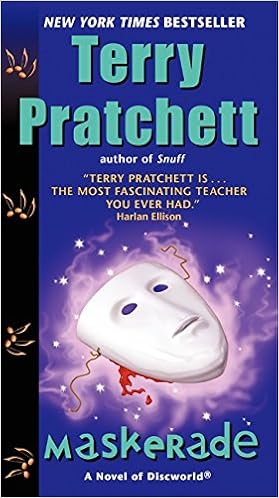
Maskerade by Terry Pratchett

The thing about a series is that if you enjoy it, once you finish one book, there is a strong impulse to dive into the next one. Additionally, I'm now well past the Discworld books that I've read in the past, so it is all new territory.

Maskerade is one of the less zany of the Discworld books. Nanny Ogg and Granny Weatherwax are back making it part of the witches subseries even if Magrat is off being a queen. In fact, the book opens with Nanny and Granny needing a third witch for their little gatherings. Nanny is particularly worried that Granny will become unhinged and either wander off and die or become one of the bad ones.

The best candidate for a new witch is Agnes Nitt, only she's gone off to Ankh-Morpork to become an opera singer. She's got an amazing voice too. The problem she finds is that she is built on rather more Wagnerian lines and her ample figure isn't what they are looking for in their stars these days. In fact, there are many in the opera-house who feel that the values of good music above all other consideration are being compromised. And it doesn't help that their patron ghost has started killing people.

This is an unusual book for Discworld series. It is really a murder mystery. Someone is killing people and Agnes, Nanny, and Granny are trying to find out who: basic mystery plot. The identity of the Ghost is the lynch pin of course.

Maskerade was a fun read but it took a long time. The pacing was very different. As with all the Discworld books, there were no chapter breaks which will always be a struggle for younger readers. Additionally, a lot of the jokes assumed at least a passing understanding of opera. Pratchett particularly pokes at some of the notoriously ridiculous plots. I spotted references to La Traviatta, The Magic Flute, The Barber of Seville, and Die Fledermaus. Wagner's entire opus is sort of generally referenced. Additionally, the Ghost in the book is an obvious reference to The Phantom of the Opera, and there is a passing reference to Cats, The Pirates of Penzance, Les Mis, Evita, and Miss Saigon. Given that I'm not a big Opera or Musical Theater fan, I am sure that I missed a lot on this one.