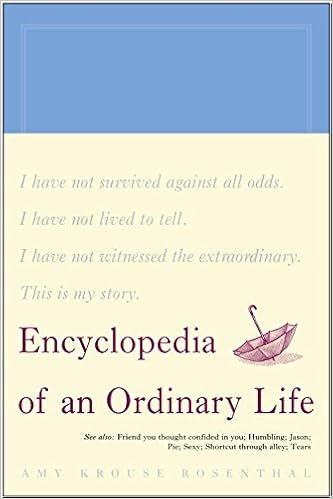
So. Sometimes I'm seduced into reading a book because of someone else's enthusiasm. I've been reading a lot of Penny Kittle just lately and she just raved about a book called Encyclopedia of an Ordinary Life by Amy Krouse Rosenthal. It's an autobiography. I hate autobiography. Generally speaking, there's nothing more tedious than someone wittering on about their own navels. (I include my own witterings about my own navel, incidentally) Yet, Kittle wrote so passionately and so convincingly about this particular autobiography that, I not only decided to read it, I had to track a copy down to buy online in order to do so.
My feelings on this book are mixed. On the one hand, Rosenthal is sentimental in a way that I find irritating. It seems like she can find meaning in the crumpled remains in an old newspaper. She feels a connection between things that have nothing to do with each other. In fact, I'm a little jealous of her ability to find awe at the utterly ordinary. An ordinary life is ordinary, so much of it runs the risk of being tedious. Rosenthal finds wonder in the ordinary and that's not a bad thing. Just really, really irritating.
On the other hand, the thing Kittle was so enamored of was the structure. Rosenthal has written her autobiography in form of a collection of encyclopedia entries. Everything is included, the profound ("meaning," "statement," "rejection," & "profound") as well as the minutia ("closet," "stupid slow driver," & "weather, asking about the".) All of it's deeply personal, if not deeply important. Even so, some of it resonated with me on a deep level.
I too find my conversation becoming overly verbose when I'm uncomfortable, I too find pictures in the random patterning of my shower tiles, and I too look for the super-rich folded over potato chips in the bag to savor first. They are simple things, but they make me feel connected to this woman who I have nothing substantial in common with.
I'm still not sure what I ultimately think about this book. It may take me months, or even years, to decide, which is, perhaps, a recommendation it its favor.
Wednesday, January 6, 2016
Tuesday, January 5, 2016
Five Vegetables I Used To Hate, But Now I Love. . .
It's funny how taste changes as we age. My parents used to have a rule that I had to at least try everything on my plate. The idea is a good one. Studies show that it can take up to five exposures before a child will accept a new food. I, however, was a particularly stubborn thing and would insist I didn't like the thing (whatever the thing) even after tasting it, no matter what my true opinion. From there I got entrenched in my stance to a point that sometimes I think I convinced myself that I really didn't like the food.
Later on after college, I decided to revisit these deeply entrenched "hatreds." Some, I still don't care for (okra, for example) but some are now on my go-to veggie list:
- Winter Squash - Apparently when I was really little, I'd eat mashed winter squash by the quart. I'd just suck it down and ask for more. Then one day I completely flipped around and refused to eat any more from that day forward. Oddly, I actually remember (or think I remember; I couldn't have been much older than 4 or 5) what caused the flip. I was at my grandparents' condo and my grandmother had heated up some frozen mashed squash. I remember the vivid orange color and slightly stringy flesh. I remember it smelled so good. Then I took a bite and it tasted like plastic and, no matter what I drank or ate, I just couldn't get the taste out of my mouth. From that day forward, no one could get me to eat the stuff. In hindsight, I think the frozen squash had gotten freezer burned. I tried it again after college. I just roasted a butternut squash in the oven with a little butter. It was divine. Now I'm back to slurping the stuff down. I roast it, stew it; I'll even steam it. Great stuff. Totally worth wrestling with the rock hard skin and all the swearing that ensues.
- Olives - As it turned out, I never really disliked olives because I'd never really tried them. All I'd had as a kid were those rubbery little rings that came out of cans and called themselves olives. They were so bitter and disconcertingly springy between my teeth that I couldn't choke them down. I was in college when I had my first properly treated kalamata. It was a revelation. Sure there was a little bitterness hiding in the background, but overlaying that bitter taste was a beautiful rich, salty, silken flesh. From there I went on to try many other types of olive and appreciate their varied characteristics. It's a tragedy that it took me so long. Not that my step-father, Mike, didn't try. He and mom used to buy these massive glass jars of kalamatas. I bet those were pretty good olives. Better late than never, I suppose.
- Avocados - Back in the 80's and 90's avocados just weren't that common in Michigan. So, what I really didn't like was that horrible insipid green mush that Mexican restaurants in Detroit called guacamole. Later on, I had the opportunity to eat a fresh avocado in Costa Rica, but I couldn't get past the awful green mush experience and refused to even try. I really am quite the idiot sometimes. I'm not sure what changed my mind. I think fresh avocados just became more omnipresent and so I eventually got over my green mush problem. I even like guacamole now, but I'm pretty picky about who makes it.
- Brussels Sprouts - Just ask my in-laws about my brussels sprouts recipes. Brussels sprouts have almost become my "thing." Which is kind of hilarious considering that I once got grounded to my room on account of brussels sprouts. I'd snuck them off my plate during dinner, wrapped them oh-so-carefully in a napkin, and hidden them under the table in a little cubby created by the trim connecting with a support oddly. My father found them while cleaning up after dinner and just like that, I was sitting in the disaster area I called a room. As I recall, I started cleaning my room out of utter boredom. In my defense, boiled brussels sprouts are just awful. I roast them in olive oil and garlic. Some times I braise them in coconut milk. Occasionally, I shred them and eat them raw with pecans and blue cheese. Much better.
- Beets - In all fairness, it's not that I didn't like beets, it's that I didn't like my dad's borscht (sorry Dad). Beets weren't very present in my childhood. They came in two forms: super sickly sweet pickled out of a can and dad's borscht, both of which I hated. Later on, one of my roommates went through an ill-advised Russian cuisine kick and I discovered what beets tasted like roasted simply in foil like a potato. Divine! I've been a beet convert ever since.
Monday, January 4, 2016
Reading List - January 2016
The last couple of months has been a book buying extravaganza interrupted periodically by family gatherings. One of the great joys, for me, of a long road trip is the opportunity to browse unfamiliar used book stores. It's really interesting to browse around and surprising the differences in what's available just 50 miles up the highway. With my reading "habit" being what it is, I don't generally buy new books, so I do a lot of buying used and borrowing from libraries, friends, and family. The holidays means a lot of family gatherings and a lot of talking about books.
As a result, my To-Read stack is more than usually tall. On the docket for this month:
1. Girl, Stolen by April Henry
2. Odd Thomas by Dean Koontz
3. A Princess of Mars by Edgar Rice Burroughs (B)
4. The Gods of Mars by Edgar Rice Burroughs (B)
5. The Warlord of Mars by Edgar Rice Burroughs (B)
6. Thuvia, Maid of Mars by Edgar Rice Burroughs (B)
7. The Chessmen of Mars by Edgar Rice Burroughs (B)
8. Thrilling Tales edited by Michael Chabon
9. The White Tiger by Aravind Adiga
10. A Thousand Splendid Suns by Khaled Hosseini
11. Night Circus by Erin Morgenstern (RR)
12. Our Man in Havana by Graham Greene (RR)
13. The Archer's Tale by Bernard Cornwell
14. The Chocolate War by Robert Cormier
15. Little Bee by Chris Cleave
16. In the Name of Salome by Julia Alvarez
17. Ender's Game by Orson Scott Card (RR)(B)
18. Hatchet by Gary Paulsen (B)
19. Encyclopedia of an Ordinary Life by Amy Krouse Rosenthal
20. Ranger's Apprentice: Book 1 The Ruins of Gorlan by John Flanagan (B)
21. Quantum Gravity Book One: Keeping it Real by Justina Robson (B)
22. Quantum Gravity Book Two: Selling Out by Justina Robson (B)
23. Quantum Gravity Book Three: Going Under by Justina Robson (B)
24. Quantum Gravity Book Four: Chasing the Dragon by Justina Robson (B)
25. Witch World by Andre Norton
26. Buried Fire by Jonathan Stroud
27. The Falcons of Fire and Ice by Karen Maitland
28. Perfect Peace by Daniel Black
29. City of Dark Magic by Magnus Flyte
30. The Patron Saint of Liars by Ann Patchett
31. Perdita by Hilary Scharper
32. Uglies by Scott Westerfeld
33. The Color of Water: A Black Man's Tribute to His White Mother by James McBride
34. Matched by Ally Condie
35. A Short History of Myth by Karen Armstrong
36. Girl Meets Boy: The Myth of Iphis by Ali Smith
37. Binu and The Great Wall: The Myth of Meng by Su Tong
38. Dream Angus: The Celtic God of Dreams by Alexander McCall Smith
39. The Helmet of Horror: The Myth of Theseus and the Minotaur by Victor Pelevin
40. Weight: The Myth of Atlas and Heracles by Jeanette Winterson
41. Paper Towns by John Green (B)
42. Telegraph Avenue by Michael Chabon
43. Readicide: How Schools Are Killing Reading and What You Can Do About It by Kelly Gallagher (B)
44. Thinking Through Genre: Units of Study in Reading and Writing Workshops 4-12 by Heather Lattimer (B)
45. Writing About Reading: From Book Talk to Literary Essays, Grades 3-8 by Janet Angelillo (B)
46. Inside Writing: How to Teach the Details of Craft by Donald H. Graves and Penny Kittle(B)
(RR = Reread, B = Borrowed)
Whew! Totally doable in a month, right?
As a result, my To-Read stack is more than usually tall. On the docket for this month:
1. Girl, Stolen by April Henry
2. Odd Thomas by Dean Koontz
3. A Princess of Mars by Edgar Rice Burroughs (B)
4. The Gods of Mars by Edgar Rice Burroughs (B)
5. The Warlord of Mars by Edgar Rice Burroughs (B)
6. Thuvia, Maid of Mars by Edgar Rice Burroughs (B)
7. The Chessmen of Mars by Edgar Rice Burroughs (B)
8. Thrilling Tales edited by Michael Chabon
9. The White Tiger by Aravind Adiga
10. A Thousand Splendid Suns by Khaled Hosseini
11. Night Circus by Erin Morgenstern (RR)
12. Our Man in Havana by Graham Greene (RR)
13. The Archer's Tale by Bernard Cornwell
14. The Chocolate War by Robert Cormier
15. Little Bee by Chris Cleave
16. In the Name of Salome by Julia Alvarez
17. Ender's Game by Orson Scott Card (RR)(B)
18. Hatchet by Gary Paulsen (B)
19. Encyclopedia of an Ordinary Life by Amy Krouse Rosenthal
20. Ranger's Apprentice: Book 1 The Ruins of Gorlan by John Flanagan (B)
21. Quantum Gravity Book One: Keeping it Real by Justina Robson (B)
22. Quantum Gravity Book Two: Selling Out by Justina Robson (B)
23. Quantum Gravity Book Three: Going Under by Justina Robson (B)
24. Quantum Gravity Book Four: Chasing the Dragon by Justina Robson (B)
25. Witch World by Andre Norton
26. Buried Fire by Jonathan Stroud
27. The Falcons of Fire and Ice by Karen Maitland
28. Perfect Peace by Daniel Black
29. City of Dark Magic by Magnus Flyte
30. The Patron Saint of Liars by Ann Patchett
31. Perdita by Hilary Scharper
32. Uglies by Scott Westerfeld
33. The Color of Water: A Black Man's Tribute to His White Mother by James McBride
34. Matched by Ally Condie
35. A Short History of Myth by Karen Armstrong
36. Girl Meets Boy: The Myth of Iphis by Ali Smith
37. Binu and The Great Wall: The Myth of Meng by Su Tong
38. Dream Angus: The Celtic God of Dreams by Alexander McCall Smith
39. The Helmet of Horror: The Myth of Theseus and the Minotaur by Victor Pelevin
40. Weight: The Myth of Atlas and Heracles by Jeanette Winterson
41. Paper Towns by John Green (B)
42. Telegraph Avenue by Michael Chabon
43. Readicide: How Schools Are Killing Reading and What You Can Do About It by Kelly Gallagher (B)
44. Thinking Through Genre: Units of Study in Reading and Writing Workshops 4-12 by Heather Lattimer (B)
45. Writing About Reading: From Book Talk to Literary Essays, Grades 3-8 by Janet Angelillo (B)
46. Inside Writing: How to Teach the Details of Craft by Donald H. Graves and Penny Kittle(B)
(RR = Reread, B = Borrowed)
Whew! Totally doable in a month, right?
Sunday, January 3, 2016
First Book of 2016: Magnus Chase and the Gods of Asgard: The Summer Sword
When I start these big momentous reading challenges (100 books in 2016), I always want book #1 to be something impressive... like a Foster Wallace... or Faulkner. Reading challenge just screams gravitas. It calls for ambition. It cries out in serious tones the depth of literary commitment. (Or, conversely, it makes me a little old lady voraciously reading romance novels. It's a tough line to walk really.) It just seems so much more appropriate to read something "important" rather than a Rick Riordan novel. Nevertheless, I read the Riordan novel first. (Unofficial theme of the year: self-effacing. It's a stretch goal.)
I have always loved the idea of mythology. It's not just the fantastical realm of gods and heroes, magic etc, it's the sense of a deeper importance to the stories. Imposing an order to the world and to human emotion. It's pretty powerful stuff and I like how Riordan provides a gateway into that world for younger readers. For the last five years I've seen his books floating around the campus in the hands of my students. He's done the Greek myths with Percy Jackson, the Roman myths with Jason Grace, the Egyptian myths with Carter and Sadie Kane, now he's branched out into the Norse myths with Magnus Chase. What's really impressive is that each of these series is tenuously linked together into the same world.
The Norse myths were my favorite growing up for being somehow grittier and more raw so it shouldn't have surprised me that Magnus chase is a harsher more sardonic protagonist than the rest of Riordan's YA work. Magnus starts the story as a homeless orphan living on the streets of Boston and is dead before page 50. So yeah, darker. Riordan backs it up though and it's a good solid read even if it took Magnus "dying" for the book to really grip me.
I have always loved the idea of mythology. It's not just the fantastical realm of gods and heroes, magic etc, it's the sense of a deeper importance to the stories. Imposing an order to the world and to human emotion. It's pretty powerful stuff and I like how Riordan provides a gateway into that world for younger readers. For the last five years I've seen his books floating around the campus in the hands of my students. He's done the Greek myths with Percy Jackson, the Roman myths with Jason Grace, the Egyptian myths with Carter and Sadie Kane, now he's branched out into the Norse myths with Magnus Chase. What's really impressive is that each of these series is tenuously linked together into the same world.
The Norse myths were my favorite growing up for being somehow grittier and more raw so it shouldn't have surprised me that Magnus chase is a harsher more sardonic protagonist than the rest of Riordan's YA work. Magnus starts the story as a homeless orphan living on the streets of Boston and is dead before page 50. So yeah, darker. Riordan backs it up though and it's a good solid read even if it took Magnus "dying" for the book to really grip me.
Saturday, January 2, 2016
Series Starters
Usually I start a series and read through all the extant books before starting in on the next series. However, in the last couple months I've started four new-to-me series, and I'm currently in my fifth.
The Giver Quartet: The Giver was a victim of the "too many people told me to read it" phenomenon. This is one of those perverse little quirks in my personality wherein I get very resistant to watching, reading, doing something because too many people told me that they loved it. Inverse herd mentality I guess. I'm an anti-sheep. It's too bad really because I actually really enjoyed The Giver. I didn't love the enigmatic end but I did very much enjoy the feel of the world and the central conflict of the story. I liked it so much, in fact, that I immediately found Gathering Blue and Messenger both of which were very good in their way, if not quite as enthralling as the first book. I'm still trying to track down Son so that I can finish out the set.
Rats of NIMH: Like most people in my generation, my first exposure to this series was the cartoon "The Secret of NIMH" that was released in 1982. In fact, I had no idea that it was an adaptation of a book until a few years ago when it came up in conversation with my husband. At this point, I don't really remember much about the cartoon, but my vague sense of it is vastly different than Mrs. Frisby and the Rats of NIMH. I enjoyed the book very much, but now I want to track down and rewatch the movie.
The Underland Chronicles: Before Suzanne Collins started in on the Hunger Games, she wrote this series for a somewhat younger age group. Goodreads kept recommending it to me but I had quite a hard time tracking down a copy in the used bookstores. Eventually I gave up and ordered off of thriftbooks.com . So far I've only read the first book in the series: Gregor the Overlander. It was a very quick read since it's aimed at a middle school audience and it's the only book I've ever read that got me to cry over the death of a cockroach. I'm looking forward to reading the four remaining books in the series.
Canongate Myth Series: I found this series by mistake. My coworker, Ali, handed me The Penelopiad assuring me that I'd love it. It's an alternate telling of "The Odyssey" but from Penelope's point of view in Ithaca. However, Penelope is telling the story to us from the underworld so there's a lot of moving back and forth in the narrative and a sort of wry humor interjected throughout. It's written by Margaret Atwood and it's clear she was having fun and flexing her writerly muscles. I particularly enjoyed the use of the 12 handmaids as a chorus. Anyway, it's very cool and as I was reading it I noticed the roman numeral 2 on the spine. So I go and ask Ali, "If this is the second book in the series, what's the first." Ali's eyes got huge and she said, "It's a series?" Anyway to make a long story short, it is a series where each book is written by a different author and is the retelling of a different myth. Many of them retell Greek myths but there is a healthy smattering of other traditions including Celtic, Chinese, and African. I'm excited; I ordered a whole bunch of them off thriftbooks.com and they just came in last week. I've already dived into Karen Armstrong's A Short History of Myth which is the oddball of the group because it's a nonfiction overview of mythology as a human experience. I might have skipped it except that I had to read her Islam: A Short History for my history of Islam class and was impressed by how readable I found it.
The Giver Quartet: The Giver was a victim of the "too many people told me to read it" phenomenon. This is one of those perverse little quirks in my personality wherein I get very resistant to watching, reading, doing something because too many people told me that they loved it. Inverse herd mentality I guess. I'm an anti-sheep. It's too bad really because I actually really enjoyed The Giver. I didn't love the enigmatic end but I did very much enjoy the feel of the world and the central conflict of the story. I liked it so much, in fact, that I immediately found Gathering Blue and Messenger both of which were very good in their way, if not quite as enthralling as the first book. I'm still trying to track down Son so that I can finish out the set.
Rats of NIMH: Like most people in my generation, my first exposure to this series was the cartoon "The Secret of NIMH" that was released in 1982. In fact, I had no idea that it was an adaptation of a book until a few years ago when it came up in conversation with my husband. At this point, I don't really remember much about the cartoon, but my vague sense of it is vastly different than Mrs. Frisby and the Rats of NIMH. I enjoyed the book very much, but now I want to track down and rewatch the movie.
The Underland Chronicles: Before Suzanne Collins started in on the Hunger Games, she wrote this series for a somewhat younger age group. Goodreads kept recommending it to me but I had quite a hard time tracking down a copy in the used bookstores. Eventually I gave up and ordered off of thriftbooks.com . So far I've only read the first book in the series: Gregor the Overlander. It was a very quick read since it's aimed at a middle school audience and it's the only book I've ever read that got me to cry over the death of a cockroach. I'm looking forward to reading the four remaining books in the series.
Canongate Myth Series: I found this series by mistake. My coworker, Ali, handed me The Penelopiad assuring me that I'd love it. It's an alternate telling of "The Odyssey" but from Penelope's point of view in Ithaca. However, Penelope is telling the story to us from the underworld so there's a lot of moving back and forth in the narrative and a sort of wry humor interjected throughout. It's written by Margaret Atwood and it's clear she was having fun and flexing her writerly muscles. I particularly enjoyed the use of the 12 handmaids as a chorus. Anyway, it's very cool and as I was reading it I noticed the roman numeral 2 on the spine. So I go and ask Ali, "If this is the second book in the series, what's the first." Ali's eyes got huge and she said, "It's a series?" Anyway to make a long story short, it is a series where each book is written by a different author and is the retelling of a different myth. Many of them retell Greek myths but there is a healthy smattering of other traditions including Celtic, Chinese, and African. I'm excited; I ordered a whole bunch of them off thriftbooks.com and they just came in last week. I've already dived into Karen Armstrong's A Short History of Myth which is the oddball of the group because it's a nonfiction overview of mythology as a human experience. I might have skipped it except that I had to read her Islam: A Short History for my history of Islam class and was impressed by how readable I found it.
Friday, January 1, 2016
Thoughts for a New Year
I don't believe in New Year's Resolutions as a rule. Everyone is big on making resolutions for the new year as though the date were somehow a mystical assurance of success. The beginnings of things and the ends of things carry significance and weight. So, when we want to make changes in our lives, we piggyback on those weighty moments. I think it makes our lives and our decisions feel more important. I don't think we need an occasion to make changes in our lives. If something is important, to steal a phrase overused to the point of triteness, "just do it."
That being said, there are some changes I want to make for this year. They say that becoming a mother changes things, and it's true in the sense that it puts things in perspective. There's no real good way to say it, over the last few years I've gotten lazy and I don't want to watch my life pass like that. So I guess, I have a couple "New Year's Resolutions."
Most of them are not worth sharing (clean out the basement). I can't even claim to be particularly interesting (limit video games to 2 hours a week). I'm like any other woman with the same boring concerns (finally drop the baby weight). So don't expect to hear to much about them(blog every day).
However, there are a couple of changes that are important to me and that I do not mind sharing. First, I always identified myself as a reader. I tell people that I read between 100 and 200 books a year, and while that certainly has been true in the past, I've been averaging about 40 books a year over the last 5 years. While that's nothing to sneeze at, (28% of Americans haven't read a single book in the last year) it's still not where I used to be and where I want to be.
Second, I want to become a better teacher. I'm not saying that I'm bad now. Actually, in some ways, I'm very good. However, with the stress of the last few years and the stress of the population I teach, I've let myself get a little complacent. Enough of that. I want to inspire my students to love reading and I don't care if they love the canonical classroom lit. I just want them to read. I want them to write and have a voice that sounds like them. I want them to be able to find their own stories and find what's important to them to write about. More than anything, I want my students to be able to think through a problem or a question. I don't want them to have to rely on waiting for the "smart kid" to respond first. I want them to care and be comfortable with caring.
Third, and most important, I want to write more. It's too easy to blame it on teaching, or being a mother, or being busy, or whatever. If I found time for video games then there is time for writing. There just is. I have a friend who suggested 10 words a day in the blog. I suspect he was being sarcastic but he's right, I can do better.
So yes. Here I go: New Year - Let's do it. Even if I always could have decided to do these things, for once I'm going to try riding the wave with the rest of the "moment seekers."
Happy New Year Y'all
That being said, there are some changes I want to make for this year. They say that becoming a mother changes things, and it's true in the sense that it puts things in perspective. There's no real good way to say it, over the last few years I've gotten lazy and I don't want to watch my life pass like that. So I guess, I have a couple "New Year's Resolutions."
Most of them are not worth sharing (clean out the basement). I can't even claim to be particularly interesting (limit video games to 2 hours a week). I'm like any other woman with the same boring concerns (finally drop the baby weight). So don't expect to hear to much about them(blog every day).
However, there are a couple of changes that are important to me and that I do not mind sharing. First, I always identified myself as a reader. I tell people that I read between 100 and 200 books a year, and while that certainly has been true in the past, I've been averaging about 40 books a year over the last 5 years. While that's nothing to sneeze at, (28% of Americans haven't read a single book in the last year) it's still not where I used to be and where I want to be.
Second, I want to become a better teacher. I'm not saying that I'm bad now. Actually, in some ways, I'm very good. However, with the stress of the last few years and the stress of the population I teach, I've let myself get a little complacent. Enough of that. I want to inspire my students to love reading and I don't care if they love the canonical classroom lit. I just want them to read. I want them to write and have a voice that sounds like them. I want them to be able to find their own stories and find what's important to them to write about. More than anything, I want my students to be able to think through a problem or a question. I don't want them to have to rely on waiting for the "smart kid" to respond first. I want them to care and be comfortable with caring.
Third, and most important, I want to write more. It's too easy to blame it on teaching, or being a mother, or being busy, or whatever. If I found time for video games then there is time for writing. There just is. I have a friend who suggested 10 words a day in the blog. I suspect he was being sarcastic but he's right, I can do better.
So yes. Here I go: New Year - Let's do it. Even if I always could have decided to do these things, for once I'm going to try riding the wave with the rest of the "moment seekers."
Happy New Year Y'all
Monday, October 12, 2015
Gotham
Anyone who knows me, knows that I'm a very impatient person. I hate network T.V. If I'm going to watch a show, I don't want to wait around for commercials, and I really don't want to wait until next Wednesday at 7 to find out what happened to the dashing hero. So I don't. Watch network T.V., that is, on network T.V. Haven't had cable in almost a decade.
Instead I wait for a whole season of something to come out and immerse myself in it for a couple of days. Netflix is great for this. Amazon and Hulu do that whole episode by episode crap. Give me the whole story arc or nothing at all.
This weekend I started "Gotham." The kids have been pestering me about it. I was prepared to hate it. I grew up with the Batman comics. Hell, I used to watch reruns of the Adam West T.V. show at my mom's place. It was fun, it was corny, but worse of all, it's nostalgia. I've found that it can be really hard to accept a new take on a beloved childhood entity.
"Gotham" is fun. The kids are right. In a way it's every bit as dark as the comic could ever be and still deliciously corny. The choice to follow a younger commissioner Gordon means that there's no direct overlap with the stories I grew up with.
I like the relationship between Detective Gordon and the 13 year old Bruce Wayne. I really like Sean Pertwee's take on Alfred. I'm about 3/4's of the way through season 1, but so far I'm really enjoying it.
Instead I wait for a whole season of something to come out and immerse myself in it for a couple of days. Netflix is great for this. Amazon and Hulu do that whole episode by episode crap. Give me the whole story arc or nothing at all.
This weekend I started "Gotham." The kids have been pestering me about it. I was prepared to hate it. I grew up with the Batman comics. Hell, I used to watch reruns of the Adam West T.V. show at my mom's place. It was fun, it was corny, but worse of all, it's nostalgia. I've found that it can be really hard to accept a new take on a beloved childhood entity.
"Gotham" is fun. The kids are right. In a way it's every bit as dark as the comic could ever be and still deliciously corny. The choice to follow a younger commissioner Gordon means that there's no direct overlap with the stories I grew up with.
I like the relationship between Detective Gordon and the 13 year old Bruce Wayne. I really like Sean Pertwee's take on Alfred. I'm about 3/4's of the way through season 1, but so far I'm really enjoying it.
Subscribe to:
Posts (Atom)