I am officially in a slump. Not because of Slade House but because I'm having such a hard time writing. Figured it was time to pull up my big girl pants, stop feeling sorry for myself, and write. . . something. Anything really.
My kids think I don't get it. I do, I really do get what it's like to just be blocked. So I'm sorry, I have to break the block and I make no claims to the quality.
Weeks like last week really make me examine the quality of the lit I'm reading. I'm not really criticizing all the YA smaltz, anything that gets a kid to read has value. However, there is a sharp difference between entertainment and literature. Functionally, entertainment I can blow through at an extreme rate. Literature, I have to slow down and analyze as I read. Both of the things I picked up to read last week fall in the literature category.
Slade House is by the same author who wrote Cloud Atlas which was a finalist for the Booker Prize and later was made into a movie. Both books left me feeling disoriented and fuzzy. As uncomfortable as that feels, I've begun to associate that feeling with good literature.
Slade House is a kind of literary fantasy. The house is the home of "soul-sucking vampires" who consume soul energy to continue their lives. Each chapter details the experience of a potential victim. It took me a while to get hooked, but once I did, I had a hard time putting it down.
It's a great book.
I might have to revisit this when I've had a little more time to digest.

Tuesday, May 10, 2016
Friday, May 6, 2016
I *Heart* Libraries
There is something special about libraries. I might be biased; I used to be a librarian after all. Walking into a library, even a speciality library in an area I don't read, is like stepping into a warm blanket. They just smell good too.
There is something wonderful about people who work in libraries too. (Again, I'm probably partial) These are people whose lives are devoted to the printed page and cultivating that love in others. As an English teacher, I feel very much like we are in related fields. I viewed my move from Librarian to English teacher, in fact, as more of a lateral shift. I still work with and around books, I just work more closely with fewer people.
It's a tragedy of the modern era that people don't use local public libraries enough. I have tons of students who claim they don't read because they can't afford the books. It's like a revelation to them when I point out that with a little planning, a library is a source of free books to read. Of course, in the age of immediate gratification, that "little planning" is the major hurdle.
This is why I'm trying to put together a program next year to get kids over to the local Library to the school. The closest library to the school actually has a youth librarian, which is super cool. I'm hoping if I can make it easier to get the kids to the library, then they'll actually learn how awsome they are. Lot's of moving parts though.
Wish me luck on that.
There is something wonderful about people who work in libraries too. (Again, I'm probably partial) These are people whose lives are devoted to the printed page and cultivating that love in others. As an English teacher, I feel very much like we are in related fields. I viewed my move from Librarian to English teacher, in fact, as more of a lateral shift. I still work with and around books, I just work more closely with fewer people.
It's a tragedy of the modern era that people don't use local public libraries enough. I have tons of students who claim they don't read because they can't afford the books. It's like a revelation to them when I point out that with a little planning, a library is a source of free books to read. Of course, in the age of immediate gratification, that "little planning" is the major hurdle.
This is why I'm trying to put together a program next year to get kids over to the local Library to the school. The closest library to the school actually has a youth librarian, which is super cool. I'm hoping if I can make it easier to get the kids to the library, then they'll actually learn how awsome they are. Lot's of moving parts though.
Wish me luck on that.
Thursday, May 5, 2016
Book Cave
This has been an exhausting week already. I love my job, I love my family, and I love my son, but what I really want is one of these:
Gosh do I just want to curl up in solitude for a day.
Maybe two.
Gosh do I just want to curl up in solitude for a day.
Maybe two.
Wednesday, May 4, 2016
Biggest Disappointment
I've had a pretty full life, all things considered. All full of ups and downs. There are very few things I feel worthy of getting melodramatic on. This though. This is big. This is one of those things that when it happens I want to just stop the day, hit rewind, and stay in bed. It's that bad.
ok, ready?
So, ever really look forward to reading a book? The cover looks cool, never heard of it before, but like the author. Totally psyched? I finally get ahold of it. Open it up. Read the first chapter.
And
Realize it's a sequel and I haven't read the first book.
GRAWR. Worst. Day. Ever. I really can't think of anything more disappointing.
Why Stephen King? Why?
You're laughing at me, aren't you?
ok, ready?
So, ever really look forward to reading a book? The cover looks cool, never heard of it before, but like the author. Totally psyched? I finally get ahold of it. Open it up. Read the first chapter.
And
Realize it's a sequel and I haven't read the first book.
GRAWR. Worst. Day. Ever. I really can't think of anything more disappointing.
Why Stephen King? Why?
You're laughing at me, aren't you?
Tuesday, May 3, 2016
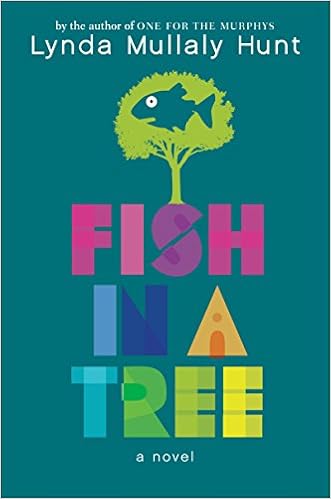
Fish in a Tree by Lynda Mullaly Hunt
Some books just hit like a punch to the jaw. I mean that in a good way. As a kid, I had several things that might be termed learning differences but nothing that could really be called a learning disability. (I suspect that if I were going through school now I'd have a dysgraphia diagnosis but that's it.) So, I don't know what it's like to be dyslexic. I'll be the first to admit that. Often when I'm working with dyslexic students I end up feeling very frustrated for them because I have no idea what they are experiencing.
I do know what it's like, though, to try and try and feel like nothing makes it better. I'm unusually kinesthetic as a learner. If I can feel it, touch it, draw it, or manipulate it then I can learn it. Everyone is a little kinesthetic (or visual or auditory), but I've met very few people as kinesthetic as I am. Early math, when I went through school, was all verbal drilling and big tables. Auditory and Visual are much weaker for me. It's not that I can't learn that way. I totally can. But at 6, 7 and 8 years old, I would have been much better off copying out by hand or putting beads in manipulatives tray to learn the multiplications table than trying to memorize it by drilling it verbally. By the time I was to math where everyone had to drill by copying out equations, I spent so much time trying to remember basic arithmetic that I couldn't follow along with other concepts. Of course, I say that, but writing by hand was physically painful too, which led to a lot of different problems . . .such as homework completion.
*shrug* The point is, I know what it is to feel dumb, even though I'm not.
So as a teacher and as a former smart dummy, Fish in a Tree made an impact. The main character, Ally, is an undiagnosed dyslexic who, as an army brat, slid under the radar by acting out instead of admitting she needs help. Most of her teachers didn't even get her for a whole year as she bounced from school to school. Eventually she lucks into the right teacher: Mr. Daniels.
I could only hope to be that good a teacher.
I do know what it's like, though, to try and try and feel like nothing makes it better. I'm unusually kinesthetic as a learner. If I can feel it, touch it, draw it, or manipulate it then I can learn it. Everyone is a little kinesthetic (or visual or auditory), but I've met very few people as kinesthetic as I am. Early math, when I went through school, was all verbal drilling and big tables. Auditory and Visual are much weaker for me. It's not that I can't learn that way. I totally can. But at 6, 7 and 8 years old, I would have been much better off copying out by hand or putting beads in manipulatives tray to learn the multiplications table than trying to memorize it by drilling it verbally. By the time I was to math where everyone had to drill by copying out equations, I spent so much time trying to remember basic arithmetic that I couldn't follow along with other concepts. Of course, I say that, but writing by hand was physically painful too, which led to a lot of different problems . . .such as homework completion.
*shrug* The point is, I know what it is to feel dumb, even though I'm not.
So as a teacher and as a former smart dummy, Fish in a Tree made an impact. The main character, Ally, is an undiagnosed dyslexic who, as an army brat, slid under the radar by acting out instead of admitting she needs help. Most of her teachers didn't even get her for a whole year as she bounced from school to school. Eventually she lucks into the right teacher: Mr. Daniels.
I could only hope to be that good a teacher.
Monday, May 2, 2016
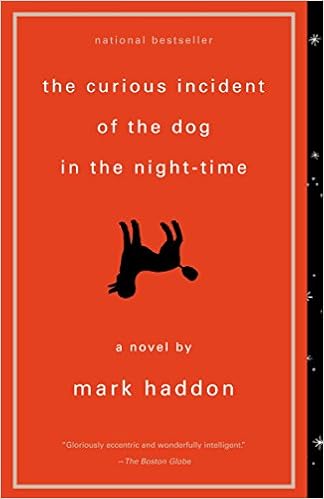
The Curious Incident of the Dog in the Night-Time by Mark Haddon
It used to be that when I told people that I worked at a special needs school, people would immediately respond with something like: "Oh like that kid in The Curious Incident of the Dog in the Dog in the Night-Time. Have you read it? It's great."
So I picked it up about 6 or 7 years back and read the first couple dozen pages. The answer to the question is: "No, this is not what I do." I put the book back down with a certain amount of irritation. Which is not the books fault, of course.
Outside of that very specialized context, it's a decent book, I suppose. The voice of the narrator, Christopher John Francis Boone, gets a little tedious by the end, but that's probably an inevitability of the Boone's condition. However, his condition is where I get generally irritated. Boone is autistic. So, Haddon, when he wrote The Curious Incident of the Dog in the Night-Time spent much of the narrative depicting the strange rules some autistics use to impose order, the strange phobias, and the general impression of overstimulation shared by many types of autism.
In my time teaching special needs, I've become convinced that Autism Spectrum Disorder does not describe one condition but rather a range of conditions sharing similar attributes. Christopher Boone is nothing like the autistic kids I work with. He's way more severe in many ways, and yet in the range of Autism, there are many more severe.
Somehow though, this book became the face of Autism for a time, and I found that irritating. I can also acknowledge that isn't Haddon's fault. He didn't set out to elucidate autism for the masses. He just wrote a book with a somewhat unique narrator.
I shouldn't be irritated, but I still am.
So I picked it up about 6 or 7 years back and read the first couple dozen pages. The answer to the question is: "No, this is not what I do." I put the book back down with a certain amount of irritation. Which is not the books fault, of course.
Outside of that very specialized context, it's a decent book, I suppose. The voice of the narrator, Christopher John Francis Boone, gets a little tedious by the end, but that's probably an inevitability of the Boone's condition. However, his condition is where I get generally irritated. Boone is autistic. So, Haddon, when he wrote The Curious Incident of the Dog in the Night-Time spent much of the narrative depicting the strange rules some autistics use to impose order, the strange phobias, and the general impression of overstimulation shared by many types of autism.
In my time teaching special needs, I've become convinced that Autism Spectrum Disorder does not describe one condition but rather a range of conditions sharing similar attributes. Christopher Boone is nothing like the autistic kids I work with. He's way more severe in many ways, and yet in the range of Autism, there are many more severe.
Somehow though, this book became the face of Autism for a time, and I found that irritating. I can also acknowledge that isn't Haddon's fault. He didn't set out to elucidate autism for the masses. He just wrote a book with a somewhat unique narrator.
I shouldn't be irritated, but I still am.
Sunday, May 1, 2016
May's Swamp of Tales
There are so many books out there that I want to read that it always seems like I will never catch up on my list. I get weird ideas in my head sometimes about reading things "in order" whatever that means. So this month is about jumping the queue. I'm only reading new books. All of the main list were written 2014 or after. Most of them came off the Goodreads Choice Awards short lists so hopefully they are good since many of these authors are completely unknown to me. I'm kind of excited.
1. The Wrath and the Dawn by Renee Ahdien
2. The Heart Goes Last by Margaret Atwood
3. Red Queen by Victoria Aveyard
4. My Grandmother Asked Me to Tell You She's Sorry by Fredrik Backman
5. Trail of Broken Wings by Sejal Badani
6. Serafina and the Black Cloak by Robert Beatty
7. The Residence: Inside the Private World of the White House by Kate Andersen Brower
8. The Fold by Peter Clines
9. The Stranger by Harlan Coben
10. Marrow by Tarryn Fisher
11. Trigger Warning by Neil Gaiman
12. Alice by Christina Henry
13. Signs Preceding the End of the World by Yuri Herrera
14. Beacon 23: The Complete Novel by Hugh Howey
15. Fish in a Tree by Lynda Mullaly Hunt
16. The Buried Giant by Kazuo Ishiguro
17. Finders Keepers by Stephen King
18. Go Set a Watchman by Harper Lee
19. A Court of Thorns and Roses by Sarah J. Maas
20. When Books Went to War by Molly Manning
21. Forensics: WHat Bugs, Burns, Prints, DNA, and More Tell Us About Crime by Val McDermid
22. Secrets of a Charmed Life by Susan Meissner
23. Slade House by David Mitchell
24. The Soul of an Octopus by Sy Montgomery
25. Rebel Queen by Michelle Moran
26. Dumplin by Julie Murphy
27. All the Bright Places by Jennifer Niven
28. Uprooted by Naomi Novik
29. Carry On by Rainbow Rowell
30. The Witches: Salem, 1692 by Stacy Schiff
31. A Darker Shade of Magic by V.D. Schwab
32. The Marvels by Brian Selznick
33. The Architects Apprentice by Elif Shafak
34. The Cartel by Don Winslow
35. Made You Up by Francesca Zappia
Professional (Some of these are older than 2014)
36.. Classroom Strategies for Interactive Learning by Doug Buehl
37. "You Gotta Be the Book" by Jeffrey D. Wilhelm
38. I Read it, But I Don't Get It by Cris Tovani
39. In the Middle by Nancie Atwell
40. Mosaic of Thought by Keene and Zimmermann
41. Reading Diagnosis for Teachers by Barr et. al
42. Strategies That Work by Harvey and Goudvis
43. Building Reading Comprehension Habits in Grades 6-12 by Zwiers
44. A Handbook for Classroom Instruction that Works by Marzano et al
45. On Caring by Milton Mayeroff
46. Write Like This by Kelly Gallagher
1. The Wrath and the Dawn by Renee Ahdien
2. The Heart Goes Last by Margaret Atwood
3. Red Queen by Victoria Aveyard
4. My Grandmother Asked Me to Tell You She's Sorry by Fredrik Backman
5. Trail of Broken Wings by Sejal Badani
6. Serafina and the Black Cloak by Robert Beatty
7. The Residence: Inside the Private World of the White House by Kate Andersen Brower
8. The Fold by Peter Clines
9. The Stranger by Harlan Coben
10. Marrow by Tarryn Fisher
11. Trigger Warning by Neil Gaiman
12. Alice by Christina Henry
13. Signs Preceding the End of the World by Yuri Herrera
14. Beacon 23: The Complete Novel by Hugh Howey
15. Fish in a Tree by Lynda Mullaly Hunt
16. The Buried Giant by Kazuo Ishiguro
17. Finders Keepers by Stephen King
18. Go Set a Watchman by Harper Lee
19. A Court of Thorns and Roses by Sarah J. Maas
20. When Books Went to War by Molly Manning
21. Forensics: WHat Bugs, Burns, Prints, DNA, and More Tell Us About Crime by Val McDermid
22. Secrets of a Charmed Life by Susan Meissner
23. Slade House by David Mitchell
24. The Soul of an Octopus by Sy Montgomery
25. Rebel Queen by Michelle Moran
26. Dumplin by Julie Murphy
27. All the Bright Places by Jennifer Niven
28. Uprooted by Naomi Novik
29. Carry On by Rainbow Rowell
30. The Witches: Salem, 1692 by Stacy Schiff
31. A Darker Shade of Magic by V.D. Schwab
32. The Marvels by Brian Selznick
33. The Architects Apprentice by Elif Shafak
34. The Cartel by Don Winslow
35. Made You Up by Francesca Zappia
Professional (Some of these are older than 2014)
36.. Classroom Strategies for Interactive Learning by Doug Buehl
37. "You Gotta Be the Book" by Jeffrey D. Wilhelm
38. I Read it, But I Don't Get It by Cris Tovani
39. In the Middle by Nancie Atwell
40. Mosaic of Thought by Keene and Zimmermann
41. Reading Diagnosis for Teachers by Barr et. al
42. Strategies That Work by Harvey and Goudvis
43. Building Reading Comprehension Habits in Grades 6-12 by Zwiers
44. A Handbook for Classroom Instruction that Works by Marzano et al
45. On Caring by Milton Mayeroff
46. Write Like This by Kelly Gallagher
Subscribe to:
Posts (Atom)