There are three things that I admire about Terry Pratchett. Actually, there are many things I admire about he guy, but there three things that I particularly admire. First, I admire his sense of imagination and snark. I love his ability to weave seemingly disparate ideas together and make something fun out of it. I love that he uses fantasy to comment on reality. It's cool.
Second, the man wrote a bazillion books. Not really, but once he started putting out books, he managed more than one a year for most years up until he died and many of them are quite good. That's impressive. I write these short posts every day and at best they are of variable quality. It's tough trying to be brilliant every day, and to produce books that quickly, Mr. Pratchett must have been brilliant most days.
Third, most personal to me, his first novel came out in 1983 and aside from a short story published in the 60's, that means that he was first published at the not so tender age of 35 (or there about) which means that there is hope for me. Not that I really believe that it's harder the older I get, but one gets a creeping worry when one reads about the breaking authors who are all breaking with they are 20. It gets a little disheartening.
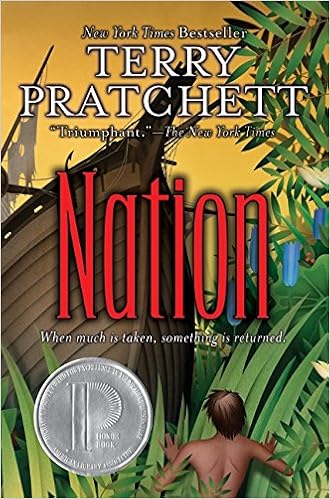
All of this is somewhat aside the point though. Most of the Pratchett books I've read are all in the Discworld series.
Nation is one of the few books that I've read of his that isn't. Additionally, it's YA. I didn't really know anything about
Nation when I picked it up and bought it on the based on my trust in the author.
There is something about the age of exploration with the big wooden ships sailing the sea at constant risk of pirates, mutiny, and stormy disaster. Also, there's the tropics. There is something compelling in the idea of being lost at sea and cast up on a tropical island. (I blame Daniel Defoe) I suppose it's the idea of the civilized man in the uncivilized world. Or perhaps, it's an issue of a good survival story. Or a story of discovery. It is a hard thing to pin down, but compelling nonetheless.
Nation is the story of a castaway British girl named Daphne, but because it is Terry Pratchett, it is also story of a native boy, Mau, who is castaway on his own home island when a massive tidal wave washes through and destroys everything including all the people. These two young people have to figure out how to communicate across language and culture simply to survive as more and more survivors wash up on their shores. Mau struggles with the way things have always been in this new post-wave reality and discovers, with Daphne's help, a long-held secret that challenges everyone's conception of the world and it's history.
Pratchett seems to like taking an iconic plot type and then really messing with the expectations. For example, stick a brit and a native stranded on a tropical island, and I tend to expect some sort of white man leads his guy Friday nonsense from the previous era. In contrast, Pratchett puts his two protagonists on more or less equal footing and makes them interdependent in a more healthy way. Sure, Daphne has the benefit of more formalized scientific knowledge that comes in handy, but Mau know how to survive in a practical sense. Different, naturally, but of equal importance.
I was impressed, over all and find this a thought provoking read.
 "The Lost Islands" is similar to "Mystery Boxes." Both are collections of seven short stories and in both there is a common theme, in this one it is a mysterious island of some sort. For some reason, in this volume all the stories came out more like fables and have easily discernible morals. This doesn't end up being tedious as it could be.