Showing posts with label book review. Show all posts

Saturday, August 11, 2018

New Boy by Tracy Chevalier

I found this while browsing the new book shelf at one of my local libraries. It has been years since I though about Tracy Chevalier's books. I was still working at the library last time I read one. However, it's a familiar name and interesting subject matter. It's also been years since I read "Othello," so reading a retelling of the story appealed.

Chevalier recast the story as a 1970's playground drama with 11 and 12 year old characters. Osei (Othello) is the son of a Ghanaian diplomat who has just moved to a suburb of Washington D.C. and is starting at a new school at the end of the school year. He is the only black face in an otherwise homogeneously white school. Dee (Desdemona) is something of a good girl teacher's pet who is asked to help Osei adjust on his first day. The attraction is instantaneous in the way of elementary school romances.

Ian (Iago) is the self styled king of the playground and sees Osei as a threat to his dominance. He then manipulates his sort of girlfriend Mimi (Emilia) into helping him convince Osei that Dee is two timing him with Casper (Casio). Mimi, of course, doesn't realize what it is she is helping set up, but is desperate to be free of Ian.

It's a pretty faithful retelling.

Of course it ends horribly; it is "Othello" after all. Transposing it to a playground made it somehow more chilling but I wasn't convinced by how calculating Ian was and the sexual overtones that come directly from the play seemed out of place with 11 year olds. The final moment of the novel is spare in its delivery and ends with the act. Shakespeare also left us with little denouement, but there is at least a sense that Iago will be punished. As tragic as Shakespeare's Othello is, placing it on a playground with little kids just makes it even more awful.

Wednesday, August 8, 2018

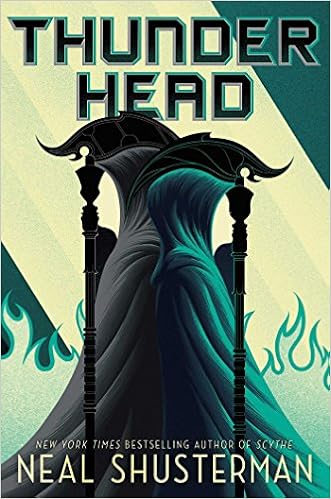
Thunderhead by Neal Shusterman

Have I ever expressed how frustrating I find reading a book and then having to wait for the next one to be written? Darn you Shusterman! (rending of hair and clothes will now commence)

Not really.

However, he really kicked over the hornet's nest at the end of this one and, dash it all, I want to know what happens. I have to wait for book three to come out: The Toll. I'm not even sure there is a release date yet. I hate waiting.

Alright, so, I got into the series as part of my larger mission to read all the Printz prize books. Scythe won a Printz honor. Then I found out that it was the beginning of a series and here we are. The thing is, it is probably worth the suspense. Shusterman has a knack for creating interesting worlds and working through interesting philosophical questions.

In the Arc of the Scythe series, Shusterman is working through two philosophical questions. 1. What would humanity be like if individuals did not face death? 2. What would a benevolent AI be like? In Thunderhead, he seems to be working on the character of the world controlling AI, Thunderhead. The AI only barely shows up in the first book.

In Thunderhead it becomes clear that the AI is, in its way, trying to do its best to protect humanity. However, because it is constrained by rules and because it is a computer and must follow its rules, it comes into conflict. This causes it to play an elaborate game of chess for high stakes and its pawns aren't generally aware they are being played.

This was a disturbingly good read. The interplay between the narratives for Citra, Rowan, and Greyson (new character) contrasts well with the snippets of editorial from the Thunderhead's point of view. Shusterman does an excellent job balancing the multiple view points and plot lines.

Worth the read.

Monday, August 6, 2018

Annihilation by Jeff Vandermeer

Sometimes I find our language severely lacking. I need a word that means - the knowledge that a book is good without ever wanting to talk about it. In the case of Annihilation I don't want to talk about it because it is seriously creepy and mind bendy. Some books are simply designed to make the reader uncomfortable. Goal achieved Mr. Vandermeer.

That said, I intend to read the rest of the trilogy. Creepiness aside, it was an intriguing read. The premise is that we are reading the field journal of a biologist who is investigating the mysterious Area X with a team of scientists and other professionals. This is the twelfth such mission. All the previous mission have either ended with deaths, disappearances, or with members mysteriously showing up at there homes.

The biologist is something of an odd one. She seems both intelligent and emotionally closed off. The intelligence draws the reader in, but the emotional distance is off putting.There is some suggestion that she may be an unreliable narrator early on which adds to the tension as things start to go wrong. The linguist doesn't make it over the border into Area X and it is all down hill from there. As things devolve, more of the mystery is revealed. By the end of the book I wasn't any more sure things than I was in the beginning.

I really want to know what's going on, therefore I will read the next book.

Incidentally, there might not be a word in English that meets my needs, but we have borrowed plenty of words from other languages with specialized meanings. My favorite is tsundoku borrowed from Japanese that means, roughly, the process of buying books and not reading them; or letting books pile up unread.

Great word.

Saturday, August 4, 2018

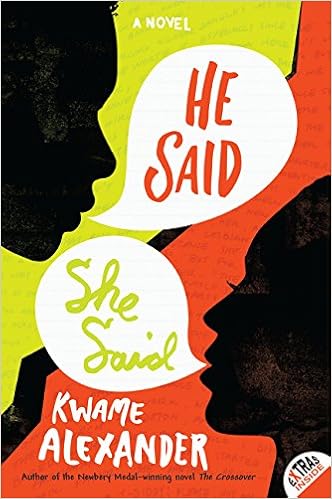
He Said, She Said by Kwame Alexander

I'm a fan of Kwame Alexander, not for myself and my own reading, but as a teacher. A significant proportion of my students are struggling readers. Their struggles come from many places. Some are dyslexic, some have issues with generalized language processing, some just struggle so much with ADHD that they have difficulty tracking a story. Occasionally, I have kids who's eyes don't work in a standard way. Whatever the reason, reading is a chore for them. So, imagine asking a kid who views reading as torture to pick a book for independent reading that they'll enjoy.

Yeah.

It doesn't go over well.

In these cases, I need to help them find a book that is both interesting to them and something that won't push them past the point of frustration. I have about ten books that I tend to turn to first in these situations, Kwame Alexander wrote two of them. Crossover and Booked both feature young men who are athletes who are dealing with difficult situations in their lives. Both books are novels in verse. The subject matter makes it relevant to my students and the format makes it less intimidating for the struggling reader. I think all that white space makes them feel like it's less work to read...even though interpreting poetry is generally a higher order skill than interpreting prose. (I don't tell them that though.)

When I become a fan of an author I tend to follow them and try to read all of their books which is how I picked up He Said, She Said. I was expecting another novel in verse...actually I was expecting a lot of things based on the other two books of his I've read. This is not a novel in verse and it is not told from a solely male perspective. He Said, She Said is told from alternating points of view between a boy named Omar (or T-Diddy) and a girl named Claudia. The book is also prose studded with phone texts and Facebook posts.

Omar is his high school's star quarterback. He's starts out a stereotype of the popular jock type. He's frivolous in his affect and he treats women as interchangeable bed partners. Claudia, on the other hand, has no time for that. She's Harvard bound and socially motivated - she writes for the school newspaper.

In the beginning Omar is trying to get Claudia into bed (she's in no way interested.) However, things begin to shift when the school cuts funding for the arts programs, all of the arts programs. Omar masterminds a protest to impress Claudia, but it soon becomes something more.

I am impressed by this book. Many of Alexander's books are about protagonists dealing with deeply personal issues. Omar and Claudia have personal issues going on but this is as much about the impact of non-violent protest. It's an excellent book for teens to read.

Friday, August 3, 2018

Artemis by Andy Weir

I was late on the Andy Weir bandwagon. I somehow missed all the initial fuss over The Martian and didn't get around to reading it until the movie was just about out. I still haven't seen the movie. They followed the movie with an announcement for his new book: Artemis. Then I had to wait. I hate waiting mainly because I have a tendency to lose track of things. I forgot about it until last June when I put a request on in in the library. It took a month for my turn to come up, but eventually the time was mine.

Artemis is another sci-fi of the old school focused on the science and its possibilities, or maybe more exactly it's a crime caper set in a classic sci-fi story. This one is set on a moon base in the nearish future. A small community lives there full time in a city called Artemis. This city is separated into several interconnected domes that represent a full social diversity from the rich rich and all the way down to the impoverished. Jazz, our protagonist, is pretty far down the social chain. She's a porter, a delivery girl, and a small time smuggler on the side.

Weir spent a lot of time getting the science right, or at least feasible. Oxygen is produced on site as a by-product of the aluminum smelting industry. The process is a little mysterious, but the theory sounds possible. Jazz gets involved in it when one of her clients asks her to do a little sabotage to break the monopoly that the Aluminun Smelters have.

Of course, Jazz doesn't have the whole story and quickly finds out that she's one tiny cog in interlocking plots of corporate espionage. She's in over head and learning to doggy paddle.

Jazz is an interesting character. She's angry at the world and brilliant. Her ability to improvise and plan is insane and her ability to teach herself everything from metallurgy to chemistry makes her a near genius. In fact, her blatant intelligence occasionally broke my ability to believe the story. I'm a teacher... an ability to learn like that is rare if not impossible. It strained my willing suspension of disbelief. However, as a whole she's pretty likable.

As a final assessment, Artemis is reminiscent of the literature of the golden age of sci fi in both the positive and negative ways. On the positive, the science is interesting and probably mostly feasible. The one place I noticed Weir fudging was in the aluminum smelting process. The rest of it all seemed very well researched and explained and that includes architecture, the specifics of living surrounded by a vacuum, and specific concerns of living on a moon base. On the negative, the characters are a little cartooney and have a broader base of expertise than is really possible. All in all, a lot of fun.

Monday, July 30, 2018

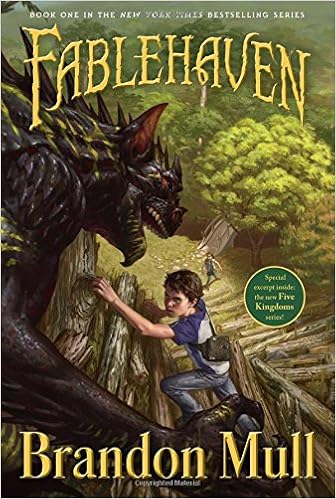
Fablehaven by Brandon Mull

It always occurred to me that fairy and folk tales are filled with some really nasty critters and that the bulk of them seem out to kill humans. The ones that aren't overtly hostile tend to be neutral at best. Many of the ones that are benign are easy to offend to disastrous effect. As cool as they are, I'm not sure I would ever really want to meet one. They are too sinister as a whole.

Even though this is true, there's a ton of fey folk popping up in literature and so much of the time they come across as benign or even silly.

In the world of Fabelhaven the world's fairies aren't fictions, they are endangered creatures, so certain humans gather them up in preserves. Seth and Kendra's grandfather is one of these people which is something neither children nor their parents realize when they are dropped off for some quality time with the grandparents. These are not benign or silly versions of the fairy tale world. These critters are dangerous or even deadly. Being the guardian of such a preserve doesn't guarantee the good will of the inhabitants.

Both kids quickly realize something is strange about the house and grounds. Grandma is missing and there are a lot of strange rules. Kendra is inclined to follow the rules, but Seth is more curious and reckless. When the rules get broken, a powerful evil force is unleashed and the kids have to find a way to fix it on their own.

So, this is cute. I picked it up because two of my big readers swore by the series. I don't think it's destined to be my next favorite series, but I do plan to finish reading through the five book run.

Friday, July 27, 2018

Saint Iggy by K.L. Going

I have accidentally started collecting K.L. Going books. Collecting but not reading. Out of her seven books, I've somehow gathered up three of them without even realizing, so I decided to give one a try. I had Saint Iggy with me in Tennessee.

Iggy is a delinquent by his own estimation. The story begins on the day that he is ejected from his school which will lead to a hearing which will probably lead to an expulsion. Many delinquents wouldn't care, but Iggy does. Iggy does because he's not really a delinquent.

Certainly, Iggy struggles with school. He was born already hooked on a drug which is what happens when an infant's mother takes drugs while she is pregnant. He thinks that he is stupid and perhaps he's not the brightest, but it seems to me that his biggest issue is focus. Everything seems to distract him and he constantly imagines conversations in his head.

Iggy also has a friend, Mo, who is supposed to be a kind of mentor, but really is just another kid looking for a drug problem. Iggy can see that unless something changes, Mo is going to get himself killed. He also wants to clear his hearing and make it back into the good graces of the school. These two problems drive the narrative.

The story was quick paced and easy to read. The book features short chapters, a linear plot, and a single point of view. So, it's a good book for struggling readers. The end however, is oddly jarring. It's not how I would have expected it to end and I'm not really sure how I feel about it. It fits the story, but it didn't seem to be where things were headed.

It was decent, I didn't love it.

Wednesday, July 4, 2018

Pinocchio by Carlo Collodi

First a disclaimer: It feels impossible to talk about my experience of this book without dealing with the Disney cartoon....so Disney, please don't sue me, I have not nice things to say about what you did to this story.

Alright, but what's new about that. Disney is forever adapting classic stories and departing mightily from their base material. So, I wasn't exactly shocked. Although in this case, it feels like Disney really tried to preserve the basic lesson of the story but ended up stripping away much of Pinocchio's character development.

I'm getting ahead of myself.

Pinocchio was first published in 1883 and is the fable about a sentient wooden puppet who wishes to be a real boy. Pinocchio, however, starts out as one of the most impossibly awful kid imaginable. He lies, he argues, he's violent, and he never does what he's told. I mean kids do all those things, but not generally to the exclusion of all other behavior. Pinocchio then spends the two or so years of the narrative going through a constant series of adventures that would be more properly labeled trials. Each of these adventures begins when Pinocchio does something bad and, as a result of his actions, horrible things happen to him and usually ends with him crying and lamenting both his behavior and his situation. At that point, a parental figure of some sort forgives him and he resolves to be better. Of the entirety of the novel Pinocchio gradually improves and does eventually become a real boy.

The fable works really on only one level, but there is some interesting subtly to it. Pinocchio is a puppet and therefore not real. In order to become real, he must learn to act as a 'good boy.' So to be human is to act in accordance with virtue.  To act out of step with this virtues makes a person less than human. These virtues are explicitly stated several times. Good boys listen and obey their parent figures, they go to school, study, and work hard. They also are selfless to the needs of others, generous, industrious, and honest. Failing any of these virtues lands Pinocchio into trouble, but Collodi seems feel that dishonesty and slothfulness are particularly bad and reserves special punishments for them. When Pinocchio is dishonest his nose grows and slothfulness turns little boys into donkeys.

Pinocchio also fits the mold as an epic hero in the sense that he descends into the underworld (several times actually) and is transformed by it.

Collodi was writing in the time right after the unification of Italy and all his children's books are apparently didactic. He was addressing what he felt were the ills of the youth of his time. Apparently Italian youth were particularly dishonest and idle.

As is always the case, the book is better than the movie. Pinocchio is actually one of my least favorite Disney movies because it all seems so disjointed and episodic. The book puts those disjointed scenes in context and gives Pinocchio a real character arc.

Tuesday, July 3, 2018

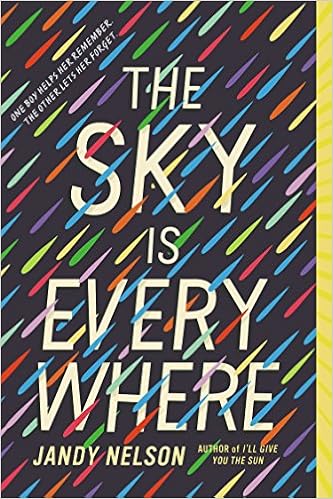
The Sky is Everywhere by Jandy Nelson

When I'm impressed by an author, I have a tendency to gather up all of that author's books so that I can read them. This can be a bit of a challenge when I'm catching a writer at the end of their career. In this case, I found Jandy Nelson on her second book, I'll Give You the Sun, because it won a Printz award in 2015. The Sky is Everywhere is her first book. I'm all caught up at this point, at least until she publishes her next book.

Lennon begins the book grieving the loss of her elder sister, Bailey, who dies of a freak fatal arrhythmia. She's 17 and her sister was 19. Both children were abandoned by their mother and are being raised by their grandmother and uncle. Every character in this book is what we used to call flaky when I was a kid. Gram is a master gardener who paints portraits of women only using the color green. Big, the uncle, is a massive Casanova arborist who's been married (and divorced) five times. Bailey was a free-spirited actress diva. Lennon is a master clarinetist who's read Wuthering Heights thirty some odd times. All of them are a little off, but they are all just really nice and sympathetic people.

Everyone's sad and trying to recover, but Lennon and Toby (Bailey's boyfriend) seem to be drowning in their grief. Lennon and Toby get closer due to their shared grief. When Lennon returns for the end of school, she meets the new guy Joe fresh in from Paris. Joe is obviously intrigued by her. Soon Lennon finds herself stuck between these two boys.

There is a heavy romance angle to this one. This book is drowning in hormones. While no actual sex, or really anything approaching sex, happens, there is a lot of very intense kissing and making out. Really. Very intense. However, that's not really what the book is about. This is not a romance novel. Ultimately this is a book about getting through grief and the kinds of mixed up emotions that happen as part of the grief process. Everything that happens between Lennon and Toby makes sense in the context of the novel. If anything, the relationship between her and Joe seems the more off key. That being said, I found the resolution touching and spent the whole last third of the book crying.

Jandy Nelson specializes in making me cry. Both her books have had me sobbing at some point during the read and it's not cheap emotion. She has a knack for creating sympathetic characters who are struggling with situations that most of us can relate to. Result = sob fest.

Friday, June 29, 2018

Repossessed by A.M. Jenkins

So in my continuing quest to track down and read the Printz and Printz Honor books, I ran across Repossessed which is the story of Kiriel, the demon. Kirial is not happy with his job in Hell as a low level tormentor and decides to take a vacation by possessing the body of Shaun, a 17 year old of low ambition, at the moment when he was supposed to die. Kiriel then spends the entirety of the book experiencing physical sensation and the complexities of the human condition. In many places Kiriel is almost embarrassingly hedonistic.

Shot through the book is Kiriel's examination of what I've always considered a central inconsistency in the Bible: if God is perfect and all knowing, then the only way for the devil to rebel is if God intended it. Kiriel is tortured by this. As a fallen angel, he's one of the punished, but why is he punished for being what he was created to be. It goes round and round and is an interesting introduction on the paradox for a teen audience.

I'm not sure what I expected when I picked up the book, but this wasn't it. On one level, this has a sizable amount of fairly crude imagery. On another, this is a deeply philosophical read. Kirial is almost better at being human than Shaun was and is deeply sympathetic. There are shades of Milton's "Paradise Lost" going on here as well as a healthy dose of C.S. Lewis's Screwtape Letters. Come to think of it...I should reread both of those.

I sense a themed month of reading coming up. hmmmmm

Saturday, June 16, 2018

Explorer: The Lost Islands edited by Kazu Kibuishi

I really like this series. It's not that graphic novels can really do anything that well written prose can do, it's that it is a different delivery method. I'm not very visual as a rule, but I like the mix of illustration and narrative. I think it may be easier to quickly depict a fantasy setting using a visual medium than if it had to be verbally depicted. Mind you, straight writing allows the readers imaginations to fill in the gaps more completely so the world feels more real in my experience. However, it's really just a case of different strengths.

"The Lost Islands" is similar to "Mystery Boxes." Both are collections of seven short stories and in both there is a common theme, in this one it is a mysterious island of some sort. For some reason, in this volume all the stories came out more like fables and have easily discernible morals. This doesn't end up being tedious as it could be.

Specifically, I really enjoyed "The Mask Dance," "Loah," and "Radio Adrift." "The Mask Dance" is about a girl who ditches her work to go to a festival after a spirit in a mask tells her her father is already there. "Loah" is a kind of creation myth about adventurous aquatic critters. "Radio Adrift" is about a young witch on a quest to find a specific sound that will hatch a pixie egg.

All of the stories are about people who think they know better or who are trying to make things easier and who find out that their view of the situation is incomplete. Over all they are well written and there is some excellent artwork.

Over all, worth a read.

Thursday, June 14, 2018

Frozen in Time by Mark Kurlansky

There's a lot of buzz among English teachers about finding YA nonfiction. Many struggling readers would prefer to read "something real" over fiction so we are all always on the hunt for good selections. Many lament that there isn't more good YA nonfiction out there. For my part, I really struggle with the concept. What fundamentally is different between a YA and regular nonfiction book intended for a broad audience? Vocabulary maybe, length? Marketing? Most teenagers are capable of reading at an adult level if they are interested in the topic.

Nevertheless, some publishers are starting to package some items as YA nonfiction.  Frozen In Time is one of these although there is nothing about the text that particularly suggests "teen" to me. Frozen In Time is a short (about 150 pages) biography of Clarence Birdseye who developed the process for quick freezing food that we still more or less use today.

Frozen food is so ubiquitous. It's strange to think that someone had to develop that, but apparently early frozen food was just terrible. It took so long to freeze the food that the ice crystals formed very large which broke the cell walls and made the food mushy when it thawed out. In the early days of frozen food, no one even had a freezer so the food would immediately thaw. To sell the frozen food, Birdseye had to figure out both how to freeze the food without destroying the texture and how to make home freezer's cost effective. It's a pretty thorny problem and interesting to think about.

Kurlansky does a good job of presenting Birdseye as an interesting eccentric. The chapters are reasonably short and there's good overviews of the science involved although I would have wished for a little more depth.

Wednesday, June 13, 2018

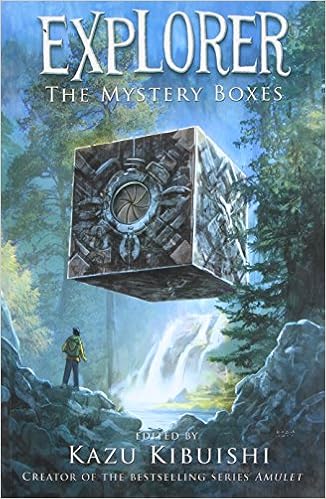
Explorer: The Mystery Boxes edited by Kazu Kibuishi

It's odd. I like graphic novels but I don't pursue them the way I do conventional fiction. Instead I have a handful of people who's opinions I highly value. They tell me to read it and I probably will. In this way I find interesting graphic novels without having to sift through the substantial portion of juvenile stuff floating around.

Indirectly, that's how I came across the Explorer series. Kibuishi is better known for the Amulet series which I haven't read yet, but it's on my stack. The Explorer series is interesting in that it's more like a collection of short stories. There are seven distinct stories written and drawn by different people in each volume. All the stories share one element. In this one, the shared element is a 'mystery box'. So, in each story there's some sort of mysterious box at the center of the action.

Each of the seven stories is a good solid read. Some of them are a little strangely moralistic such as "The Soldier's Daughter." While it was a touching story it was also a somewhat heavy handed statement about the nature of revenge. "The Keeper's Treasure" was an interesting thought on what we confer value to.

I was very impressed with "The Butter Thief" which was an adaptation of Japanese fables and an inadvertent commentary about preserving traditional folk ways. I particularly liked the sparse art style of this one.

"Whatzit" had a classic Saturday morning cartoon feel. It's about the cosmic warehouse workers who ship out components for new universes. The story is cute but I particularly liked the artwork which reminded me of "Johnny the Homicidal Manic."

All in all, this is a good introduction to what graphic Novels can be.

Sunday, June 10, 2018

Bronx Masquerade by Nikki Grimes

Sometimes I feel like a shelter for lost books. They appear in stacks on my desks or in boxes left outside my door. Sometimes people tell me excuses: "I bought this, but I can't find time to read it" or "Someone gave it to me, but it's not really my thing." As if the excuse matters or is needed. Sometimes there is no note at all and I'm left to wonder if this orphaned book is now mine or is someone missing it? I get a small but sizable percentage of my collection this way.

I got Bronx Masquerade through Lydia's shelter for lost and abandoned books. I'd never heard of it before though Nikki Grimes is a familiar children's book author. Apparently, despite my ignorance of it, Bronx Masquerade created a bit of sensation when it came out and is even taught as a class text in places. It appeared on my desk as part of a stack that Nathan put up for adoption.

The format is a mix of short, personal first person commentary and poetry. The story is that a group of kids in a Bronx high school all fall into the idea of open mike poetry after one kid writes a poem about Langston Hughes. There are eighteen kids in the class, they are not all friends with each other, and they all have something to say through their poetry. Each of the poems expresses some sort of inner truth or personal observation and the through the first person essays we get to hear some of the reactions of the other students to the poems/ideas.

Over the course of the semester, the students begin to revise their opinions of each other and become more sensitive to each other's experiences. The Open Mike phenomenon spreads in popularity until a local paper comes out cover them.

There is something about this book that feels raw and thrown together. The ideas don't always meld together or flow well from one to the next. In a way, it looks like what a teacher would cobble together as a class project from student poetry and reflections. That is possibly part of it's strength. The lack of polish lends verisimilitude. 

 I didn't find this a transcendent experience, but it did give me a lot to think about.


Wednesday, June 6, 2018

The Sun Is Also a Star by Nicola Yoon

I am swiftly becoming a Nicola Yoon fan. It started when Bella, a student of mine, read Everything Everything. She gave such a compelling book talk that I asked to borrow her copy. I read it in about a night and if I wasn't blown away, I was at least deeply impressed. I made acquiring a copy of Yoon's only other book, The Sun Is Also a Star, a priority.

Well I did it, I found a copy at Half Price Books in Decatur. I read it last night and today and it is clear that Yoon is developing as a writer. Much like her previous book, this is a love story. Daniel, who is first generation born American from Korean parents, is at a weird turning point in his life. His parents want him to be a doctor. Daniel may just want to be a poet. He takes a day to wander around New York City as a last day of freedom/childhood. Natasha is Jamaican. She was born there but her parents immigrated with her illegally when she was eight. The day the book begins is her last day in the US. At 10 P.M. she and her family are being deported. She spends her last day looking for a last chance way to stay. Daniel and Natasha meet, both hurtling toward their individual destinies, but their attraction to each other is immediate and overwhelming.

Daniel and Natasha are a case of opposites attracting that rings true to me, which says something. Usually, I just sort of scoff at those things. While there is a high potential for sap, Yoon manages to avoid nearly all of it. Natasha spends most of the book pushing against this relationship with Daniel. She's smart, into science, and prides herself on her realism. She's also very private with her business, which creates a lot of narrative tension. Daniel ends up being like this being like a large and over exuberant puppy. He's looking for a sign from the universe, Natasha is it, and he's more than happy to fall. Natasha's realism balances Daniel's optimism and vice versa. Even so, it much get to be a bit much except that the almost the entire action of the book happens over the course of one day.

In her previous book, Yoon stuck very close to one point of view. In this book, she preserves that intimate first person narrative, but she alternates between Natasha's point of view and Daniels. Periodically she dials out into a third person omniscient to comment on her two characters or describe the background of one of the several side characters and family members. The result is a complex rube goldberg machine of a plot that demonstrates the interconnectivity in the lives of strangers.

It's interesting and it's sentimental. I think my dad should read it. I enjoyed my read very much and found myself near tears by the end.

Thursday, May 10, 2018

Carpe Jugulum by Terry Pratchett

So I sense that Terry Pratchett was a fan of "Young Frankenstein". Actually, it wouldn't surprise me if he were some sort of generalized Mel Brooks fan.

King Verence is a father and in the interest of good politics, he invites all the neighbors to the naming. All the neighbors, including the family of vampires out of uberwald. These are progressive vampires. They've accustomed themselves to holy symbols, holy water, garlic, and low doses of sunlight. They've done away with dank castles and biting young women in nightgowns. Instead they develop arrangements with their food enforced through mind control.

But let's face it, Uberwald is so last century. They have their eye on sunny Lancre and are totally willing to eat King Verence in the process. This is of course where the witches get involved. Witches in Discworld are hard to control and most people would probably say, don't bother. Granny Weatherwax didn't get an invite to the christening and has gone off leaving Agnes/Perdita and Nanny Ogg to manage things. Witches work best in groups of three so Queen Magrat comes out of retirement toting baby Esmeralda and going to the rescue.

Ok, so in terms of all of the Discworld novels, this isn't one of the strongest. However there are some really good moments. I really like the Igors and Uberwald in general. It's like the area of Discworld reserved for hokey horror stereotypes. While it's been mentioned in several of the books, this is the first partially set there. So, yeah fun.

Tuesday, May 8, 2018

Snotgirl: Green Hair Don't Care Vol. 1 by Bryan Lee O'Malley and Leslie Hung

I find my books from a variety of sources. One of the places I lurk on for YA books is book riot where I read an article talking about how social media is a positive communication tool. Part of the article was a group of three recommendations. Snotgirl was one of the recommendations. I shared the article with my principal and as a result our media specialist ordered the books. Yay.

Snotgirl is a graphic novel about this completely insecure hot girl named Lottie. She's beautiful and self absorbed. She's a fashion blogger and she's recently broken up with her boyfriend of five years. She also suffers from ridiculously bad allergies (not attractive). So, her doctor puts her on a drug trial for a new allergy medicine. At this point, things get weird. It seems like the pills are causing memory gaps and screwing up her emotions. There are elements of the unreliable narrator here, and I finished volume one semi-convinced that Lottie is hallucinating some things.

The social media angle is pervasive. First, Lottie is a blogger which is a sort of social media but she is also constantly texting and tweeting. She updates Instagram constantly and she is constantly check the social media of others, including semi cyber stalking the girl that her ex-boyfriend is now dating. It's everywhere and the source of a lot of plot development. Mixed in is this weird conflict with identity. Lottie is the girl with the crazy bad allergies but she also her fashion perfect alter-ego for the blog. They are not similar to each other, but both real. It sounds weird but I've actually had students who struggle with this.

As a teacher, there's a lot of mixed feeling about social media. Eight years ago, or so, it was a lot of alarm about social media, so we are making progress. I think we, as a group, still aren't sure how to deal with it. It's like any other tool. Neutral, like a hammer. I can use a hammer to build a house, I can also use a hammer to break down walls. Constructive and destructive like all tools. It's all about how it's used.

I have a personal dislike for a lot of social media. I'm shy and somewhat private by nature, spewing my random thoughts online just doesn't appeal to me, generally. However, I think the perception of audience and anonymity appeals to many young people. And, they do use it to communicate. One of the big criticisms is that young people use their technology to isolate from the world, however, much of what they do with it is reaching out to and communicating with the world. In a sense, when I pick up a book, I am isolating more than they are. That's just a reality.

I think the issue comes with that very sense of anonymity. There's a lot of ridiculous crap out there and the perception of distance and protective layer of anonymity means that young people feel free to say things that they would never say in person. In person, the repercussions and judgement are immediate and clear.  Society has a moderating effect on behavior. Online, that's diluted. There are as many people celebrating trolls as denouncing them. If someone makes you angry, you can block them. You can't block people in real life...at least not very effectively. In extreme cases, they bring that less constrained communication into real life and suffer real life consequences.

Ultimately, I think that things will re-balance as the internet generation gets older and more mature. Society will begin policing itself again....it just takes time. In the meantime, teachers teach. Which means we need to find positive ways to deal with social media (god help me).

Friday, May 4, 2018

Long Way Down by Jason Reynolds

I actually finished my read of this a couple days ago, but I couldn't quite get my thoughts together on it. Some books read like a punch to the gut and when you finish you are helpless to get a breath. I've been a fan of Reynolds for a full year. I first read his book American Boys which is about the beating of a black boy by a police officer and witnessed by a white kid who had connections to both the black boy and the police officer. What impressed me at the time was that the book was set up in alternating chapters from the points of view of the two young men. I felt that the feelings and conflicting issues were handled with equal sensitivity. As a result it felt like a fair-minded examination of the issues at hand. That's not an easy thing to manage.

Long Way Down takes on similarly difficult material. In this case, Reynolds tells the story of Will, a young man who's older brother just got gunned down in a part of a cycle of gang retribution. Will wakes up in the morning and decides to take his brother's gun and shoot the boy he's sure killed his brother, Shawn. He gets into the elevator on the seventh floor and it takes an unusual amount of time to make it down to the lobby. At every floor, the car stops and a different person affected by gang violence steps on to talk to Will about his decision.

This is a book about gang violence. Yes. Really though, it's about the cycle of retribution. How violence begets violence and revenge is a self perpetuating goal. It's about gangs but it's really just about the nature of revenge.

Long Way Down is a novel in verse told in the close perspective of Will. His reactions and feelings are raw and well expressed. This book gave me chills and despite the subject matter, I would hand it to virtually any of the boys I teach (with varying amounts of preparation). I continue to be a fan of Reynolds.

Wednesday, May 2, 2018

Sunny by Jason Reynolds

Part three in the four part Track Series by Jason Reynolds, Sunny  just came out at the beginning of April. That makes this unusually fresh read for me. I generally wait with great patience for prices to come down, but this one was a media center purchase and I swiped it. In my defense I waited a whole three weeks.

Each of the four books follows a different character and is named for that character. These four kids are the new members of the community track team. I have to admit, of the four characters I was least looking forward to Sunny. I mean Ghost starts it all off and he's an amazingly compelling and sympathetic character. Patina comes next and she's super sassy coupled with an interesting home situation. But Sunny.

Sunny is just weird. He's this super smiley kid who seems to react weirdly to the events in the other two books. There's just something off about him.

To give Reynolds credit, he really works with that for this book. Sunny is written as a series of diary entries but I swear the kid is suffering from synesthesia. He interprets everything as sound, but it does enliven the diary entries.

Sunny also has an interesting back story. His mom died giving birth to him and he lives in a giant house with his father, Darryl. He's also home schooled. (I'm not inherently opposed to the idea of homeschooling but I have to admit that as it is described here I have to wonder what the kid is actually learning.) All of this accounts some for his weird affect.

This is a good quick read. The diary entries are short providing a lot of breaks and the subject matter is relatable.I'll be interested in how Reynolds closes out the series.

Wednesday, April 25, 2018

The Windup Girl by Paolo Bacigalupi

I picked up The Windup Girl  on a whim at an Ollies. I'd never heard of it, but it won a Nebula and a Hugo, so I felt it was a safe bet. It took me 11 days to read. I guess most people would think that's pretty quick  For me, that's almost glacially slow. I generally finish a book every other day or so. Even non-YA I tend to get through in about three days on average. 11 days is an eon for me. I got pretty frustrated about it too.

I almost put it down in favor of something I could get some momentum going on. I'm glad I stuck with it though. The Windup Girl is a grim look at what GMO companies like Monsanto could do to the world given a chance. The action is set in Thailand where isolationist policies have helped the country survive the collapse of the ecosystem, the melting of the ice caps, and a succession of bio-engineered plagues and blights. As in any setting like this, the balance of power is tenuous and political intrigue tends to be a key element of the plot.

The narrative follows several points of view. Anderson Lake is a calorie man which is something like an industrial spy for the for the big agricultural engineering corporations who wants to crack the secret to Thailand's food independence.  Hock Seng is a Chinese refugee from Malaya that works for Anderson Lake. He however has plans to regain what he lost in Malaya and he's not too pick about how he gets it. Emiko is a windup girl or artificially engineered and created human. She calls herself a new person and is genetically programmed towards obedience. Jaidee is an enthusiastic government official who believes in his duty and is ruthlessly honest. Kanya is Jaidee's subordinate...she has secrets.

None of these characters is a hero. Each is a fully imagined character with both admirable and sinister qualities. The way they are presented is almost clinical. It is almost like Bacigalupi doesn't intend the reader to feel any specific sympathy for any of them. This detachment allows the story to really be about what happens in the world as the precarious position of the Thai wobbles and then falls apart. While many of the characters do distasteful things, all the protagonists are given backstories rich enough to make their decisions believable.

It's a story filled with tension and anxiety. It's in the characters and it's in the setting itself. There is a constant threat of invasion or pandemic. While I'm happy to be done with it, I'm glad I made it all the way through. The resolution was worth the time I spent on it.