Showing posts with label biology. Show all posts

Monday, August 6, 2018

Annihilation by Jeff Vandermeer

Sometimes I find our language severely lacking. I need a word that means - the knowledge that a book is good without ever wanting to talk about it. In the case of Annihilation I don't want to talk about it because it is seriously creepy and mind bendy. Some books are simply designed to make the reader uncomfortable. Goal achieved Mr. Vandermeer.

That said, I intend to read the rest of the trilogy. Creepiness aside, it was an intriguing read. The premise is that we are reading the field journal of a biologist who is investigating the mysterious Area X with a team of scientists and other professionals. This is the twelfth such mission. All the previous mission have either ended with deaths, disappearances, or with members mysteriously showing up at there homes.

The biologist is something of an odd one. She seems both intelligent and emotionally closed off. The intelligence draws the reader in, but the emotional distance is off putting.There is some suggestion that she may be an unreliable narrator early on which adds to the tension as things start to go wrong. The linguist doesn't make it over the border into Area X and it is all down hill from there. As things devolve, more of the mystery is revealed. By the end of the book I wasn't any more sure things than I was in the beginning.

I really want to know what's going on, therefore I will read the next book.

Incidentally, there might not be a word in English that meets my needs, but we have borrowed plenty of words from other languages with specialized meanings. My favorite is tsundoku borrowed from Japanese that means, roughly, the process of buying books and not reading them; or letting books pile up unread.

Great word.

Monday, March 12, 2018

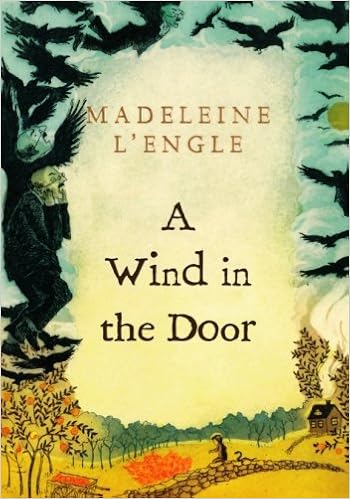
A Wind in the Door by Madeleine L'Engle

This is another case of "I know I read it, but I just don't know when or anything about it." The only solid memory I have of it is of the description of the cherubim, Proginoskes. I remembered something about a big ball of wings and eyes and it might have in fact been an illustration.

A Wind in the Door picks up about a year after the events of A Wrinkle in Time. Meg is in high school and Charles Wallace has started with school. Charles Wallace is, in fact, having as much trouble adjusting to school as Meg did. He's super smart and tiny; it makes him a target for bullying.

Charles Wallace is also suffering from some sort of vague illness. When he greets Meg with a story about dragons in the garden, even Meg gets concerned. If the bullying wasn't enough, now her cherished little brother is seeing things. Nevertheless, she goes to check it out and finds, not a pack of dragons, but rather a single cherubim and a monolithic teacher.

In the larger world, something is causing the stars to disappear. Of course it is all connected and Meg and Calvin must race time to save Charles Wallace.

If A Wrinkle in Time was underpinned with physics, A Wind in the Door is exploring cellular biology. Most of the action has to do with mitochondria which really are quite interesting. Every cell in our body has them and mitochondria have distinct DNA from our own. They are symbiotic prokaryotes which was a new idea at the time that the book was written. The science is a little messed up, but we really do need mitochondria for our cells to function so it's pretty cool stuff.

There is also a stronger religious theme floating through this one probably because of the cherubim. I didn't find it obnoxious, but it was definitely more present.

Monday, June 20, 2016

Soul of an Octopus by Sy Montgomery

I love aquariums. I have very early memories of my mom and dad's wall'o'tanks. I don't precisely remember what they had in them (vague memories of a knife fish), but I could probably even now sketch out a basic layout of what the racks looked like. This must have been formative. By the time I was three, they were gone.

Much later in life, I spent a period of time obsessed with freshwater aquariums. For a while, I researched and kept 20 and 30 gallon aquariums. I was never so proud as when my dwarf flame gourami actually spawned. I even got a 110 gallon tank but never quite got it set up. (I wasn't very confident that it didn't need resealing. Can you imagine 110 gallons of water gushing across the floor dotted with flopping fishies? I can.) I had to give them up when we moved into an apartment on the 4th floor. Aquariums quickly get very heavy. Occasionally, I set up a beta tank, but that's about it. Frankly, I miss them. (I lust after this for my classroom. Wink. Wink. Nudge. Nudge.)

Soul of an Octopus was on the Choice Book Awards List for 2015. I've honestly never heard of Sy Montgomery, but apparently she's written a large number of non-fiction books which I plan to check out. Soul of an Octopus is about her 3ish year obsession with the great pacific octopuses at the New England Aquarium.

Let's face it, Octopuses are way strange but oddly compelling creatures. I could fill an entire blog post of interesting facts about Octopuses. I knew a little about them before reading Soul of an Octopus, but I never realize how social they can (and often are) with humans. Montegomery's memoirish account of her time working with the people and octopuses of the New England Aquarium is a compelling and interesting read. It's strange to think about loving and appreciating the intelligence of something as alien as an octopus, but that's clearly what she did. Montgomery clearly conveys how much the octopuses affected and impressed her.

While this is not a significantly weighty science read, it is very interesting. I recommend it.