Showing posts with label book series. Show all posts

Thursday, May 10, 2018

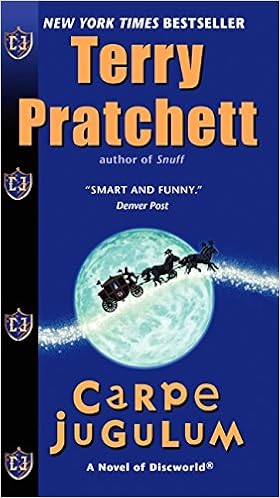
Carpe Jugulum by Terry Pratchett

So I sense that Terry Pratchett was a fan of "Young Frankenstein". Actually, it wouldn't surprise me if he were some sort of generalized Mel Brooks fan.

King Verence is a father and in the interest of good politics, he invites all the neighbors to the naming. All the neighbors, including the family of vampires out of uberwald. These are progressive vampires. They've accustomed themselves to holy symbols, holy water, garlic, and low doses of sunlight. They've done away with dank castles and biting young women in nightgowns. Instead they develop arrangements with their food enforced through mind control.

But let's face it, Uberwald is so last century. They have their eye on sunny Lancre and are totally willing to eat King Verence in the process. This is of course where the witches get involved. Witches in Discworld are hard to control and most people would probably say, don't bother. Granny Weatherwax didn't get an invite to the christening and has gone off leaving Agnes/Perdita and Nanny Ogg to manage things. Witches work best in groups of three so Queen Magrat comes out of retirement toting baby Esmeralda and going to the rescue.

Ok, so in terms of all of the Discworld novels, this isn't one of the strongest. However there are some really good moments. I really like the Igors and Uberwald in general. It's like the area of Discworld reserved for hokey horror stereotypes. While it's been mentioned in several of the books, this is the first partially set there. So, yeah fun.

Wednesday, May 2, 2018

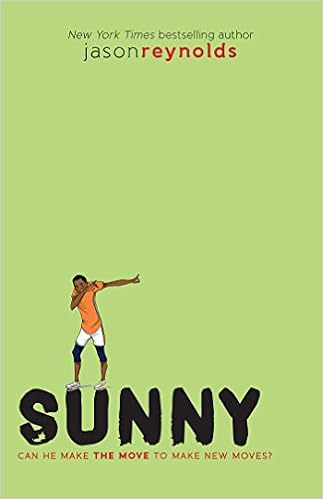
Sunny by Jason Reynolds

Part three in the four part Track Series by Jason Reynolds, Sunny  just came out at the beginning of April. That makes this unusually fresh read for me. I generally wait with great patience for prices to come down, but this one was a media center purchase and I swiped it. In my defense I waited a whole three weeks.

Each of the four books follows a different character and is named for that character. These four kids are the new members of the community track team. I have to admit, of the four characters I was least looking forward to Sunny. I mean Ghost starts it all off and he's an amazingly compelling and sympathetic character. Patina comes next and she's super sassy coupled with an interesting home situation. But Sunny.

Sunny is just weird. He's this super smiley kid who seems to react weirdly to the events in the other two books. There's just something off about him.

To give Reynolds credit, he really works with that for this book. Sunny is written as a series of diary entries but I swear the kid is suffering from synesthesia. He interprets everything as sound, but it does enliven the diary entries.

Sunny also has an interesting back story. His mom died giving birth to him and he lives in a giant house with his father, Darryl. He's also home schooled. (I'm not inherently opposed to the idea of homeschooling but I have to admit that as it is described here I have to wonder what the kid is actually learning.) All of this accounts some for his weird affect.

This is a good quick read. The diary entries are short providing a lot of breaks and the subject matter is relatable.I'll be interested in how Reynolds closes out the series.

Wednesday, April 25, 2018

The Windup Girl by Paolo Bacigalupi

I picked up The Windup Girl  on a whim at an Ollies. I'd never heard of it, but it won a Nebula and a Hugo, so I felt it was a safe bet. It took me 11 days to read. I guess most people would think that's pretty quick  For me, that's almost glacially slow. I generally finish a book every other day or so. Even non-YA I tend to get through in about three days on average. 11 days is an eon for me. I got pretty frustrated about it too.

I almost put it down in favor of something I could get some momentum going on. I'm glad I stuck with it though. The Windup Girl is a grim look at what GMO companies like Monsanto could do to the world given a chance. The action is set in Thailand where isolationist policies have helped the country survive the collapse of the ecosystem, the melting of the ice caps, and a succession of bio-engineered plagues and blights. As in any setting like this, the balance of power is tenuous and political intrigue tends to be a key element of the plot.

The narrative follows several points of view. Anderson Lake is a calorie man which is something like an industrial spy for the for the big agricultural engineering corporations who wants to crack the secret to Thailand's food independence.  Hock Seng is a Chinese refugee from Malaya that works for Anderson Lake. He however has plans to regain what he lost in Malaya and he's not too pick about how he gets it. Emiko is a windup girl or artificially engineered and created human. She calls herself a new person and is genetically programmed towards obedience. Jaidee is an enthusiastic government official who believes in his duty and is ruthlessly honest. Kanya is Jaidee's subordinate...she has secrets.

None of these characters is a hero. Each is a fully imagined character with both admirable and sinister qualities. The way they are presented is almost clinical. It is almost like Bacigalupi doesn't intend the reader to feel any specific sympathy for any of them. This detachment allows the story to really be about what happens in the world as the precarious position of the Thai wobbles and then falls apart. While many of the characters do distasteful things, all the protagonists are given backstories rich enough to make their decisions believable.

It's a story filled with tension and anxiety. It's in the characters and it's in the setting itself. There is a constant threat of invasion or pandemic. While I'm happy to be done with it, I'm glad I made it all the way through. The resolution was worth the time I spent on it.

Saturday, April 14, 2018

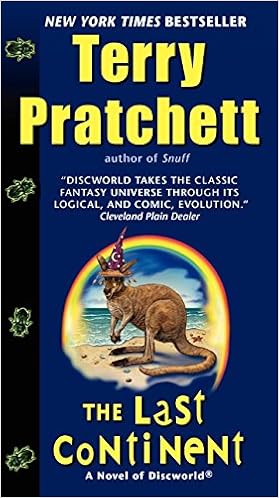
The Last Continent by Terry Pratchett

An "antihero" is a central character/protagonist in a book or movie who is devoid of all the usual characteristics of a hero. One of Pratchett's main characters, Rincewind, is an antihero. Rincewind is a self-proclaimed coward. He's refined running away to the level of a sport. As a wizard, he's abysmal. The closest thing to a heroic skill he's got is a natural facility for learning different languages. Every book with Rincewind in it involves a lot of running away and ending up in the right place anyway.

This might be the best Rincewind novel so far out of the six I've read. I like Rincewind any way. I didn't when I was a teenager, Rincewind is one of those characters that requires the reader to have a certain amount of life experience before he can be appreciated.

At the end of last novel, Interesting Times, Rincewind washed up on the hypothetical/lost continent of Ecksecksecksecks (also written XXXX). This continent is the Discworld corollary to Australia. As it turns out, Rincewind's bizarre life and exposure to large amounts of magical energy has left him with a personal field that tends to warp reality a little around him. In this case, because he washed up in Ecksecksecksecks in the present, he causes something to happen far back in the past at the creation of the continent that he now has to fix. He's told this by a giant anthropomorphized kangaroo. Rincewind responds by running away. Of course, he accidentally runs in the direction he needs to go in order to fix it anyway, so no worries.

In the meantime, the Librarian of the Unseen University is very sick and the wizards need to know his name in order help him. However, as an orangutan he can't tell them and no one seems to have it written down. Because Rincewind used to be the Librarian's assistant, the wizards figure they need to find Rincewind. In the process the wizards get themselves stranded on Mono Island in the distant past and meet the God of Evolution who is the only god on the disc that doesn't require believers to exist.

Pratchett also plays with aboriginal dreamtime and I spotted a reference to Crocodile Dundee in there. As always, I'm sure I missed as many references as I caught. However, I really enjoyed this one and would generally recommend it to Pratchett fans.

Monday, April 9, 2018

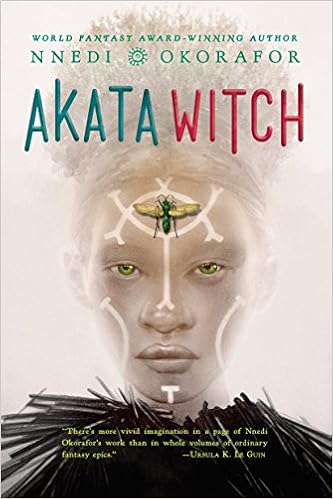
Akata Witch by Nnedi Okorafor

In a vague way, I've been trying to find more literature from non American or British authors. Over time I've been picking at African literature, but I haven't had a ton of success. I greatly like Chinua Achebe, but then who doesn't. I believe strongly that reading widely and on a variety of cultures is a way of developing insight. It is also highly enjoyable. When I heard about Akata Witch I had to read it.

I tripped across Akata Witch on Book Riot. It appears on many of their lists and is billed as an African Harry Potter which I think diminishes both Harry Potter and Akata Witch. There are certainly some similarities. Both books start with very young protagonists who discover that not only magic exists but also that they can do it. Additionally, they then start training in magic and eventually run against some sort of big bad that they have to confront even though they are just children. So, yes, in the broad strokes they are similar ideas. That's where it ends though.

Akata Witch is set in Nigeria and Sunny, the main character, is an American born Nigerian. She's also an albino which is a very mystical thing. The whole magic culture described is based on African juju, although the existence of other magical traditions is accounted for. The values are different and the environment is wild, colorful, and lively. Instead of one big magical school. The four students study with a master. Education is more hands on and figure it out on your own. Which all makes for a much different feel.

I liked the veneration of knowledge for its own sake and the attitude about the important things in life. Don't get me wrong, I love the Harry Potter books and they will always be special to me. Akata Witch is just different and special in its own way.

It's really hard to describe why this book is so amazing without ruining some of the joy of discovery. I'm thrilled to have a copy in my classroom library and I was so enthusiastic about my description of it this morning that a student already has it checked out. I'm looked forward to talking with him about his impressions of it.


Thursday, April 5, 2018

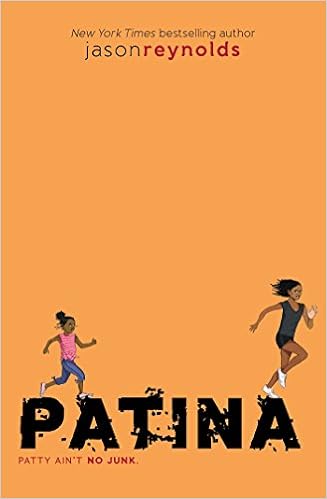
Patina by Jason Reynolds

So, these middle reader series are just too easy to eat up. This is book two in the Track series and follows Patina who is the only girl of the four newbies to join the Defenders track team.

Patina, goes by Patty, has one of the more unusual family situations. She and her younger sister, Maddy, have been adopted by a white woman and her husband. Patty and Maddy are black, so there is some background friction about that which shows up initially in the first book Ghost. The friction isn't because her adopted mom is white, it's because Patty seems to feel like she needs to defend it. Her bio mom isn't out of the picture.

Her mother, Beverly Jones, is still alive and still involved in Patty's life but because she's a diabetic double amputee, she can't take care of herself and two little girls. That's where the adopted family comes in. They are actually Patty and Maddy's uncle and aunt who adopted them when things started to get out of hand. Like I said, unusual in fiction, but probably pretty common in real life.

So, while this is still about the running, this volume comes out a little more like a family drama. Patty's got a lot of choked down rage and anger. She's going to a predominantly white prep school and she's got a lot of static in her head about it. Strangely, while Patty feels out of place at the school, it doesn't seem like it's really a race issue. It feels more like a socioeconomic division which while it does often break along race lines, skin color doesn't really seem to be at the core of the alienation.

Clearly, there are more race themes in this book. While Ghost is definitely black, in his book it was really more about being in poverty than any kind of class friction. Patina is definitely struggling with some internalized friction.

I think Ghost was a more compelling character, but Patina is a good book too. I guess I just get tired of girl drama and there's no way to write this without girl drama.

Tuesday, April 3, 2018

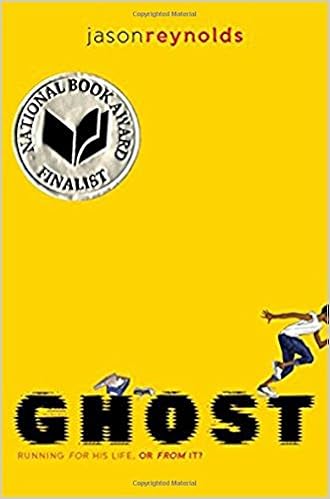
Ghost by Jason Reynolds

I actually met Jason Reynolds at a NCTE conference about a year and a half ago. I had one of those weird experiences for a reader where listening to the author made me believe that I would love his book...and I did. I passed it around all my friends and they loved it too. One of them loved it so much, in fact, that they walked off with it and we had to replace it. Jason Reynolds is officially on my watch list, so I was very excited to see a series coming out from him.

The Track series, of which Ghost is the first, is about four friends of about middle school/high school age who are members of a track team. Four books are scheduled and each book follows a different one of the four.

Ghost kicks it off with Castle Crenshaw, known to himself as Ghost. Ghost is a poster child for tragic and damaged. His father is in jail for shooting a gun at he and his mom. So now his mom works hard in a hospital cafeteria during the day and studies to be a nurse at night. She works hard for him and Ghost knows it.

However, knowing something like that doesn't mean that it's easy or even possible to be the perfect kid. In fact, that's almost a recipe for a lot of internal turmoil and conflict. Ghost struggles and he has a temper. He gets in trouble at school a lot mainly because he hates a bully and he hates a showboat. This intolerance for a showboat sparks him into racing a hot shot sprinter on the team and one thing leads to another.

Ghost is good. Like really good. I gulped down the whole thing in about three and a half hours. It is a short book but the conversational tone of the writing and the pacing really gripped me hard. I was just watching this kid, who could easily be a kid that I teach, making all of these totally obvious mistakes and instead of getting annoyed with him, I really worried for him. Reynolds did a great job of capturing Ghost's voice.

Monday, April 2, 2018

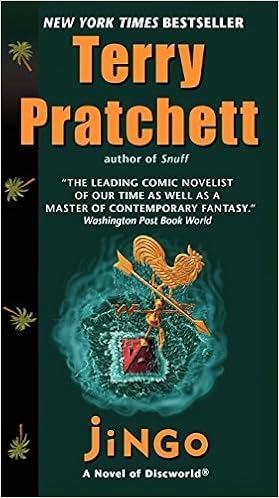
Jingo by Terry Pratchett

Upon further thought, Terry Prachett must have been a delightful irritating person to know. It must have been jokes and puns non-stop. I know people like that. They can be exhausting.

"Jingo" is one of those words that I think most people in my generation and after have lost track of. It means "a vociferous supporter of policy favoring war, especially in the name of patriotism." It is derogatory and has a weird etymological derivation. Originally it appeared in that sort of street magician patois. As in, "By jingo, I conjure thee. Abracadabra! Bwahahaha." (I added the "bwahahaha" but I really feel it belongs there) So, all together there is a sense of the ridiculous contained in the word. It makes me picture puffed up men in uniforms with ridiculous sideburns and stinky cigars who bellow about the sorry state of foreign national interests, there ought to be a war to straighten it all out. It is also a kind of chilling word since most people don't seem to see this as ridiculous.

Accordingly, Jingo is about a war in Discworld that began for no particular reason other than a bunch of puffed up idiots getting the idea in their heads. An island appears in the sea between Ankh-Morpork and the desert nation of Klatch. Conflict over whose island it is sparks political maneuvering and an assassination attempt. Of course, it really appears that the politicians involved were already looking for an excuse because that's just how these things work.

Commander Vimes, as commander of the watch, is immediately involved to investigate the assassination attempt which predictably and far too obviously leads back to the Klatchians. In the meantime, the city prepares for war.

I think I was just in the mood, but once I started Jingo I couldn't put it down. It's part of the Watchmen sub series and so it follows some of my favorite characters including Carrot and Angua. Also, and unusually, Lord Vetinari featured more prominently as a character which doesn't happen often. While, I figured out the sense of how things would have to wrap up, the specifics eluded me until the very end and there were some excellently twisty bits of intrigue involved.

Sunday, March 25, 2018

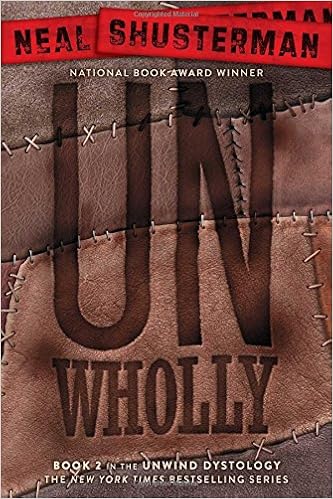
UnWholly by Neal Shusterman

In the acknowledgements, Shusterman says that he had envisioned UnWind as a stand alone novel. Indeed, it reads as a self-contained story. Most of the narrative lines are tied up in the end and, if the world isn't fixed by the events of the story, there is definite positive change. It doesn't really call for a sequel. In fact, there doesn't seem to be room for a sequel.

I always get a little leery when that is the case and I find that series just continues on when the author hadn't initially planned for it. My fear is always that the succeeding books are just going weaken the narrative and ruin my memory of the first book. If I weren't also plagued by intense curiosity, I'd probably just ignore the extra books. However, I am the proverbial cat and I just have to know.

In this particular case, Shusterman did a good job extending the story. It didn't feel forced or artificial, it just felt like a natural extension of the narrative.

The whole series is an examination of the ethics of organ harvesting taken to an extreme. In this world, no fetus can be aborted and their existence is protected until they reach the age of 13. At that point, they can be "UnWound" or basically taken a part for organs and tissue. The idea is that their lives continue in their hosts.  Of course the kids slated for unwinding don't take a lot of  comfort in that. From the first book, Conner, Risa, and Lev pick up in their own narratives and add chapters from the point of view of Cam, a complete human built out of unwind parts, Nelson, the juvie cop that Conner tranqed in UnWind, and Starkey, a storked kid that ends up in the camp in the airplane graveyard.

If Unwind is about the simple struggle of three kids who just want to survive, UnWholly is about an entire culture resistant to change and how much of the government is owned by the corporations who feed on the system as it already is. Cam is an interesting exploration on the question of what makes a human human. He's built out of pieces of 99 individual unwinds, so no one donor could be said to be dominant. It's an interesting character and the question is left hanging.

There are two more books in the series and I'm planning to read them both.

Wednesday, March 21, 2018

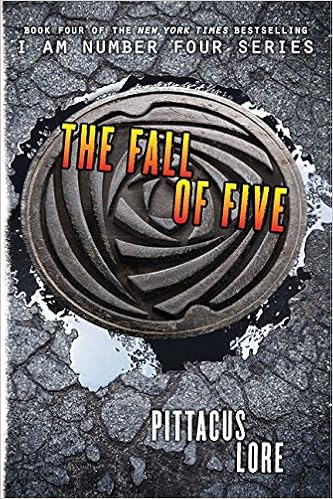
The Fall of Five by Pittacus Lore

It took me several tries to get a good start going on this one. Ryan thinks I'm reading them out of a misplaced sense of obligation. I get why he thinks that, but that's not it. I'm struggling through them because several of my students have read them and talk about them which means other students are interested in reading them. I try to read the things that become popular for whatever reason whether I find them personally motivating or not.

The Fall of Five is the fourth book in the Lorien Legacies and my biggest problem with it is that it came after the third book in the series: The Rise of Nine. (I really did not like that book.)

In this volume, the garde is reunited with each other. They've found Sarah and survived an encounter with the big bad, Setrakus Ra, and they soon run into Sam and his dad. They survive, but it's obvious they aren't ready to face off against the Mogadorian horde.

They retreat to Nine's Chicago penthouse and try to develop a plan. This is complicated by the appearance of Five.

I really like how the book opened with Sam finding his dad. I'd kid of written them both off. I assumed at the beginning of the series that the dad probably died tragically, and when Sam was captured by the Mogs and abandoned by Four and Nine, I was not entirely sure that he wasn't going to show up dead or brainwashed on the other side.

Structurally there are some issues.  The chapters switch between three different points of view: John/Four, Marina, Sam. There is no regular pattern to this, and it is not always clear for several paragraphs whose POV the reader is in. This interrupts the flow of the narrative and makes it feel a little more meandering than it actually is. Additionally, the progression of events feels a little disconnected. Things seem to be happening a little more randomly and it's chapter after chapter of characters reacting.  This seems to be because Lore is exploring the characters more, but it means the feel of narrative shifts.

Oh, and Nine is still a colossal jerk.

Sunday, March 18, 2018

The Mime Order by Samantha Shannon

Some stories stick with you and live in the memory. They are compelling and, if they are a part of a series, they demand to be finished. The Bone Season series is a little like that for me. The biggest criticism I had of the first book was that it had such a steep learning curve. That is a result of such a densely imagined and layered world. Shannon drops her readers into the middle of her world without preamble or lifeline beyond a chart or two. However, once I got my feet under me (so to speak) it was an entrancing read.

The Mime Order was similarly entrancing, but without the learning curve. Paige is back in London and in hiding from Scion. The escapees from Sheol I have scattered and gone to ground. Paige is also avoiding her old Mime-Lord, Jaxon Hall, who wants her to come back to work as his mollisher.

Paige, however, remains disillusioned with Jaxon and his intentions. She wants to bring down Scion and the Rephaim but has no money and little power to do that. She soon finds herself forced back into working for Jaxon who blocks her every attempt to spread words about the alien corruption of Scion. Amidst her frustration, Paige worries about the enigmatic Warden who she last saw during the break out.

The voyant syndicate (think supernatural mob) has always been corrupt, but something more is going on in the shadows and Paige keeps tripping into it. When the Underlord is slaughtered in his own den, Paige is the first person to discover it making her a prime suspect.

The Bone Season was really an escape story. There was some intrigue involved in laying the plans for escape but overall with was pretty straight forward. The Mime Order operates on a completely different level. There's plenty of action but the story hinges entirely on political intrigue. The whole thing is about trust and betrayal. While I anticipated many of the twists and turns, the last twist took me by surprise.

Excellent read. I'm seriously considering buying the last book new. I'm not sure I have the patience to wait for a used copy.

Friday, March 16, 2018

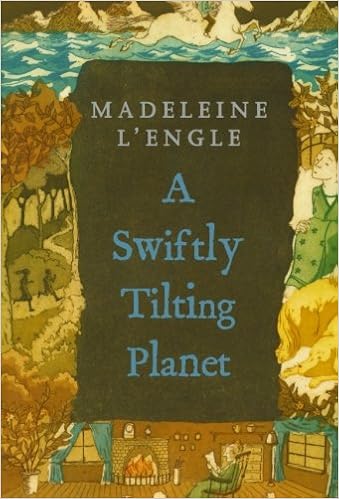
A Swiftly Tilting Planet by Madeleine L'Engle

Rereading these books has been a bizarre experience. I have such a firm memory of having read them, but no specifics. I don't remember a single thing about A Swiftly Tilting Planet. As a result, my reread was slower.

A Swiftly Tilting Planet takes place almost 10 years after the previous book. Charles Wallace is 15. Meg is an adult, married to Calvin, and expecting her first child. Sandy and Denny are training to be a doctor and a lawyer. It's all a very different feel to the previous novels.

The family, minus Calvin but plus his mother, are about to sit down to Thanksgiving supper when the president calls up Mr Murry to let him know that Mad Dog Branzillo, leader of Vespugia, has threatened nuclear war with the U.S. Of course, this dampens the mood. Soon Mrs. O'Keefe, Calvin's mother, busts out with a poem/prayer she calls Patrick's Rune and charges Charles Wallace with the task of averting disaster.

While thinking what to do at the star-gazing rock, Charles Wallace meets a winged unicorn named Gaudior who can transport them through time. It's a good thing to because it turns out that to avert disaster Charles Wallace must travel into the past to change the "might have beens" that led to the conflict.

A Swiftly Tilting Planet, like the first two books in the series, is heavy in Christian allegory which I was slow to identify. Thanks to a long talk with my friend Nathan, I figured out that this is an adaptation of the story of Cain and Abel filtered through the lens of Welsh folklore. It's a complicated plot that moves back in forth in time  and spans several generations.

It was a good book, and one of the better time travel novels I've read.

While I don't generally seek out Christian allegory, I have to admit that I was disturbed when I thought it was absent in this novel. The layering of meaning that allegory provides adds a richness to these books that is at least half of what makes them satisfying.

Wednesday, March 14, 2018

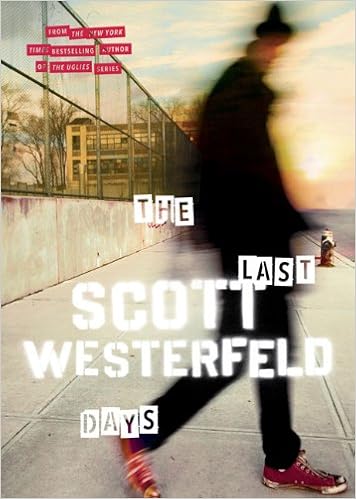
The Last Days by Scott Westerfeld

When I find that I've accidentally started a series, I usually try to track the rest of it down. I was surprised to find out Peeps had a sequel; it seemed so self contained. Part of the success of the first book was its unique structure with narrative alternating with mini essays on parasitology. It really worked, but it didn't seem like the kind of thing that could work indefinitely.

The Last Days starts up in New York City some time after the events of Peeps. Cal and Lace show up, but they aren't the main characters. This book is about a group of teens who just want to play music and be famous. Moz and Zahler are two guitarists in search of instrument variety. They are both good musicians but have no direction. All that changes when in a freak coincidence Moz and Pearl meet while rescuing a stratocaster from certain death. Its previous owner was infected by the parasite that causes something like vampirism and was insane at the time.

Pearl is a musician of a different type. She goes to Julliard and understands the theory of music and how to play multiple instruments. She also knows a really good vocalist named Minerva. The only problem here is that Minerva is also infected. Infected and untreated which means she's only a couple steps off of crazy and very dangerous.

Last but not least they need a drummer who they find in an OCD street performer named Alana Ray. With this last addition they are finally a band and create an almost magical sound which is good because the world around them is falling apart. People are disappearing, rats are roaming the streets in hordes, feral cats are ruling the roost. In short, it's all going to hell.

Ok, so there's an ethnographic idea that folk tales have a far back basis in truth. Not literal truth mind you, but some sort of important idea or event that warps over time. So a clever author looks at the idea of a vampire and starts playing the what if game. When I was younger I came up with the idea of vampires being a sort of care-taking race for humanity. It's not a big stretch and that's what this really is. Vampire as magical undead infection, no. However, vampire as parasite. . .sure why not. Then you just got to figure out why nature would need a subset of humanity with incredible strength and aggressiveness.  Voila...story.

This was a fun read. It isn't as good as Peeps, not by a long shot. I missed the micro-essays and the story just didn't move me as much, but it was a fun light read when I needed one. I kinda hope he keeps producing books in this world, but I kind of doubt it will happen.

Monday, March 12, 2018

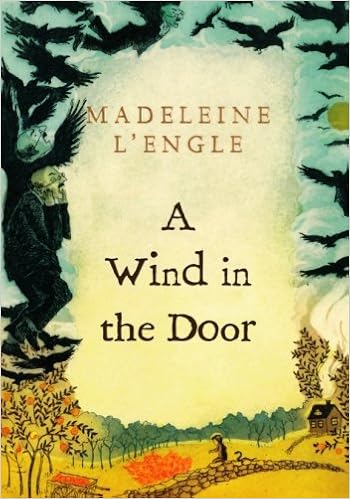
A Wind in the Door by Madeleine L'Engle

This is another case of "I know I read it, but I just don't know when or anything about it." The only solid memory I have of it is of the description of the cherubim, Proginoskes. I remembered something about a big ball of wings and eyes and it might have in fact been an illustration.

A Wind in the Door picks up about a year after the events of A Wrinkle in Time. Meg is in high school and Charles Wallace has started with school. Charles Wallace is, in fact, having as much trouble adjusting to school as Meg did. He's super smart and tiny; it makes him a target for bullying.

Charles Wallace is also suffering from some sort of vague illness. When he greets Meg with a story about dragons in the garden, even Meg gets concerned. If the bullying wasn't enough, now her cherished little brother is seeing things. Nevertheless, she goes to check it out and finds, not a pack of dragons, but rather a single cherubim and a monolithic teacher.

In the larger world, something is causing the stars to disappear. Of course it is all connected and Meg and Calvin must race time to save Charles Wallace.

If A Wrinkle in Time was underpinned with physics, A Wind in the Door is exploring cellular biology. Most of the action has to do with mitochondria which really are quite interesting. Every cell in our body has them and mitochondria have distinct DNA from our own. They are symbiotic prokaryotes which was a new idea at the time that the book was written. The science is a little messed up, but we really do need mitochondria for our cells to function so it's pretty cool stuff.

There is also a stronger religious theme floating through this one probably because of the cherubim. I didn't find it obnoxious, but it was definitely more present.

Sunday, March 11, 2018

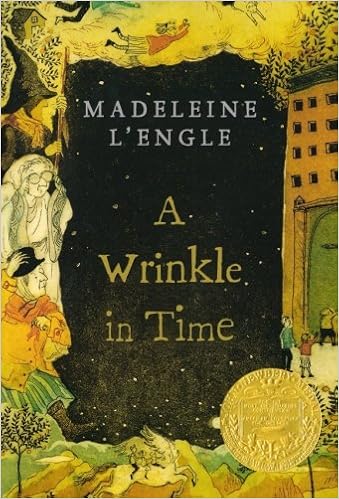
A Wrinkle in Time by Madeleine L'Engle

I read the entire Time Quintet, which is begun with A Wrinkle in Time, when I was a kid. I know that I did, but I can't remember exactly when. I know that most of it was before middle school, because I was surprised when I discovered the fourth book, Many Waters, on a shelf in the middle school library.

Some how the memories linked with A Wrinkle In Time are tied up with my memories of the first grade and Mrs. Brodie's class, but that can't be right because even though I was a little precocious in how I learned to read, I can't have been that advanced. At a guess, I must have been around 8 or 9 which explains some things about my memories of the book. Specifically, I couldn't remember anything about it except that I loved it.

I think I must have been too young for a lot of the concepts to stick despite being drawn in by the characters of Meg and Charles Wallace.

Meg struggles in school. She's smart but she can't seem to do things the way her teachers expect...even though she comes up with the right answers. She gets in trouble and she gets in fights. Many of these fights are in defense of her baby brother, Charles Wallace. Charles Wallace is odd. He's four but he speaks like an adult and seems to be able to read the minds of both Meg and her mother.

Charles Wallace and Meg live with their mother and twin brothers. Dad has disappeared mysteriously which is another cause for friction. One dark and stormy night the mysterious Mrs. Whatsit appears which leads the two kids along with their friend Calvin on a journey to rescue their father from a world consumed by an evil shadow.

This is a supremely cool book for kids. Meg is one of those universal characters. I think every kid, girl or boy, at some point feels out of step with the rest of the world and gets angry. That's probably what drew me in at such a young age, but the narrative encourages young readers to think about things like theoretical physics and what the consequences would be. It's just really cool; there is a reason it's survived with young readers for over 50 years and hasn't somehow become dated.

Saturday, March 10, 2018

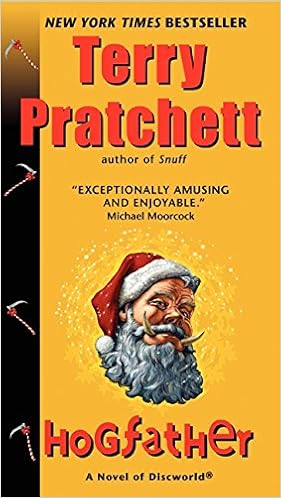
Hogfather by Terry Pratchett

I've known that this existed for a long time and I've been dreading it a little. It seems like any T.V. show, if it lasts long enough, must do a Christmas episode. Usually this just means that the action happens among tinsel and Christmas carols. The wrap is usually has one of the approved Christmas themes of love or miracles.

The same idea holds true for long book series, but with book series, I find it annoying generally. If a series goes long enough, eventually there will be a Christmasy one...even if set in a fantasy world that doesn't have Christmas properly. Some Christmas analog is created and continue as planned.

*insert annoyed rant about a religious holiday (which stole a solar observance anyway) being secularized in order to turn a profit*

So, the Hogfather is an analog to Father Christmas and Hogswatch is Christmas. He flies around in a sleigh pulled by eight giant pigs dispensing gifts and consuming sherry and pork pies left out by the kiddies. By Jove, I believe we've stumbled across the Discworld Christmas novel. *sigh*


Alright, I should have trusted Pratchett a little more than I did walking in. Yes, it is a Christmas novel. However Pratchett plays with all the things about Christmas that I find annoying so it had some fun points too.

In Hogfather mysterious figures called The Auditors have hired the assassins guild to kill the Hogfather. The assassin Teatime, who's a little batty, develops a plan to kill an imaginary being by invading the realm of the Tooth Fairy. This plan works.

Without the Hogfather, the world is out of whack. Death steps into the sleigh to keep the Hogfather's place open. Household gods start popping into being because of the unused free floating belief which gets the wizards involved. Susan StoHelit (granddaughter of Death) gets involved by trying to figure out what her grandfather is up to.

Over the course of the novel Pratchett not only examines the human tendency to create  monsters and bogeymen but also the general evolution of these myths. It's interesting stuff if looked at from a distance. While there is the occasional gushy Christmas moment, on the whole this is more of a romp. I particularly enjoy Susan who just desperately wants to be normal despite her special death related powers. She works as a governess who can actually see the monsters hiding under the bed and gets them out by pounding them with a poker. I hope there is more of her.

Tuesday, March 6, 2018

Double Whammy by Carl Hiaasen

Carl Hiaasen is one of those authors that Ryan has been trying to get me to read virtually since the day we met. I've picked up his first book, Tourist Season, several times, but haven't been able to get traction on it. Hiaasen's YA material, however, is another story. I love it all. It's fast paced, features engaging characters, and deals with environmental issues in a savvy responsible way. One of those, Skink: No Surrender, features a character that started out in his non-YA books. So, this is backtracking to the first appearance of Skink.

Double Whammy is about bass fishing. No, really. Bass fishing. I know know more about bass fishing than I ever wanted to. R.J. Decker is a down on his luck private eye with an anger issue. He's hired by a sportsman named Gault to catch some cheaters in the act. This isn't an amorous thing, this is about cheating at big fishing tournaments. It's weird, but pretty straightforward. At least it is until dead bodies start showing up.

Decker meets up with Skink as a sort of local guide. Skink is big, hairy, and slightly crazy, but he has a nice smile and a quick mind. As odd-ball as he is, he takes to Decker's case and soon finds reasons of his own to help out.

I've never really understood people who watch fishing shows for entertainment. I get why fishing is appealing, but the idea of watching people fish on T.V. dumbfounds me. This is a view that Hiaasen seems to share. There's a snarky sarcastic angle to all this where the main characters seem to be bemused on some level that anyone would bother this much for sport fishing that appeals to me.

Skink is a draw too. For such a bizarre character, he's fun to watch. It's like watching disaster walking around in human skin. He's a survivalist who seems to live off of fresh road kill and a manic conviction that the world would be better off without humans. I like him.

Obviously, this isn't intended for a young audience, but I can think of plenty of teens that would love this.

Saturday, March 3, 2018

Sever by Lauren DeStefano

Yay! Another series down. I had been about to drop this series, but I'm glad I didn't. This is a clear case of the last book making the whole thing worthwhile because it clarified many of the running themes.

 Sever opens with Rhine in a hospital recovering from her harrowing experiences at the mercy of Housemaster Vaughn's medical experimentation. Linden is finally aware of what his father's been doing and Cecily is well on the way to redeeming her mistakes from earlier in the series when she trusted Vaughn overmuch.

Rhine has a new mission to chase down her twin brother, Rowen, who has turned terrorist by bombing research labs. Linden and Cecily decide to help her and they start the trip back northward. However, with everything more in the open, things are also much more complicated and there is no hiding from Vaughn.

Vaughn is definitely the major antagonist of the series, but in this volume his character is greatly expanded and he becomes less two dimensional which leads into the development of what I see as the major theme of the series.

With this last book, the focus on the ethics of medical research really comes into focus. First, the basic premise of the book is that a generation of genetically modified humans led to a catastrophic malady. While it's initially referred to as a virus in the first two books, it becomes clear in Sever that it's a direct result of the genetic tinkering. The offspring of the modified generation have bodies that simply shut down and die on a consistent time clock.

As a result, medical research happens without the consent of the subjects they are ultimately trying to save. This desperation to fix them is at the core of Vaughn's character and many of his actions. The goal is seen to supersede the rights of the victims. Horrible and dangerous experimentation is conducted without oversight or precaution and at times without the subjects consent. This leads to the brand of terrorism that Rhine's twin is involved in.

So, ultimately this whole series plays with the idea of ends justifying means. In fixing a problem, how much is destroyed? As much as the book is about Rhine's story, the most interesting character to examine is Vaughn as his competing motivations and his effect on those around him come into focus.

I'm glad I stuck with the series.

Monday, February 26, 2018

The Bone Season by Samantha Shannon

I cannot remember now where I heard of The Bone Season. Possibly, it was on that list I mentioned back in January of books that hadn't found their audience yet. Regardless of that, I placed it in my Thriftbooks wishlist and the price dropped under $4 at the beginning of February, so I bought it. I've been dropping a little behind in my non-YA and I was looking for something to catch up with so I picked it up.

One of the great delights of reading is discovering something new and wonderful. When I pick up a book that I've heard of or one from an author I know, I have certain expectations. I try to keep an open mind, but those expectations influence my reading. Usually, my expectations are met or exceeded and the experience is good but it's like talking to the friend of a friend. I don't know this book personally yet, but I've shared experiences already with it either through other people telling me about it or through other books written by the same author.

Picking up a book I've never properly heard of is a different experience. I don't know the author so I don't know what to expect from them. There's no trust there that the book is necessarily worth my time, but there's no preconception to live up to either. Every page is a discovery. When this works out well, it's the most exciting experience.
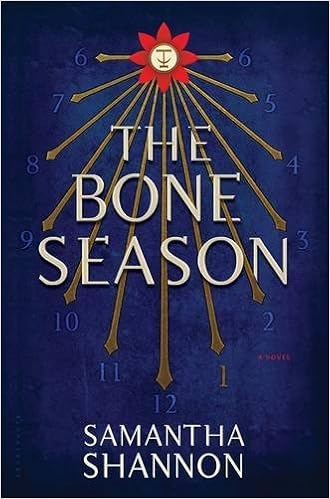
The Bone Season is a dystopian novel set in the near future of London. The monarchy really ended with Victoria and Edward VII was a madman who unleashed a plague of 'unnaturalness', or clairvoyance, on the world. At least that's the official party line of Scion, the totalitarian government bent on eliminating clairvoyants, also called just 'voyants.'  Being forced underground, the voyants turn to various types of crime and band together in criminal syndicates.

Enter Paige Mahoney. Paige is an unusual type of voyant called a dreamwalker. While most voyants can only interact with the aether (spirit realm) in superficial ways, Paige has the ability to send her spirit out of her body entirely. There are drawbacks, of course, like the tendency to stop breathing when her spirit is out of body, but it allows her to snoop around the minds of others. She is a valuable commodity in this world.

She is, however, until caught in a random check and snapped up by the authorities. She expects to die, but instead she's transported to a secret colony in Oxford where she learns that an alien race from the aether called the Rephaim has been gathering up voyants for centuries.

The world is reminiscent of "V for Vendetta" complete with underground plots and political intrigue. Paige is very relatable protagonist. While her anger could be distancing, her compassion makes her enticing. She doesn't act like the dashing hero, but more like a young but competent woman in a situation beyond her ability entirely comprehend.

The beginning was exposition heavy. While Shannon did a decent job interweaving the exposition with action, the first 25 to 50 pages were noticeably slower going than the rest of the book and require patience to slog through. There is a lot of jargon slung around and only half explained about various types of voyants that eventually blends into the flow of narrative. On the upside though, once past the initial investment of time, the narrative moves at a brisk pace. There is plenty of action as well as intrigue. All the characters are richly drawn and the setting is well nuanced with detail.

Oh, and it's the beginning of a series.

The Bone Season was not written with teens in mind, but would be appropriate for a teen well versed in dystopian literature.
Friday, February 23, 2018

The Jewel of the Kalderash by Marie Rutkoski

Yay! Finishing out a series. I started this series last year when I picked it up randomly for having an interesting cover combined with an enticing back blurb.

The whole series is set in a fantasy version of Bohemia during the Hapsburg empire. In this version, many of the people have magical talents. The talents, however, tend to be fairly specific and each individual only gets one. So for example, a talent could be making magical objects out of glass or being able to see the future, but in the normal course of things a person could not have both.

Petra (who has a metal gift and mind magic!), Neel (who has ghostly spectral hands), and Tomik (who has a gift for glass) escaped the evil Hapsburg prince in book one and the enigmatic and half sinister English spymaster, John Dee, in book two. So book three opens with the three on route to the Vatra, or Romani homeland.

Neel quickly gets embroiled in local politics while Petra searches for a cure for her father who was turned into a monstrous gray man by one of the evil prince's lackeys. Poor Tomik is still hopelessly smitten with Petra. While nothing happens the way the three expect, Petra is soon executing a plan to track down a cure while Neel tries to avoid assassination.

A good end for a trilogy  brings back most of the characters and wraps the overarching conflicts. If it's a very good conclusion, it can stand on its own as a book and be enjoyable even if the preceding books haven't been read. This is a very good conclusion.

While I've mentioned before that I'm not a big fan of the "one girl must pick between two boys" motif that has been so common just lately, Rutkoski manages it about as elegantly as I've ever seen. All the characters reach a meaningful resolution and it's one of those bittersweet cases of a perfect ending. Wonderful ending, but there's no room for more in the series.