Showing posts with label nonlinear. Show all posts

Sunday, March 25, 2018

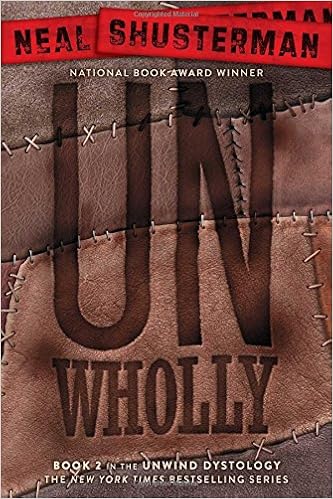
UnWholly by Neal Shusterman

In the acknowledgements, Shusterman says that he had envisioned UnWind as a stand alone novel. Indeed, it reads as a self-contained story. Most of the narrative lines are tied up in the end and, if the world isn't fixed by the events of the story, there is definite positive change. It doesn't really call for a sequel. In fact, there doesn't seem to be room for a sequel.

I always get a little leery when that is the case and I find that series just continues on when the author hadn't initially planned for it. My fear is always that the succeeding books are just going weaken the narrative and ruin my memory of the first book. If I weren't also plagued by intense curiosity, I'd probably just ignore the extra books. However, I am the proverbial cat and I just have to know.

In this particular case, Shusterman did a good job extending the story. It didn't feel forced or artificial, it just felt like a natural extension of the narrative.

The whole series is an examination of the ethics of organ harvesting taken to an extreme. In this world, no fetus can be aborted and their existence is protected until they reach the age of 13. At that point, they can be "UnWound" or basically taken a part for organs and tissue. The idea is that their lives continue in their hosts.  Of course the kids slated for unwinding don't take a lot of  comfort in that. From the first book, Conner, Risa, and Lev pick up in their own narratives and add chapters from the point of view of Cam, a complete human built out of unwind parts, Nelson, the juvie cop that Conner tranqed in UnWind, and Starkey, a storked kid that ends up in the camp in the airplane graveyard.

If Unwind is about the simple struggle of three kids who just want to survive, UnWholly is about an entire culture resistant to change and how much of the government is owned by the corporations who feed on the system as it already is. Cam is an interesting exploration on the question of what makes a human human. He's built out of pieces of 99 individual unwinds, so no one donor could be said to be dominant. It's an interesting character and the question is left hanging.

There are two more books in the series and I'm planning to read them both.

Thursday, January 4, 2018

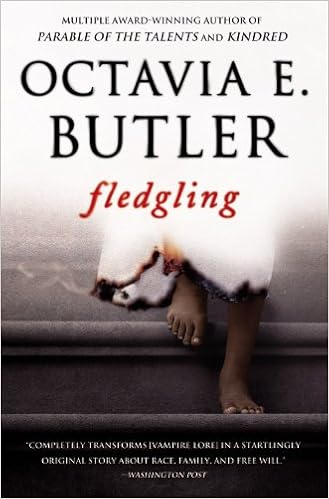
Fledgling by Octavia E. Butler

So I finished my first non-YA book. Somehow, when I picked up Fledgling, I didn't expect a vampire novel. I'm not sure why it surprised me, after all Butler's done aliens and time travel so vampires fit right in.

Generally there are two camps with vampire books. 1: vampires are evil festering undead and the stuff of nightmares. 2: vampires are sparkly and sexy. In either case, what makes a vampire a vampire is something mystical or magical. Fledgling took a different approach. Butler's vampires are explained as a separate and symbiotic species to humans. There is a sexual component to them but they are far more alien than human, so they end up somewhere between the two camps.

The book opens when Shori wakes up in a cave in incredible pain and without any memory of who or what she is. At first she simply tries to heal and survive. Soon though she begins looking for people and crosses paths with Wright and binds him to her without really meaning to. It soon becomes apparent what she is, and despite looking about 11, she's actually 53 years old.

The rest of the book is a slow discovery of what Shori is and what has happened to her. In many ways, aside from the whole vampire thing, this is just a really well written mystery.

I have to admit that I found the sexual aspects somewhat off putting. It reminded me very much of my experience of the Xenogenesis trilogy. I don't tend to think of myself as being a prude, but there is something kind of creepy about a being who looks to be a bout 10 years old having intimate relations with adult humans even if she is, in fact, over twice the age of the humans in question. I got used to it quickly and Butler did a good job of creating an alternate sense of normal, but still. . . disturbing.

Excellent book, but obviously it's not one I can recommend to my students as a general rule. Everyone else should read it though.

Saturday, July 1, 2017

Flipped by Wendelin Van Draanen

I might have a new author to add to my favorite lists.

Somehow when I finished The Running Dream last year, I never got around to reviewing it which is a shame because it is an excellent YA novel about a high school track star who loses her leg in a bus accident coming back from a Meet.  I'm not going to review it here past saying that I would recommend it to any of my athlete girls and most of the boys too. It's that good.

I kind of forgot about Van Draanen after that. It was a busy year and a cursory look at her bibliography led me to believe that The Running Dream was an outlier. She seems to mostly write for an elementary school audience. I mainly stick to YA, teen and Middle Readers. So, when I was doing my recent book buys I kept tripping across Flipped and couldn't figure out why the author name looked so familiar until I found a copy of it shelved next to The Running Dream. Then it clicked.

I read it over a single morning. What really pulled me in was the structure. Flipped is told from two points of view: a somewhat quirky girl named Juli and Bryce whose family is all about appearance. The chapters alternate narrators, but where as most novels with multiple narrators tend to use the shift in POV to advance the sequence of events, in Flipped the two narrators are telling the reader about the same events but from their very different perspectives. As a result, the story has a little bit of a Rashomon feel to it. It's an excellent demonstration of the use of point of view.

The story, on its surface, is a pretty standard teen romance. Juli, at the tender age of seven, is smitten at first sight with Bryce when he moves in across the street. The crush continues through middle school until she finally realizes that she doesn't really even know the object of her affections. Bryce on the other hand is completely conflict avoidant and this somewhat intense girl makes him want to run for the hills until one day he sees her in a different light and then he can't stop looking at her.

Like I said, pretty standard. What makes it worth reading is the conflict between the two interpretations of events. Both narrators end up sympathetic and the families around the two characters are full of interesting characters.

I would recommend this to both male and female teens and middle schoolers.

Sunday, February 5, 2017

Animal Man by Grant Morrison

Animal Man has got to be one of the hokiest super heroes, which is a bit tragic given that he's got one of the coolest powers. Animal Man can absorb abilities from the animals around him and use them in a super human way. Cool, right? When I was a kid, I used to imagine having that power. But Animal Man was one of those naive all american types which made him a little unsatisfying.

Grant Morrison took the hero and gave him an update.  Actually, he seems to be part of a modern trend of giving writers a trial run on revitalizing old comic book properties. Neil Gaiman completely reinvented Sandman and Alan Moore gave Swamp Thing a face lift.

Morrison's Animal Man is a more human figure. He struggles with being a good husband and father while balancing the responsibility of having super powers. At least in the beginning. It's a nice update on the basic character and makes him more relatable.  Ellen, the wife, added a good counterpoint or anchor to the non-super world.

At least in the start. As the story progresses, it veers sharply away from the standard super hero fare.

As it goes on, it's clear that Morrison is playing with narrative structure and convention. He completely obliterates the fourth wall and culminates with writing himself in as a character in a sort or interstitial quasi space which is neither the comic world nor the real one.

It's weird.

Really weird.

But good.

Wednesday, January 11, 2017

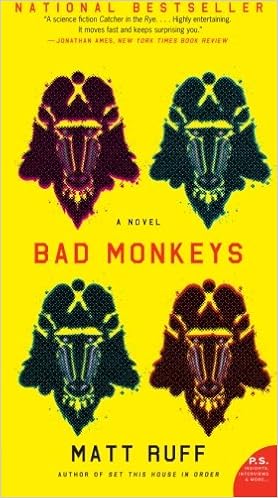
Bad Monkeys by Matt Ruff

This is a Ryan recommendation. I've read Matt Ruff before and his books are stunningly diverse. With most writers, there is a definite feel to their work that links it all together. Each book of Ruff's that I've read, has had a unique writing style. This isn't a bad thing, but it does mean that you never know what you'll get picking up one of his books.

Bad Monkeys is a strange book. Part of it is that I'm reading a lot of YA with a lot of very young protagonists, Jane Charlotte is in her 40's. Most of it is that Jane Charlotte is an unreliable narrator and a not terribly likable one.

This is a psychological thriller. The story begins with Jane Charlotte in the psych ward attached to a prison. She's guilty of murder and being evaluated by a psychologist. During this evaluation, she tells her story. The plot then alternates chapters between the psychologist and the events of her story.

Jane Charlotte insists that she is part of a secret society guiding human culture. She's part of the unit that eliminates irredeemable members of society, those that cause widespread harm. Before long, she encounters a group with the opposing purpose to cause widespread chaos and harm.

Clearly, these groups are in conflict.

It's rare to read something that creeps me out so completely. That's a compliment actually. I believe that any book that can cause a strong emotional reaction is by that factor alone a good book. So by that metric, this was a very good book.

I will never be reading it again.