Showing posts with label witches. Show all posts

Monday, July 30, 2018

Fablehaven by Brandon Mull

It always occurred to me that fairy and folk tales are filled with some really nasty critters and that the bulk of them seem out to kill humans. The ones that aren't overtly hostile tend to be neutral at best. Many of the ones that are benign are easy to offend to disastrous effect. As cool as they are, I'm not sure I would ever really want to meet one. They are too sinister as a whole.

Even though this is true, there's a ton of fey folk popping up in literature and so much of the time they come across as benign or even silly.

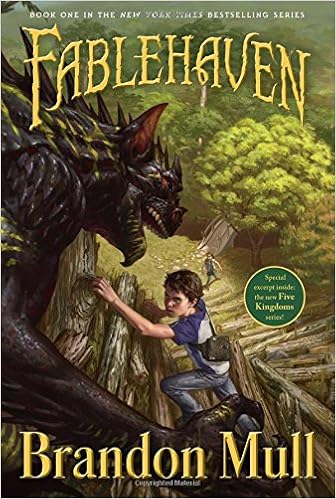
In the world of Fabelhaven the world's fairies aren't fictions, they are endangered creatures, so certain humans gather them up in preserves. Seth and Kendra's grandfather is one of these people which is something neither children nor their parents realize when they are dropped off for some quality time with the grandparents. These are not benign or silly versions of the fairy tale world. These critters are dangerous or even deadly. Being the guardian of such a preserve doesn't guarantee the good will of the inhabitants.

Both kids quickly realize something is strange about the house and grounds. Grandma is missing and there are a lot of strange rules. Kendra is inclined to follow the rules, but Seth is more curious and reckless. When the rules get broken, a powerful evil force is unleashed and the kids have to find a way to fix it on their own.

So, this is cute. I picked it up because two of my big readers swore by the series. I don't think it's destined to be my next favorite series, but I do plan to finish reading through the five book run.

Thursday, May 10, 2018

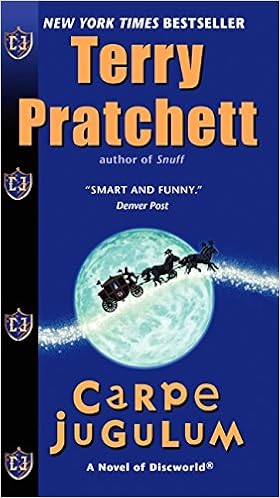
Carpe Jugulum by Terry Pratchett

So I sense that Terry Pratchett was a fan of "Young Frankenstein". Actually, it wouldn't surprise me if he were some sort of generalized Mel Brooks fan.

King Verence is a father and in the interest of good politics, he invites all the neighbors to the naming. All the neighbors, including the family of vampires out of uberwald. These are progressive vampires. They've accustomed themselves to holy symbols, holy water, garlic, and low doses of sunlight. They've done away with dank castles and biting young women in nightgowns. Instead they develop arrangements with their food enforced through mind control.

But let's face it, Uberwald is so last century. They have their eye on sunny Lancre and are totally willing to eat King Verence in the process. This is of course where the witches get involved. Witches in Discworld are hard to control and most people would probably say, don't bother. Granny Weatherwax didn't get an invite to the christening and has gone off leaving Agnes/Perdita and Nanny Ogg to manage things. Witches work best in groups of three so Queen Magrat comes out of retirement toting baby Esmeralda and going to the rescue.

Ok, so in terms of all of the Discworld novels, this isn't one of the strongest. However there are some really good moments. I really like the Igors and Uberwald in general. It's like the area of Discworld reserved for hokey horror stereotypes. While it's been mentioned in several of the books, this is the first partially set there. So, yeah fun.

Friday, February 16, 2018

The School for Good and Evil: The Last Ever After by Soman Chainani

Have you ever noticed that books in a series get longer as the series progresses? It's like editors get leery of criticizing an author's work, but I'm generally of the opinion that a good editor is worth their weight in gold. Creative types sometimes have a hard time seeing their work objectively and that's where a good editor comes in. It's their job to suggest where necessary cuts should be made and where scenes need more substance to aide the flow of narrative. Just think what an amazing book Harry Potter and the Order of the Phoenix could have been if it had been 200 pages shorter and minus the puberty morass.

Anyway, I guess it's clear I think this the third tome in the series suffers from being too long. The Last Ever After weighs in at a whopping 655 pages and I'm generally of the opinion that that's too long for something billing itself as a YA novel. (I'm sure there are exceptions, but I can't come up with any.)

It would be one thing if the pacing was such that I didn't notice the length. That does happen sometimes, but there were several times during my read where I ended a session with a huge sigh and started flipping around to gauge the length of the section/chapter.

That all sounds pretty negative. Aside from its length and related pacing issues, this is a decent book.  At the end of the second book, Agatha has her kiss and chooses Tedros. Sophie has her kiss and chooses the evil school master. The Last Ever After picks up only a few weeks later with Agatha and Tedros trapped in the reader world and having severe relationship issues. In the meantime Sophie is in the school master's tower with a rejuvenated school master deeply questioning the wisdom of her choice.

Of course, the only choice is to reopen "The Story of Agatha and Sophie" yet again but with even higher stakes. I'm trying not to roll my eyes here, but yeah... heavy sarcasm on the word 'again'.

Right, so I think part of my frustration with the length is that the ending was telegraphed from the first book in the series. There were some nice moments along the way and some of the side characters really got developed and fleshed out in this third volume...but it's still quite the undertaking to read.

Saturday, February 10, 2018

The School for Good and Evil: A World Without Princes

I was enchanted enough with the first book, that I went ahead and picked up the second. Honestly, the story was so tied up at the end of the first book that I didn't really know where Chainani could go in the second book.

Apparently, when a reader does something strange in the fairy tale world school, it does strange things to the whole world. So, Sophie and Agatha got to go home, but once there they each find that they are unhappy for one reason or another. Sophie is still having a hard time with her father and wishes she could see her mother again. Agatha has moments of regretting her choice to go home with Sophie and wishes for Tedros. They are soon lured back to the fairy tale school but find that everything is different. The schools are no longer for good and evil but have instead becomes a school for girls and a school for boys. The sexes are at war, or nearly so because Agatha proved that a princess did not necessarily need a prince.

Of course, Sophie and Agatha are at the heart of the conflict and it just isn't clear what the right path is.

So good things: Tedros becomes something more than an annoying and self-righteous prick. I also like that the narrative puts Tedros and Sophie on even footing by having him echo things Sophie has said. The pacing issue in the first book is fixed in the second. I like the way the evil students and good students find common ground, even if it feels temporary.

And the bad things: The story is getting annoyingly moralizing. It seems like Chainani's world is punishing action over intention. Sophie often acts with good intention and she just keeps getting smacked down in a way that I'm finding annoying. I don't really like Sophie. I wouldn't hang out with her given a chance but it just seems like she's being bullied by the story and I hate bullies. Agatha seems more than usually powerless which I don't like but may also be temporary leading in to the third book.

All in all, there is stronger and smoother writing in the second book but the plot line is more confusing. Certainly, A World Without Princes was a more enjoyable read than the first book.

Thursday, February 1, 2018

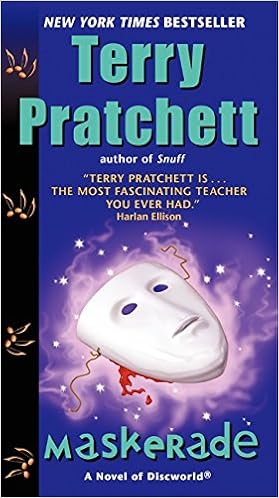
Maskerade by Terry Pratchett

The thing about a series is that if you enjoy it, once you finish one book, there is a strong impulse to dive into the next one. Additionally, I'm now well past the Discworld books that I've read in the past, so it is all new territory.

Maskerade is one of the less zany of the Discworld books. Nanny Ogg and Granny Weatherwax are back making it part of the witches subseries even if Magrat is off being a queen. In fact, the book opens with Nanny and Granny needing a third witch for their little gatherings. Nanny is particularly worried that Granny will become unhinged and either wander off and die or become one of the bad ones.

The best candidate for a new witch is Agnes Nitt, only she's gone off to Ankh-Morpork to become an opera singer. She's got an amazing voice too. The problem she finds is that she is built on rather more Wagnerian lines and her ample figure isn't what they are looking for in their stars these days. In fact, there are many in the opera-house who feel that the values of good music above all other consideration are being compromised. And it doesn't help that their patron ghost has started killing people.

This is an unusual book for Discworld series. It is really a murder mystery. Someone is killing people and Agnes, Nanny, and Granny are trying to find out who: basic mystery plot. The identity of the Ghost is the lynch pin of course.

Maskerade was a fun read but it took a long time. The pacing was very different. As with all the Discworld books, there were no chapter breaks which will always be a struggle for younger readers. Additionally, a lot of the jokes assumed at least a passing understanding of opera. Pratchett particularly pokes at some of the notoriously ridiculous plots. I spotted references to La Traviatta, The Magic Flute, The Barber of Seville, and Die Fledermaus. Wagner's entire opus is sort of generally referenced. Additionally, the Ghost in the book is an obvious reference to The Phantom of the Opera, and there is a passing reference to Cats, The Pirates of Penzance, Les Mis, Evita, and Miss Saigon. Given that I'm not a big Opera or Musical Theater fan, I am sure that I missed a lot on this one.

Friday, January 26, 2018

The School for Good and Evil by Soman Chainani

I've been curious about this book for while. It has compelling cover art and it hit the New York Times Bestseller List which always gets my attention for YA. My sister-in-law read it and had a sort of ambivalent reaction to it which is intriguing in and of itself. As a general rule, Carra tends to have clear reactions to the things that she reads. So, I borrowed it. I can see why Carra had the reaction she did, I can also see how it got to be a bestseller.
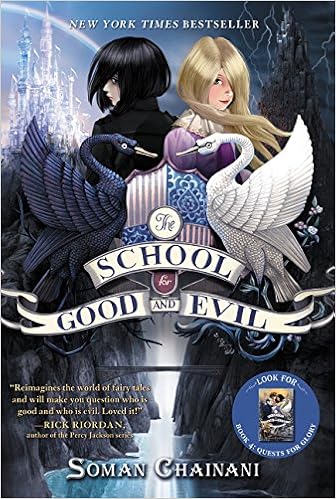
The School for Good and Evil is about two girls, Sophie and Agatha, who live in a village called Gavaldon that is completely enclosed in a ominous and somewhat magical forest. The village is completely isolated by this forest and it is impossible to escape. Every four years on the eleventh day of the eleventh month two children who are at least 12 are abducted. One child is good, sweet, and beautiful. One child is evil, sinister, and ugly. Everyone is sure that Sophie will be the good child taken this year and that Agatha will be the one taken for evil. Indeed, Sophie wants to be the one taken.

Sophie and Agatha are, in fact, the ones taken but against expectation Sophie ends up in the school for evil and Agatha ends up with the good. Is it a mistake, or is there something going on beneath the surface?

The world Chainani created for this book is amazing. I absolutely love the premise. The students are basically in training to be in fairy tales. That could be saccharine but it becomes clear very early on that there are dire consequences for failing in your studies which gives the whole world a bit of an edge from the get go. All the characters, in both schools, are well developed. All the primary and secondary characters are fully three dimensional which is challenging given how many there are. The plot reversals all make sense for the characters, and there are a startling number of them.

There are flaws, however. Firstly, Sophie and Agatha are supposed to be 12 and I very quickly stop believing that. The act and react to situations more like a 15 or 16 year old. Frankly, the good schools focus on princesses snaring princes is more than a little odd if they are all supposed to be between 12 and 16, the age range alone makes the concept a little problematic. However, more critically, I think: there is just too much going on here and not enough space for it. There is a massive cast of fully developed characters and almost too many plot twists. While everything that happens is properly seeded in the narrative, so much happens that it is easy to forget say...a two line description on the second page that becomes critically important in the last twenty pages. The last 100 pages or so end up feeling very compressed.

I think Chainani would have done better to split the plot arch over two, if not three, books and take more time developing events. However, I did very much enjoy the read and would recommend it despite the flaws.
Saturday, October 15, 2016

The Gemma Doyle Series by Libba Bray

I originally had this pegged as a YA series and I'm not sure why. I think I read an article that mentioned the second book in passing and the title stuck in my brain as such do. I picked up the second book, Rebel Angels, first because of this and had to backtrack the beginning of the series.

The first two books, A Great and Terrible Beauty and Rebel Angels, were very quick reads. Gemma Doyle finds out at age 16 that her mother has hidden secret magical powers from her and that Gemma has inherited some of them. Gemma is packed up by her family and moved from India back to Victorian England where her family sends her off to boarding school.

At boarding school, Gemma learns how catty and awful girls can be while discovering the use of her powers to enter "The Realms." There are a lot of sinister overtones and I found a lot of the girl drama tedious, if accurate.

The third book was nearly 800 pages long and it dragged on quite a bit. It took me about three weeks of on and off reading to slog through it. The only reason I didn't put it down was that it was the end of the series. Ultimately, I got through it, and it wasn't terrible, just in need of an editor. The wrap up was a solid completion of the story lines but I found several aspects of it irritating. The romantic subplot in particular was particularly unsatisfying.

The first two are well worth the read and it's an interesting world.

1. A Great and Terrible Beauty
2. Rebel Angels
3. The Sweet Far Thing