Showing posts with label magic. Show all posts

Monday, July 30, 2018

Fablehaven by Brandon Mull

It always occurred to me that fairy and folk tales are filled with some really nasty critters and that the bulk of them seem out to kill humans. The ones that aren't overtly hostile tend to be neutral at best. Many of the ones that are benign are easy to offend to disastrous effect. As cool as they are, I'm not sure I would ever really want to meet one. They are too sinister as a whole.

Even though this is true, there's a ton of fey folk popping up in literature and so much of the time they come across as benign or even silly.

In the world of Fabelhaven the world's fairies aren't fictions, they are endangered creatures, so certain humans gather them up in preserves. Seth and Kendra's grandfather is one of these people which is something neither children nor their parents realize when they are dropped off for some quality time with the grandparents. These are not benign or silly versions of the fairy tale world. These critters are dangerous or even deadly. Being the guardian of such a preserve doesn't guarantee the good will of the inhabitants.

Both kids quickly realize something is strange about the house and grounds. Grandma is missing and there are a lot of strange rules. Kendra is inclined to follow the rules, but Seth is more curious and reckless. When the rules get broken, a powerful evil force is unleashed and the kids have to find a way to fix it on their own.

So, this is cute. I picked it up because two of my big readers swore by the series. I don't think it's destined to be my next favorite series, but I do plan to finish reading through the five book run.

Saturday, April 14, 2018

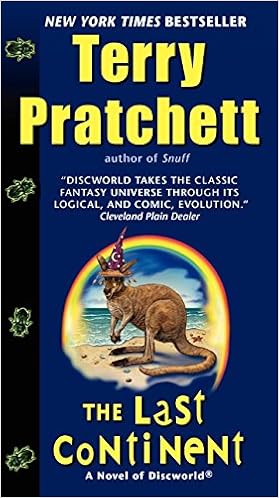
The Last Continent by Terry Pratchett

An "antihero" is a central character/protagonist in a book or movie who is devoid of all the usual characteristics of a hero. One of Pratchett's main characters, Rincewind, is an antihero. Rincewind is a self-proclaimed coward. He's refined running away to the level of a sport. As a wizard, he's abysmal. The closest thing to a heroic skill he's got is a natural facility for learning different languages. Every book with Rincewind in it involves a lot of running away and ending up in the right place anyway.

This might be the best Rincewind novel so far out of the six I've read. I like Rincewind any way. I didn't when I was a teenager, Rincewind is one of those characters that requires the reader to have a certain amount of life experience before he can be appreciated.

At the end of last novel, Interesting Times, Rincewind washed up on the hypothetical/lost continent of Ecksecksecksecks (also written XXXX). This continent is the Discworld corollary to Australia. As it turns out, Rincewind's bizarre life and exposure to large amounts of magical energy has left him with a personal field that tends to warp reality a little around him. In this case, because he washed up in Ecksecksecksecks in the present, he causes something to happen far back in the past at the creation of the continent that he now has to fix. He's told this by a giant anthropomorphized kangaroo. Rincewind responds by running away. Of course, he accidentally runs in the direction he needs to go in order to fix it anyway, so no worries.

In the meantime, the Librarian of the Unseen University is very sick and the wizards need to know his name in order help him. However, as an orangutan he can't tell them and no one seems to have it written down. Because Rincewind used to be the Librarian's assistant, the wizards figure they need to find Rincewind. In the process the wizards get themselves stranded on Mono Island in the distant past and meet the God of Evolution who is the only god on the disc that doesn't require believers to exist.

Pratchett also plays with aboriginal dreamtime and I spotted a reference to Crocodile Dundee in there. As always, I'm sure I missed as many references as I caught. However, I really enjoyed this one and would generally recommend it to Pratchett fans.

Monday, April 9, 2018

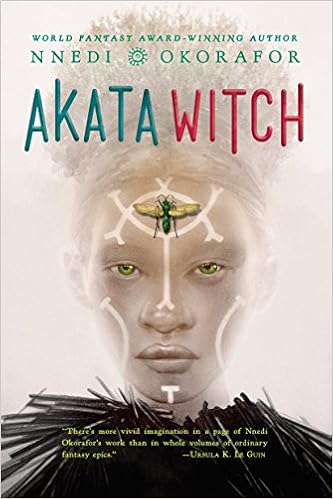
Akata Witch by Nnedi Okorafor

In a vague way, I've been trying to find more literature from non American or British authors. Over time I've been picking at African literature, but I haven't had a ton of success. I greatly like Chinua Achebe, but then who doesn't. I believe strongly that reading widely and on a variety of cultures is a way of developing insight. It is also highly enjoyable. When I heard about Akata Witch I had to read it.

I tripped across Akata Witch on Book Riot. It appears on many of their lists and is billed as an African Harry Potter which I think diminishes both Harry Potter and Akata Witch. There are certainly some similarities. Both books start with very young protagonists who discover that not only magic exists but also that they can do it. Additionally, they then start training in magic and eventually run against some sort of big bad that they have to confront even though they are just children. So, yes, in the broad strokes they are similar ideas. That's where it ends though.

Akata Witch is set in Nigeria and Sunny, the main character, is an American born Nigerian. She's also an albino which is a very mystical thing. The whole magic culture described is based on African juju, although the existence of other magical traditions is accounted for. The values are different and the environment is wild, colorful, and lively. Instead of one big magical school. The four students study with a master. Education is more hands on and figure it out on your own. Which all makes for a much different feel.

I liked the veneration of knowledge for its own sake and the attitude about the important things in life. Don't get me wrong, I love the Harry Potter books and they will always be special to me. Akata Witch is just different and special in its own way.

It's really hard to describe why this book is so amazing without ruining some of the joy of discovery. I'm thrilled to have a copy in my classroom library and I was so enthusiastic about my description of it this morning that a student already has it checked out. I'm looked forward to talking with him about his impressions of it.


Wednesday, March 21, 2018

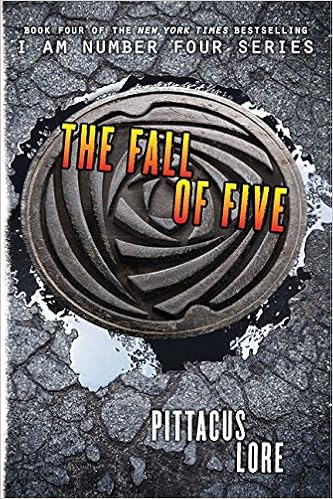
The Fall of Five by Pittacus Lore

It took me several tries to get a good start going on this one. Ryan thinks I'm reading them out of a misplaced sense of obligation. I get why he thinks that, but that's not it. I'm struggling through them because several of my students have read them and talk about them which means other students are interested in reading them. I try to read the things that become popular for whatever reason whether I find them personally motivating or not.

The Fall of Five is the fourth book in the Lorien Legacies and my biggest problem with it is that it came after the third book in the series: The Rise of Nine. (I really did not like that book.)

In this volume, the garde is reunited with each other. They've found Sarah and survived an encounter with the big bad, Setrakus Ra, and they soon run into Sam and his dad. They survive, but it's obvious they aren't ready to face off against the Mogadorian horde.

They retreat to Nine's Chicago penthouse and try to develop a plan. This is complicated by the appearance of Five.

I really like how the book opened with Sam finding his dad. I'd kid of written them both off. I assumed at the beginning of the series that the dad probably died tragically, and when Sam was captured by the Mogs and abandoned by Four and Nine, I was not entirely sure that he wasn't going to show up dead or brainwashed on the other side.

Structurally there are some issues.  The chapters switch between three different points of view: John/Four, Marina, Sam. There is no regular pattern to this, and it is not always clear for several paragraphs whose POV the reader is in. This interrupts the flow of the narrative and makes it feel a little more meandering than it actually is. Additionally, the progression of events feels a little disconnected. Things seem to be happening a little more randomly and it's chapter after chapter of characters reacting.  This seems to be because Lore is exploring the characters more, but it means the feel of narrative shifts.

Oh, and Nine is still a colossal jerk.

Friday, February 23, 2018

The Jewel of the Kalderash by Marie Rutkoski

Yay! Finishing out a series. I started this series last year when I picked it up randomly for having an interesting cover combined with an enticing back blurb.

The whole series is set in a fantasy version of Bohemia during the Hapsburg empire. In this version, many of the people have magical talents. The talents, however, tend to be fairly specific and each individual only gets one. So for example, a talent could be making magical objects out of glass or being able to see the future, but in the normal course of things a person could not have both.

Petra (who has a metal gift and mind magic!), Neel (who has ghostly spectral hands), and Tomik (who has a gift for glass) escaped the evil Hapsburg prince in book one and the enigmatic and half sinister English spymaster, John Dee, in book two. So book three opens with the three on route to the Vatra, or Romani homeland.

Neel quickly gets embroiled in local politics while Petra searches for a cure for her father who was turned into a monstrous gray man by one of the evil prince's lackeys. Poor Tomik is still hopelessly smitten with Petra. While nothing happens the way the three expect, Petra is soon executing a plan to track down a cure while Neel tries to avoid assassination.

A good end for a trilogy  brings back most of the characters and wraps the overarching conflicts. If it's a very good conclusion, it can stand on its own as a book and be enjoyable even if the preceding books haven't been read. This is a very good conclusion.

While I've mentioned before that I'm not a big fan of the "one girl must pick between two boys" motif that has been so common just lately, Rutkoski manages it about as elegantly as I've ever seen. All the characters reach a meaningful resolution and it's one of those bittersweet cases of a perfect ending. Wonderful ending, but there's no room for more in the series.

Friday, February 16, 2018

The School for Good and Evil: The Last Ever After by Soman Chainani

Have you ever noticed that books in a series get longer as the series progresses? It's like editors get leery of criticizing an author's work, but I'm generally of the opinion that a good editor is worth their weight in gold. Creative types sometimes have a hard time seeing their work objectively and that's where a good editor comes in. It's their job to suggest where necessary cuts should be made and where scenes need more substance to aide the flow of narrative. Just think what an amazing book Harry Potter and the Order of the Phoenix could have been if it had been 200 pages shorter and minus the puberty morass.

Anyway, I guess it's clear I think this the third tome in the series suffers from being too long. The Last Ever After weighs in at a whopping 655 pages and I'm generally of the opinion that that's too long for something billing itself as a YA novel. (I'm sure there are exceptions, but I can't come up with any.)

It would be one thing if the pacing was such that I didn't notice the length. That does happen sometimes, but there were several times during my read where I ended a session with a huge sigh and started flipping around to gauge the length of the section/chapter.

That all sounds pretty negative. Aside from its length and related pacing issues, this is a decent book.  At the end of the second book, Agatha has her kiss and chooses Tedros. Sophie has her kiss and chooses the evil school master. The Last Ever After picks up only a few weeks later with Agatha and Tedros trapped in the reader world and having severe relationship issues. In the meantime Sophie is in the school master's tower with a rejuvenated school master deeply questioning the wisdom of her choice.

Of course, the only choice is to reopen "The Story of Agatha and Sophie" yet again but with even higher stakes. I'm trying not to roll my eyes here, but yeah... heavy sarcasm on the word 'again'.

Right, so I think part of my frustration with the length is that the ending was telegraphed from the first book in the series. There were some nice moments along the way and some of the side characters really got developed and fleshed out in this third volume...but it's still quite the undertaking to read.

Saturday, February 10, 2018

The School for Good and Evil: A World Without Princes

I was enchanted enough with the first book, that I went ahead and picked up the second. Honestly, the story was so tied up at the end of the first book that I didn't really know where Chainani could go in the second book.

Apparently, when a reader does something strange in the fairy tale world school, it does strange things to the whole world. So, Sophie and Agatha got to go home, but once there they each find that they are unhappy for one reason or another. Sophie is still having a hard time with her father and wishes she could see her mother again. Agatha has moments of regretting her choice to go home with Sophie and wishes for Tedros. They are soon lured back to the fairy tale school but find that everything is different. The schools are no longer for good and evil but have instead becomes a school for girls and a school for boys. The sexes are at war, or nearly so because Agatha proved that a princess did not necessarily need a prince.

Of course, Sophie and Agatha are at the heart of the conflict and it just isn't clear what the right path is.

So good things: Tedros becomes something more than an annoying and self-righteous prick. I also like that the narrative puts Tedros and Sophie on even footing by having him echo things Sophie has said. The pacing issue in the first book is fixed in the second. I like the way the evil students and good students find common ground, even if it feels temporary.

And the bad things: The story is getting annoyingly moralizing. It seems like Chainani's world is punishing action over intention. Sophie often acts with good intention and she just keeps getting smacked down in a way that I'm finding annoying. I don't really like Sophie. I wouldn't hang out with her given a chance but it just seems like she's being bullied by the story and I hate bullies. Agatha seems more than usually powerless which I don't like but may also be temporary leading in to the third book.

All in all, there is stronger and smoother writing in the second book but the plot line is more confusing. Certainly, A World Without Princes was a more enjoyable read than the first book.

Thursday, February 1, 2018

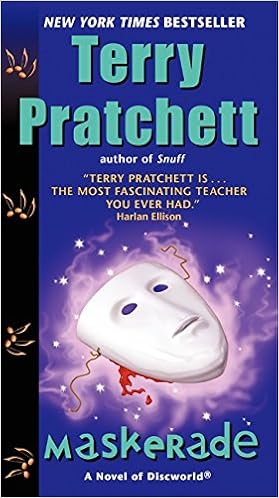
Maskerade by Terry Pratchett

The thing about a series is that if you enjoy it, once you finish one book, there is a strong impulse to dive into the next one. Additionally, I'm now well past the Discworld books that I've read in the past, so it is all new territory.

Maskerade is one of the less zany of the Discworld books. Nanny Ogg and Granny Weatherwax are back making it part of the witches subseries even if Magrat is off being a queen. In fact, the book opens with Nanny and Granny needing a third witch for their little gatherings. Nanny is particularly worried that Granny will become unhinged and either wander off and die or become one of the bad ones.

The best candidate for a new witch is Agnes Nitt, only she's gone off to Ankh-Morpork to become an opera singer. She's got an amazing voice too. The problem she finds is that she is built on rather more Wagnerian lines and her ample figure isn't what they are looking for in their stars these days. In fact, there are many in the opera-house who feel that the values of good music above all other consideration are being compromised. And it doesn't help that their patron ghost has started killing people.

This is an unusual book for Discworld series. It is really a murder mystery. Someone is killing people and Agnes, Nanny, and Granny are trying to find out who: basic mystery plot. The identity of the Ghost is the lynch pin of course.

Maskerade was a fun read but it took a long time. The pacing was very different. As with all the Discworld books, there were no chapter breaks which will always be a struggle for younger readers. Additionally, a lot of the jokes assumed at least a passing understanding of opera. Pratchett particularly pokes at some of the notoriously ridiculous plots. I spotted references to La Traviatta, The Magic Flute, The Barber of Seville, and Die Fledermaus. Wagner's entire opus is sort of generally referenced. Additionally, the Ghost in the book is an obvious reference to The Phantom of the Opera, and there is a passing reference to Cats, The Pirates of Penzance, Les Mis, Evita, and Miss Saigon. Given that I'm not a big Opera or Musical Theater fan, I am sure that I missed a lot on this one.

Friday, January 26, 2018

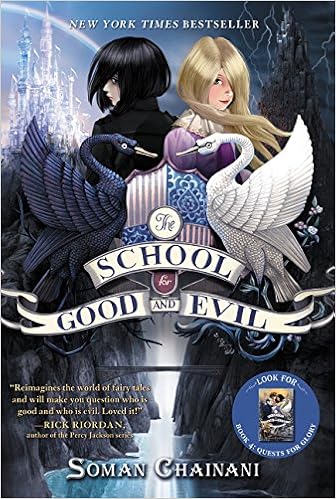
The School for Good and Evil by Soman Chainani

I've been curious about this book for while. It has compelling cover art and it hit the New York Times Bestseller List which always gets my attention for YA. My sister-in-law read it and had a sort of ambivalent reaction to it which is intriguing in and of itself. As a general rule, Carra tends to have clear reactions to the things that she reads. So, I borrowed it. I can see why Carra had the reaction she did, I can also see how it got to be a bestseller.

The School for Good and Evil is about two girls, Sophie and Agatha, who live in a village called Gavaldon that is completely enclosed in a ominous and somewhat magical forest. The village is completely isolated by this forest and it is impossible to escape. Every four years on the eleventh day of the eleventh month two children who are at least 12 are abducted. One child is good, sweet, and beautiful. One child is evil, sinister, and ugly. Everyone is sure that Sophie will be the good child taken this year and that Agatha will be the one taken for evil. Indeed, Sophie wants to be the one taken.

Sophie and Agatha are, in fact, the ones taken but against expectation Sophie ends up in the school for evil and Agatha ends up with the good. Is it a mistake, or is there something going on beneath the surface?

The world Chainani created for this book is amazing. I absolutely love the premise. The students are basically in training to be in fairy tales. That could be saccharine but it becomes clear very early on that there are dire consequences for failing in your studies which gives the whole world a bit of an edge from the get go. All the characters, in both schools, are well developed. All the primary and secondary characters are fully three dimensional which is challenging given how many there are. The plot reversals all make sense for the characters, and there are a startling number of them.

There are flaws, however. Firstly, Sophie and Agatha are supposed to be 12 and I very quickly stop believing that. The act and react to situations more like a 15 or 16 year old. Frankly, the good schools focus on princesses snaring princes is more than a little odd if they are all supposed to be between 12 and 16, the age range alone makes the concept a little problematic. However, more critically, I think: there is just too much going on here and not enough space for it. There is a massive cast of fully developed characters and almost too many plot twists. While everything that happens is properly seeded in the narrative, so much happens that it is easy to forget say...a two line description on the second page that becomes critically important in the last twenty pages. The last 100 pages or so end up feeling very compressed.

I think Chainani would have done better to split the plot arch over two, if not three, books and take more time developing events. However, I did very much enjoy the read and would recommend it despite the flaws.

Monday, January 22, 2018

Interesting Times by Terry Prachett

Ok, the time has come. I'm taking a stand. The Discworld series is not YA! (So, now there are a bunch people sputtering in their beverages that anything involving puns, wizards, and self-animated walking luggage has to be YA and a whole other group of people rolling their eyes and saying "well, duh! Of course it isn't")

See this is the problem with classing things by age. What's the cut off and how does one go about defining it?

Here's my reasoning for Discworld. It's really quite simple. When I first read this series I was 16. I didn't hate them, but I also didn't get why they were supposed to be funny. Reading the series was a long boring experiment in cross-cultural befuddlement.  Over the course of a couple years I got about as far as Soul Music before apathetically throwing in the towel. I'm now in my late 30's, more than twice the age I was then, and I love them.
The difference is that now I get the jokes. Part of that is that I'm just older and all the protagonists are fully adults. It resonates more. Part if is that I've watched a great deal more BBC programming. So, I'm more familiar with British humor in general. The biggest reason though is that I've read a great deal more literature and history. Most of the jokes involve a frightening breadth of literature. To get the jokes, one has to be fairly well read and, as much as I read, I think I'm missing things still. What teenager has read more in their less than twenty years than I have in my slightly less than 40 years?

So, NOT YA!

Alright, enough of that.

Interesting Times is a Rincewind book. It starts out with the gods of luck and fate sitting down to play something that seems like chess. The "board" is the empire on the counterweight continent, which is where Twoflower came from in Colour of Magic. Fate has all the noble families of the empire. Luck has Rincewind, Cohen the Barbarian, a horde of geriatric barbarians, and the red army. Things then play out as they often do in Pratchett's books. By which I mean, a string of seemingly unrelated an ridiculous things happen that in the end all come together like the pieces of a puzzle box.

The Agatean Empire is clearly modeled after the imperial Chinese court and so this all made me slightly uncomfortable. Pratchett is a satirist and poking at another culture this way just gives me the willies. That's not to say that it wasn't all very funny, because it was. It just made me squirm a little. It was, however, fun to get all the characters back from the first book for a kind of character reprise.

Good read, but not a quick one. Humor relies on a passing familiarity with Imperial Chinese history and culture and some knowledge of Sun Tzu's The Art of War. The biggest challenge for adolescent readers is the lack of chapter breaks. There are no chapter delineations, just text breaks when Prachett picks up with a different point of view character.
Thursday, January 18, 2018

Ironside by Holly Black

So, changelings. I've always been fascinated and creeped out by the idea of changelings. The idea is that the faeries come and steal a baby away and leave something behind in its place cloaked in glamour (illusion). The thing they leave behind might be a log or bundle of straw and then the illusion either wears off and reveals what is underneath or the baby seems to die before the magic dissipates. Sometimes though they leave a faerie baby behind and the magic never wears off but the babies are difficult and sickly. As they grow they develop into wild cantankerous children who act out and run away. From a pragmatic view this is an early explanation for difficult children that absolves the parents of responsibility.

The thing is that these stories always focus on the human parents or sometimes the human baby...but they are always human-centric. Ironside focuses on the faerie child instead as a protagonist which is an interesting  perspective. After all, what must it be like to realize that your parents aren't your parents and that you aren't even human?

Even though the first two books in the series have little in the way of shared characters, this third book in the series brings most of the main characters from both of the earlier books back. Roiben is about to be crowned; Kaye is still in love with him and insecure about it. Corney is dealing with his trauma from the first book and looking for ways to protect himself from the fey. Val and Ravus are making a go of the whole human & troll love match thing, but don't turn up much. Dave is still broken and burned out from his drug overdose, but Luis features more in this last book and finally gets some resolution.

The plot picks up a couple of months after the second book with the coronation of Roiben as the unseelie king. Kaye declares her love to him publicly and receives a seemingly impossible quest which she takes as a rejection. Casting about for a path, she decides to tell her human family the truth and gets wrapped up in the seelie queen's plot to take over the unseelie court.

In some ways, I think this the best of the three books. The first two were fun reads but there is a better balance to the story in Ironside. The intrigue means that this isn't just a teen romance which is nice. I'm sad that there aren't any more books in the series, the world is a lot of fun.

Tuesday, January 16, 2018

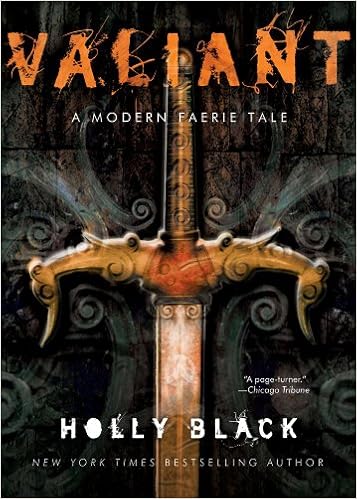
Valiant by Holly Black

It's always weird writing posts for multiple books in a series, which is why I started doing those series posts a while back. Those series posts always felt a little lack luster though and so now I'm back to this.

I'm not sure what I expected from a second novel in the Modern Faerie Tale series. I guess I assumed that the story would follow Kaye or at least Roiben. However, Valiant introduces entirely new characters. While still part of the same world, there is almost no cross-over in characters.

Valiant introduces Val who is something of a jock and something of a tom-boy. She plays lacrosse at school has a gay friend named Ruth and a boyfriend with a mohawk named Tom. There's nothing unusual or difficult about her life, she's just drifting through. That changes when she accidentally walks in on her boyfriend cheating on her with another woman, and the last woman Val would have expected.

Val goes to a hockey game to clear her head and just doesn't go home. It's not a concious decision, she just fails to get on the train home and soon is distracted by meeting Lolli and Dave who live in an abandoned subway station. Val fits right in. Soon, Val meets Dave's brother Luis and finds out how the exiled fey manage to survive in New York City. Oh, and obviously she discovers that the fey exist.

The only glaring problem is that someone is killing the fey and humans are high up on the suspect list.

This one reminded me less of the paranormal romances and more of Francesca Lia Block's Weetsie Bat books. I think because there is more of a dreamy quality to some of the writing. During her time on the streets, Val experiments with a drug that is a sort of magical acid. So there is a sort of weird magical realism going on.

Clearly there are some tough themes here, but relevant to a teenaged audience. Aside from the drugs, Val spends most of the book living rough on the streets. It's appropriate for teens but does require a more mature mindset.

Sunday, January 14, 2018

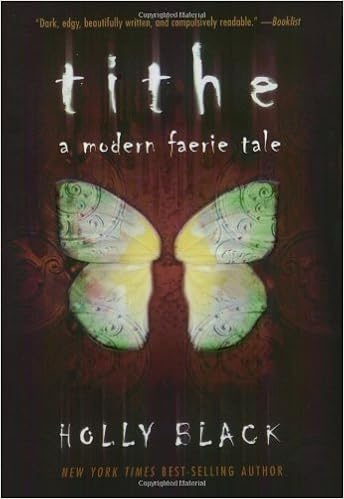
Tithe by Holly Black

I've read Tithe before. I know this, but during my reread I never remembered what happened which isn't normal for me. The Modern Faerie Tale series was intensely popular for a few years when I first started teaching so I picked up the first of the three books. I remember liking it, but that's about it.

In this story Kaye is a teenager who follows her mom from city to city as she tries to succeed in the rock world. Mom is not terribly successful and so Kaye mostly takes care for her as well as herself. She has dropped out of school and going nowhere fast.

Kaye is an odd kid. For one thing, she's seen fairies and sometimes when she's day dreaming things happen.

The premise of the world is that all the fey folk in the stories still exist and live in the more wild places. The reason we don't see more of them is that we surround ourselves with iron which makes them ill. Kaye is more wrapped up in it all than even she knows when her fairy friends deliver a revelation about Kaye's origins and she meets a tortured fairy knight, Roiben.

Basically this is a teen level paranormal romance: all the weird romantic situations without any of the ...ah... "heated moments." Think fantasy adventure mixed with high school drama.

The characters are fun and the world richly imagined if somewhat gritty. This isn't high literature or anything, but it is a lot of fun.

Wednesday, January 10, 2018

Trickster's Queen by Tamora Pierce

The problem with reading a book in series literature, for me at least, is that once I begin I feel impelled to pick up the next one and the next one until I run out of extant books in the series or the series concludes. I get really frustrated actually when I have to wait for the next installment because the writer hasn't written it yet. This is why I tend to wait for series to conclude and then read them all in one big marathon. I do T.V. the same way.  It's a character flaw.

Luckily, "The Lioness's Daughter" series is a duet. Also luckily, I managed to finish it before having to go back to school.

Trickster's Queen picks up about six months after the end of of Trickster's Choice. Aly has earned her place as spymaster and has spent the winter building and training a network of spies. The old king is dead and the Balitang family is going back to the capitol city. This sounds like a good thing. But it's not. With all the deaths, the youngest child Elsren is now the presumed heir to the throne and that's not a very safe position to be in.

The court intrigue deepens and the pressure from Kyprioth increases as fears drawing the notice of two of his god siblings. Despite her youth, Aly has earned the respect of her raka conspirators, but can she keep track of all moving pieces and keep her prospective queen alive?

This is an excellent continuation from the first book even though the feel is much different. Trickester's Queen is less action oriented. It is more focused on the plotting and intrigue. While there is plenty of action still, the narrative is more driven by following Aly's complex schemes which provides a very different reading experience.

Saturday, January 6, 2018

Trickster's Choice by Tamora Pierce

Every time I think I've finally finished all the Tamora Pierce books, Jess keeps handing me another. I'm appreciative, they are good books, but whenever I start one I get trapped in it until I finish it. It's a nice problem to have I guess, but I'm looking forward to reading books that I can put down when I need to.

Trickster's Choice is the start of a the "Daughter of the Lioness" storyline set in the Tortall world. This story-line follows Alanna and George's daughter Aly. Aly takes after her father, the ex-master thief turned spy. She's headstrong and a thrill seeker and completely uninterested in the traditional life-pursuits for a young noblewoman.

What she really wants to be is a spy. However, Mom and Dad don't want their little girl in that much danger. Who would? It's infuriating to Aly though, and after a heated discussion with her mom, Aly decides to sail down the coast a little and cool down. That's where she runs into the pirates who capture her and sell her into slavery.

Soon, Aly finds herself tangled up in the local politics of the Copper Isles and talking to local gods, specifically Kyprioth the trickster god.

So, in reading Pierce it seems that she like's coming sideways at real world issues in her books. She's taken on gender issues and slavery. This one seems to be coming at issues of race and conquest. It's interestingly pragmatic about the issues in a way that we often aren't. One of the things I've always valued about books is their ability to shed light on the issues of our world without the baggage so that we can think clearly about it. Most people seem to take literature, especially fantasy, at face value, but I think when it's well done, it can be more thought provoking than even the best history which must always be examined for agenda.

In any case, good read. Appropriate for high schoolers and precocious middle schoolers. Solid themes and thought provoking. Some, minimal romance but nothing lascivious. Strong characters both female and male.

Tuesday, October 31, 2017

Month of Tamora Pierce

I had a bit of reading dry spell during my absence but broke it in early October when one of my co-workers loaded up my desk with 11 Tamora Pierce books. I generally think highly of Jess's taste in YA and since a student saw the books on my desk and got excited, I decided to break through my dry spell. I finished the last of the 11 early this morning.

Over all, I think Pierce writes good fantasy-based YA.What I read fell into three series all set in the same world. While she includes some gritty elements here and there, mostly it falls into a standard girl oriented format.

Beka Cooper Series
  1. Terrier
  2. Bloodhound
  3. Mastiff

This series follows the deeds of Beka Cooper whose highest aspiration is to be a "Dog" or city guard. She was born in slums of Corus and can hear the spirits of the dead who linger on the backs of pigeons. This series, of the three I read, included the most gritty realism. Pierce does a good job describing a medieval city slum. Unlike the rest of the series, each of these books almost read like a thriller/mystery with all the action revolving around Beka's investigations. There is intrigue and betrayal and a talking cat of dubious origins. Good stuff.

Song of the Lioness Series
  1. The First Adventure
  2. In the Hand of the Goddess
  3. The Woman Who Rides Like a Man
  4. Lioness Rampant

 This series picks up at least 100 years after the Beka Cooper series. In fact, Beka's several times grandson turns up as one of the main secondary characters. In this series, it's been a long time since there were any lady knights, but Alanna Trebond is determined to avoid her fate as pampered noble lady. She disguises herself as a boy and joins page training at the palace. Over the course of the series she becomes a knight and then a hero. She has several love affairs, which are tastefully handled by Pierce. This series features a lot of court intrigue. While Alanna isn't a blundering warrior type, she's not exactly a deep thinker either. It's a solid series, but I wish there were more of the intrigue angle.

Immortals Series
  1. Wild Magic
  2. Wolf-Speaker
  3. Emperor Mage
  4. The Realms of the Gods

This is the series I actually started with. It takes place soon after the events described in "Song of the Lioness" and follows a character named Daine who is a young woman with a secret. The resolution of this secret accounts for most of the first novel so I won't say much. Suffice it to say, there is more than one kind of magical ability in this world and Daine has one of the more rare and unusual. All of Pierce's series seem to feature animal companions, but this series is practically infested with them. This series also opens the door for more magical critters which is an interesting expansion.


Sunday, July 2, 2017

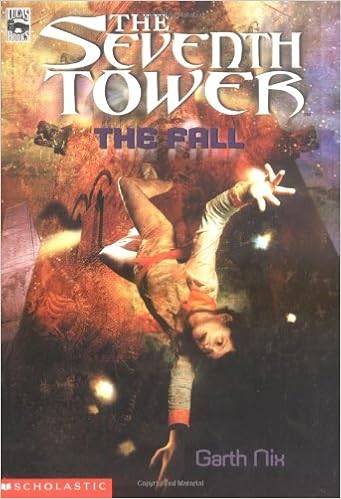
Series Review: The Seventh Tower by Garth Nix

It seems like when I mention Garth Nix to the readers in my sphere, everyone has read a different one of his books. Wilfrid handed me Sabriel. Ben recommended Shade's Children which I'm still trying to find. Jessica handed me these books, "The Seventh Tower" series.

Tal has problems. His father is missing and his mother is sick. In order to get out of his trouble, Tal needs a 'primary sunstone.' In this world, the sunlight is blocked from the surface of the planet by a magical black veil. The sunstones are almost exactly what they sound like, stones that store light in the form of magical energy. Tal's people, the Chosen, have a highly regimented and organized society to manage teaching and using the light-based magic. At the bottom of the organizational ranking are those who cannot use magic at all, the Underfolk. If Tal can't get his sunstone, the whole family will slide down to Underfolk status. So, Tal decides to steal one.

However, it all goes wrong when Tal falls off the tower where the sunstones are grown and ends up on the frozen surface of the world where he meets Milla, a combative member of the Icecarls. Now Tal is stranded on the surface and he still needs a sunstone.

I'm trying to get away from the series review format. I don't think, in general, that I do justice to the books when I'm writing them, even if I really enjoy the series. However, with this series, it really all felt like one very long YA novel that got chopped up into six books. This is not the first time that I've felt this way about a YA series. I think that publishers have imposed a length limitation on individual novels regardless of the size of the story particularly for the younger end of the audience group.

As a side note, since discovering Garth Nix in February of this year, I've now read a total of 20 Garth Nix novels. I've enjoyed it, but I think it's time for Garth Nix break.

Tuesday, May 2, 2017

To Hold the Bridge by Garth Nix

I finished this one back in the beginning of April. It's another collection of short stories, 19 this time, and like the other Nix collection I read only the title story is an Old Kingdom story. The collection is broken into 5 thematic groups such as Science Fiction or Coming of Age.

Overall this is a strong collection with a large variety of work. Some of Nix's ideas are a little weird, but fun. There's even a story in here based on the Barsoom stories of Edgar Rice Burroughs and one based on the Hell Boy comics.

My favorites were:

  1. "To Hold the Bridge" - An Old Kingdom story, this is really a coming of age story where a kid of meager means takes a chance and joins 'The Bridge Company' which involves the older timeline of the books. He learns and thrives there, but is plagued with self doubt.
  2.  "A Handful of Ashes" - this was a weird case of being more drawn in by the world than the plot line. It's a magic heavy world dominated by schools of magic. Somewhat dark and gritty, the story focuses on scholarship student who works for the school in exchange for her studies.
  3. "The Quiet Knight" - A LARPing story. LARPs, or Live Action Role Play, are an odd little sub-section of the table top role play groups except that they make and dress up in their characters gear, get people to be monsters, and got running around parks like mad fiends. Personally I think it sounds like a lot of fun, but they don't end up in too many pieces of media. In "The Quiet Knight" the protagonist's 'game-life' intersects with real life and it's. . .sweet.
  4. "Peace in Our Time" - Science Fiction this time about a world where everyone has tiny pieces of technology inside of them and the people who maintain such are elevated to the position of priests, except it's all fallen apart apparently. However we are getting the story through a somewhat befuddled head of a ancient survivor of the civilization's collapse.
  5. "Vampire Weather" - so, it's fun when literature is really social commentary. This story is about vampires, clearly, but it's really about the anti-vaccers. I'm not sure it's ultimately a very good story but I enjoyed the concept.

This is worth having for the title story alone.

Wednesday, March 22, 2017

Goldenhand by Garth Nix

This is the last of the extant Old Kingdom Series novels. It came out in 2016, so I have high hopes that there will be more soon. It's a little strange how, as a late comer to an author, I can get so invested.

Goldenhand picks up very soon after the events of Abhorsen. Apparently, there's a short story that fits in between the two but I don't think it's necessary to read if first, but it probably helps to understand the set up. It's called "The Creature in the Case."

Lireal lost a hand during Abhorsen and Sam has created her a new golden prosthetic to replace it, hence the name. Sabriel and Touchstone are taking a much needed vacation leaving Lireal in charge of all Abhorsen matters. In the course of this she's called to the wall to meet Nick who has discovered a free magic creature.

Poor Nick, the guy is a sort of magical freak. The events of previous books have left him infested with free magic, but the Disreputable Dog also baptised him to Charter magic. So he's kind of a living Charter Stone. (If you read the previous books, that made sense. If you haven't, think source of magic.)

In any case, Chlorr of the Mask shows up and causes problems that Nick and Lireal have to deal with. It's pretty fun. However, I will note that this volume reads more like YA than any other book in the series.

Sunday, March 19, 2017

Clariel by Garth Nix

11 years after Abhorsen was published, Nix came out with Clariel. That's a long lag. Most authors produce one book every year to two years to keep a series going. Slower than that, and it can be difficult to get a new book out because the fans wander off and find new things to follow. Sometimes though, if a book has a big enough following, a new book in the series can be well received. Clariel is such a book.

Sometimes an author gets interested in the backstory of a villain which can lead to some interesting problems. If the villain cannot be made sympathetic in someway, it can be hard to run a book from their perspective. Make them too sympathetic and it is no longer believable that they can be villainous. So, it's a very hard line to walk. I imagine it is made harder when the first exposure
the audience has to the character is as a villain.

In this case, Nix came up with an interesting solution. The events of Clariel happen about 600 years before the rest of the Abhorsen books. For most of the book, it is unclear how, or even if, the main character Clariel relates to the other later timeline. By the time I figured it out, the book was about three quarters of the way through.

Clariel is a girl uprooted from her environment by her parents and moved to the capital city of Belisaere. Her parents are goldsmiths and it's a good move for them with plenty of opportunity. However, it's a disaster for Clariel who wants nothing more than to be alone in the forest. Normally this just makes for an unhappy teenager, but Clariel is related to both the royal and abhorsen bloodlines and so is an inheritor of power. Power, can be a wonderful thing or it can be terrible.

I like the story of Clariel and, while the end made sense and was satisfying, it made me sad. The best part of the book for me was the glimpse of the Old Kingdom at or nears it's height of glory. All of the Abhorsen books take place in a time when the Old Kingdom is struggling to put itself back together, so it's interesting.