Showing posts with label education. Show all posts

Friday, June 9, 2017

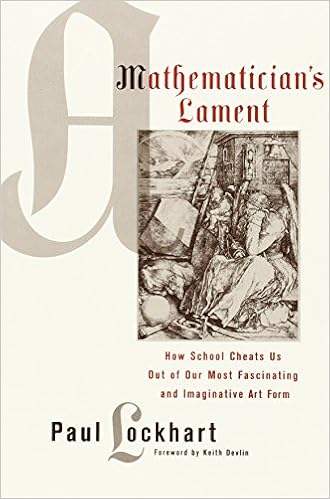
A Mathematician's Lament by Paul Lockhart

Ryan recommended this book to me. Actually, I discovered the title at last year's NCTE conference when one of the speakers mentioned in an off-hand kind of way during the last panel I went to. It's about math education and sounded interesting so I ordered it off Amazon for Ryan's Christmas present. I was expecting some sort of weighty tome, what came was a slim little white book of about 140 pages. 

Ryan, being Ryan, was enthusiastic about it and read it over a couple of days. He loved it, and immediately handed back to me as a recommendation. 

I picked it up as a break from fiction. I really only expected to skim the first few pages and then put it aside to read later, but what happened was that I found myself a few hours later still curled into a corner of the couch and turning the last page. It is very readable.

Essentially, this is a polemic. Lockhart states a problem: that the current organization of math education saps the creativity out of mathematics. He defines the problem well and even describes what his ideal of math education is. However, he doesn't really have a solution. Lockhart readily recognizes the limitations of the individual teacher in the current educational climate. 

So, as an English instructor, it may come as a shock that I got as enthralled in a math text as I did. I'm pretty mathy, actually. However, my interest in the text has more to do with the sort of universal issue with today's education. As long as we are, as educators, beholden to these bizarre standardized tests, education is only ever going to cater to the tests. We've all become SAT tutors instead of doing what educators are supposed to be about: guiding and honing the native curiosity of our students. 

The issues that Lockhart mentions are issues in every subject. The problem is that education shouldn't be about memorizing facts (that only helps in team trivia), it should be about teaching students to approach problems with logic and discernment. Anyone can memorize facts at any point of their life. Learning to think, though, is about a pattern of responses that can help a person throughout the entire course of their lives and that is what Lockhart is actually talking about. Stop making it about the subject and start making it about the problems we encounter as part of our everyday lives.

I can't give an overall opinion about this little tome, however I can say that it has me reevaluating how I teach. Maybe that is conclusion enough.

Friday, June 2, 2017

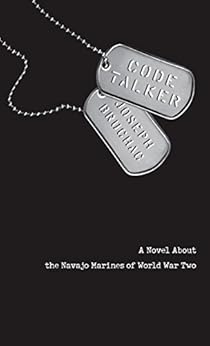
Code Talkers by Joseph Bruchac

Let me start off by saying that war novels just aren't my thing. I find the whole notion of war pointless and depressing so reading about it in my fiction isn't high on my list typically. However, many of my students feel differently and I'm trying to push the boundaries of my current experience in YA. Code Talkers was donated to my classroom library and I try to read everything I place on my shelves for my students.
So, here goes.

Code Talkers is a historical novel written concerning an interesting piece of World War II history. I'm not sure how common the knowledge of Navajo Code Talkers are these days. I knew about it, but I pick up a lot of random information in my voluminous reading. It was however top secret for decades after the end of the war.

WWII was a war that relied on secure communications. Massive armies and all their support staff had to be in communication to a greater degree than ever before necessary. The problem was that the Japanese were really good at breaking U.S. codes and had prepared for the war by learning many of the languages spoken here including many of the languages of various Native American groups. However, one language they did not learn, because of it's incredible difficulty to learn, was Navajo. So the U.S. Marine Corps recruited groups of bilingual Navajo to develop a code that was underpinned by the Navajo language. The japanese never broke the code mostly because they couldn't understand the language that it was based on.

This book is a fictionalized account of one of these code talkers, Ned Begay. Ned's story starts when he was six and saying goodbye to his parents for the first time to go to Mission School. One of the goals of these schools was to stamp out the Navajo language with, one can only assume, the great goal of culturally integrating the Navajo into the U.S.'s European derived culture. Ned does well and becomes fluent in English. He continues on to High School, and when Pearl Harbor is bombed, he wants to join the fight. He does, and the novel follows Ned as he survives through the war.

According to Bruchac's Author Note, he had a hard time finding a way to write this story. He wanted to write a book about the Code Talkers but experimented with several different formats before settling on a novel. Apparently, the first draft was more history book than it was story. I think this struggle is evident in the text. The narrator, a much older version of Ned who is telling the story to his grandchildren, always seems oddly removed from the events of the story - almost dispassionate. I think this distance in the voice is a relic of the author's struggle finding a format.

Despite the dispassionate narrative voice, Code Talkers is a good account of the War for young readers. Additionally, it also introduces and addresses several issues about the U.S. treatment of the Navajos and attitudes about their culture including their forced relocation at one point and the campaign to eradicate the language. All in all, it's a good transition to fiction for students who tend to prefer nonfiction.

Thursday, June 1, 2017

Don't you Dare Read This, Mrs. Dunphrey by Margaret Peterson Haddix

Sometimes I recognize an author's name and I don't know why. At my last book buying trip I snagged on this book because the author's name seemed familiar. Later, I figured out I recognized it from her book Just Ella which was a 'thing' when I started teaching. In any case, I picked out this specific title to try because of its premise.

Don't You Dare Read This, Mrs. Dunphrey is a novel in the form of  a required journal written by a girl named Tish Bonner. Basically, Mrs. Dunphrey makes a deal many English teachers make which is "If you just write, I promise I won't read the entries you tell me not to." (It's a deal I've been tempted to make myself.) So, Tish writes in her journal. She writes even though she almost aims at being a poor student. She writes because there's too much going on in her life, she has no one else to talk to, and Mrs. Dunphrey keeps her promise not to read it.

As the book continues, Tish's home situation deteriorates until she comes to a breaking point and must make a decision.

This book hit me hard. When I finished it, I was in tears and I sat stunned for several minutes. The reasons for this are complicated and personal to myself.

First, it hit me right in an anxiety button. I've never been in a situation where there was not enough money or food to take care of the necessities, but it's always been one of my driving fears. I don't know why. Tish's situation in the book takes that basic fear and gives it a hard twist because, as a 16 year old with a younger brother to watch out for, her options for providing enough money to live on are very limited.

Second, I spent most of the book frustrated and angry and Mrs. Dunphrey for not seeing the warning signs that something serious was wrong with Tish. Of course, I know it's not that easy. It's not easy for me when I have 10 students in a classroom and I cannot imagine how impossibly difficult it is for someone with 30 or 40 students in a room at a time.

In the end, the resolution relies on the trust Mrs. Dunphrey earns with Tish by keeping her word. Still, it was very hard to read and very good.

Thematically, this book is about neglect and resiliency. It's about the love of a sister who tries to protect her brother. It is about a teenager dealing with sexual harassment of her manager at her job and her limitations in dealing with him because of her desperate need for money. In an overarching way, it is about both the flaws of the educational system and the strengths of individual teachers. It is a beautiful and tough book.