Showing posts with label historical fiction. Show all posts

Wednesday, July 25, 2018

Homer & Langley by E.L. Doctorow

There is a fantastic used bookstore in Chattanooga called McKay's. Every time we pass through the city we try to stop by. Usually I'm trolling around for YA novels for my classroom library, but this time I was actually trying to find myself some literary fiction. Since deciding that I was going to read 50 non YA books this year, I've had to face the fact that my taste in literary fiction has become somewhat atrophied over the last several years. I'm on a very laid back mission to work on that.

To that end, I snagged an E.L. Doctorow novel: Homer & Langley. My reasoning on this is a little vague, but here's how it went. Fact 1: over ten years ago a person, who's taste in literature I trust, recommended that I read Ragtime. I dutifully bought the book and never managed to read it. I later found out that this is not an entirely uncommon experience of the book. Fact 2: I became a fan of Cory Doctorow. Fun tidbit - Cory Doctorow is not at all related to E.L. Doctorow, but speaks of him highly. I figured therefore that I would give good ole E.L. another chance.

So then, Homer & Langley.  Well the good news is that I was riveted. I read most of it in the car on the way back from Chattanooga. I finished it the next day on the couch which resulted in me wallowing in a profound funk. Reading Homer & Langley is like watching a train wreck happen. I mean it's just awful. Both Homer and Langley are easy to sympathize with and the entire book is watching them slowly descend into secluded insanity.

Homer and Langley are the children  of privilege living in New York City. The lived in an elegant home during and elegant time. Homer is blind. He goes blind as a teenager. Langley, the older brother, survives the first world war but is ravaged by a mustard gas attack. By the time Langley gets home, the sibling's parents succumb to the influenza epidemic.

Langley isn't right in the head and slowly descends into madness. Homer, due a somewhat passive nature, becomes more and more reliant on his mad brother who compulsively collects junk and feels a deep distrust of most.

It doesn't end well.

In fact, the end was so awful that I ended up feeling just deeply icky and depressed. The only thing that made me feel better was to find out that the book is based on two real brothers who lived in New York. I'm not sure why that should make me feel better, but somehow it does. I spent the rest of the evening reading up on Homer and Langley Collyer who are one of the most notorious and publicized cases of compulsive hoarding. Interesting stuff.

Ok, next... something happy.

Saturday, April 7, 2018

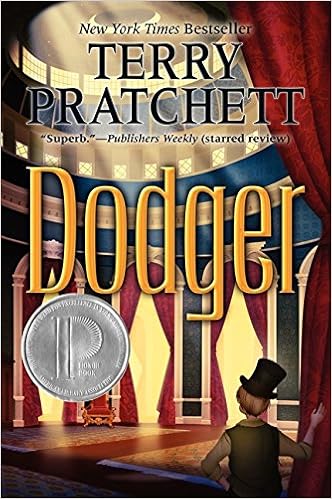
Dodger by Terry Pratchett

I admit to being slightly fascinated to find this other side of Terry Pratchett. I'm so used to associating him with  Discworld that these YAs are an interesting change. While less all out zany, there is still a surfeit of tongue-in-cheek humor in Pratchett's YAs.

Dodger is what Pratchett calls a historical fantasy. It is set in early Victorian England when conditions for the poor in London was scarily awful. The Dodger is a sort of sewer scavenger called a tosher albeit one who is unusually clever and quick thinking. Things change for him when during a storm he hears a woman's screams and rushes to her rescue. Successfully, I might add.

The woman ends up being more than she seems, of course, and things get complicated.

In a way the appeal to this book for me, an adult, is how it works on a meta level. Pratchett uses a large number of real historical figures in his narrative. One of these figures is Charles Dickens. This leads one to the natural connection from this Dodger to the Artful Dodger in Oliver Twist. Of course, this is all pure fiction, but it's amazing who knowing that influences the read of the story even for me who's never actually read the Dickens novel.

Also present is Queen Victoria (of course), Prince Albert, Sir Robert Peel, Henry Mayhew, and Benjamin Disraeli among others. While Pratchett is pretty clear about what is and is not historically based, his writing is so natural and convincing that it's easy to take it all as historical. I find that I want to read more on this age of British history.

Friday, November 3, 2017

The Seer of Shadows by Avi

There is something fun about a good ghost story. A ghost is a kind of puzzle in literature. They represent unfinished business and hidden nefarious deeds. I love it. It's a little strange to me that they've fallen out of vogue, but I haven't seen too many written just lately. This one, by Avi, is set during the height of spiritism's popularity in 1872 New York City.

Horace Carpetine is fascinated by the science of photography. Accordingly, this enterprising 14 year old gets himself apprenticed to a somewhat dubious photographer: Mr. Middleditch. Mr. Middleditch is lazy but also a good teacher. Horace learns to set up the glass plates and how to develop the negatives and prints. In fact the only thing he hasn't learned to do is snap the shots himself.

All this changes when a high society lady in mourning appears to arrange a photograph of herself for her dead daughter's grave. Mr. Middleditch immediately develops a plan using double exposures to create the image of the daughter's ghost. A hoax, in short.

Things quickly get out of hand and there is more going on than it appears. Are the images a hoax, or a real ghost after all?

This was a good, fast paced book. Chapters were short and first person narration helped the creation of suspense. While this is clearly a ghost story primarily, it also tackles some of the contemporary issues surrounding slavery.

Sunday, June 25, 2017

The Surrender Tree by Margarita Engle

The verse novel is a funny little genre. Its roots are in the ancient epics like Gilgamesh, the Iliad, the Odyssey, and Beowulf. These epics are culturally invaluable as a common literary thread and form a foundation for most of the western literary tradition. The verse novel is a separate modern tradition that saw its initial popularity in the early and mid 19th century. Then it faded out, but not completely. There's a steady trickle of examples through the twentieth century particularly in 60's (everywhere) and in the Caribbean.

A recent revival of the form has happened in YA lit starting in the early 2000's. There are dozens and dozens of examples at this point and I've had great success getting reluctant readers to read them. There's something about the greater white space on the page,the lyricism, and language play that works for kids who struggle finding books to read for the full range of reasons.

The Surrender Tree is the story of Cuba's struggle for independence from Spanish rule. It is a verse novel told from five points of view but mainly focusing on Rosa la Bayamesa who was an herbal healer hunted by the Spanish as an escaped slave. Rosa is a historical figure as are most of the characters in the novel and many of the events in the story are real historical events, but the narrative is highly fictionalized.

Rosa lived almost her entire life running from slave hunters and caring for the various refugees from the intermittent war with Spain. She didn't just help the Cubans either. She also helped wounded Spanish soldiers some of which defected to the Cuban side.

I liked the immediacy of the voice and the connection of the story to the jungles and healing plants. I got a real sense of the anxiety and hopelessness of the situation and various voices, all of them Cuban of one sort or another, gave different perspectives on the events. I didn't like what ended up feeling like a dearth of information. The verse novel can be a very sparse form for conveying historical context and I finished the book feeling a little like the characters existed in these little Cuba-scented bubbles.

Overall, The Surrender Tree is a good gateway text to Cuban history and an excellent example of the verse novel featuring the fairly typical multiple voice format.

Friday, June 2, 2017

Code Talkers by Joseph Bruchac

Let me start off by saying that war novels just aren't my thing. I find the whole notion of war pointless and depressing so reading about it in my fiction isn't high on my list typically. However, many of my students feel differently and I'm trying to push the boundaries of my current experience in YA. Code Talkers was donated to my classroom library and I try to read everything I place on my shelves for my students.
So, here goes.

Code Talkers is a historical novel written concerning an interesting piece of World War II history. I'm not sure how common the knowledge of Navajo Code Talkers are these days. I knew about it, but I pick up a lot of random information in my voluminous reading. It was however top secret for decades after the end of the war.

WWII was a war that relied on secure communications. Massive armies and all their support staff had to be in communication to a greater degree than ever before necessary. The problem was that the Japanese were really good at breaking U.S. codes and had prepared for the war by learning many of the languages spoken here including many of the languages of various Native American groups. However, one language they did not learn, because of it's incredible difficulty to learn, was Navajo. So the U.S. Marine Corps recruited groups of bilingual Navajo to develop a code that was underpinned by the Navajo language. The japanese never broke the code mostly because they couldn't understand the language that it was based on.

This book is a fictionalized account of one of these code talkers, Ned Begay. Ned's story starts when he was six and saying goodbye to his parents for the first time to go to Mission School. One of the goals of these schools was to stamp out the Navajo language with, one can only assume, the great goal of culturally integrating the Navajo into the U.S.'s European derived culture. Ned does well and becomes fluent in English. He continues on to High School, and when Pearl Harbor is bombed, he wants to join the fight. He does, and the novel follows Ned as he survives through the war.

According to Bruchac's Author Note, he had a hard time finding a way to write this story. He wanted to write a book about the Code Talkers but experimented with several different formats before settling on a novel. Apparently, the first draft was more history book than it was story. I think this struggle is evident in the text. The narrator, a much older version of Ned who is telling the story to his grandchildren, always seems oddly removed from the events of the story - almost dispassionate. I think this distance in the voice is a relic of the author's struggle finding a format.

Despite the dispassionate narrative voice, Code Talkers is a good account of the War for young readers. Additionally, it also introduces and addresses several issues about the U.S. treatment of the Navajos and attitudes about their culture including their forced relocation at one point and the campaign to eradicate the language. All in all, it's a good transition to fiction for students who tend to prefer nonfiction.

Thursday, January 12, 2017

The Book Thief by Markus Zusak

So Holocaust lit. I've said it before, this isn't my favorite genre. However, in the last few years I've had at least four students read The Book Thief for their independent reading. And... *sigh* ... I made a commitment to read what my kids are interested in.

So, I read it over the break.  It took me a total of eight days to get through. Now, I realize that sounds fast to most people. Let me put it in context. I read 160 (ish) books last year. That means that on average I read a book every other day or so. Realistically, an average nonfiction book will take me around five days, a novel takes about three usually, a YA novel in about a day, and I can usually read two middle readers in a day and still get other things done. So, for something billing itself as a YA novel to take me eight days is...odd.

The main character,  Liesel, is a lutheran but her parents are communists and after her father dies, her mother takes Liesel to a little town outside of Munich to be cared for by a foul-mouthed laundress and her gentle husband. Liesel eventually understands that this was done to protect her, but she's a kid and feelings of abandonment are inevitable.

She eventually adjusts, but she's a little girl living in Nazi Germany and things are complicated. The Book Thief's plot spans the war following Liesel's life. Oh, and it's narrated by Death who seems to have a soft spot for her.

Honestly, I don't think this is really YA lit. I'm not saying that it's inappropriate for a high schooler to read. It's a good book. It's just really dense, and while it has a youthful protagonist, that doesn't necessarily make it YA.

Every few chapters I found myself having to put it down to process the material and read something a little lighter. It's a worthwhile read but be prepared to process a lot of complicated and thorny issues. Zusak is unflinching in his depiction.

Thursday, December 29, 2016

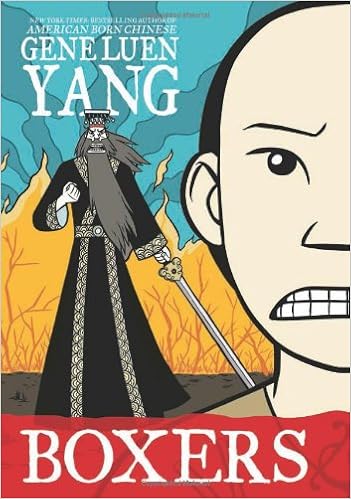
Boxers & Saints by Gene Luen Yang

Gene Luen Yang is famous for writing the graphic novel American Born Chinese which was the first graphic novel ever nominated for a National Book Award. Yang is currently serving as the 5th ever ambassador for young people's literature (a Library of Congress designation).

Boxers is about the the Boxer Rebellion in China (1898) which happened when swarms of foreign missionaries and soldiers basically took over China and bullied chinese peasants. Little Bao watches the missionaries and chinese converts basically destroy his family and harass his village.

Bao joins, and eventually leads, a group of kung fu trained peasants who march on Peking. In terms of the story, the peasants are actually possessed by various chinese deities. While strange, it does a good job of emphasizing the conflict between two very different cultures. Yang does a good job of showing the desperation and outrage of the chinese citizenry as well as the unbelieveable rumors going around the demonized the white missionaries.

It's a bit of a downer and the fantastical elements are sometimes very jarring. However, it's also quite good.

The plot line of Saints overlaps with the story of Boxers. Vibiana, born as Four-Girl, was the unwanted girl child in a large family. She didn't even have a proper name and, while not actually abusive, she wasn't nurtured or feel loved. In fact, she is often called a demon and even comes to believe and embrace her "demon" nature

At least not until she encounters Christianity. What starts out as a way to escape her family and snag free cookies soon becomes a full conversion of faith. However, Vibiana soon discovers the flaws in her adopted faith/culture.

In many ways, Yang depicts the missionaries as sympathetic but flawed people. It's never as simple as good vs. evil and Yang conveys that.

Thursday, November 3, 2016

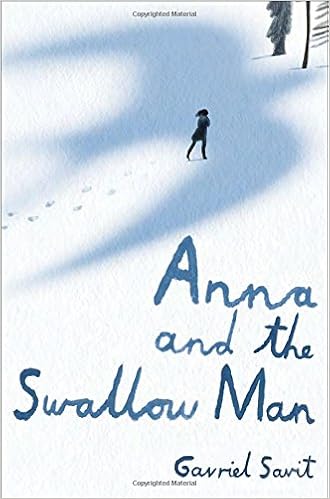
Anna and the Swallow Man by Gavriel Savit

Ok, so this is another book that Ansley handed to me... and then got pretty feisty with me until I read it.  (And I thought I was a demanding promoter of lit, sheesh) I have to admit the girl has good taste in literature.

A few years back I got a little done with what I've been calling Holocaust Lit. It's not that I think it's overrated, or bad, or even boring. I just don't enjoy reading it. I can handle sad tragic lit. I love a good cry when I'm not crying over me. The Holocaust though, is on a completely different level from run of the mill tragedy. The reality is that most human tragedy is caused by the people/victims involved. Their choices, while ultimately flawed, make sense to us which is the source of the pathos.

The Holocaust was not tragic in that sense. Nothing those people/victims did warranted or invited what happened to them. It was a senseless reminder of how close to mindless beasts we still are. People talk about it like it couldn't happen any more, but I look at our current political situation here and I feel that we are all too close.

I'm getting off point.

Anna and the Swallow Man is set in Poland right after the Nazis rolled in and carted off all the intellectuals. Anna's father is an intellectual. A linguist to be precise. Anna, as his daughter, already speaks five or six languages by the time she is seven and her father simply disappears. Now a seven year old alone in Nazi Occupied Poland shouldn't stand a chance of survival, but a chance encounter with a strange spindly man with chameleon like powers of adaptation leads to an informal adoption. The pair tramp around the Polish wilderness living off the land and gently swindling people into giving them what they otherwise need. A moving target is hard to find, after all.

The Swallow Man is a vaguely sinister figure. While it is clear that he truly cares of Anna, I never find myself feeling comfortable with their relationship. Perhaps that's the point. Under those circumstances, what does trust really  look like.

I haven't really absorbed the ending yet. I'm not sure what Savit was getting at with it, but the book as a whole is a worthwhile read. Even with my issues reading Holocaust Lit, I found myself drawn in enough to finish it in a an evening.