Showing posts with label male protagonist. Show all posts

Saturday, June 9, 2018

The Fifth Elephant by Terry Pratchett

I was just saying that I hoped there would be more novels set in Uberwald and here it is. How pleasing.

Commander Vimes of the city watch is being sent to Uberwald in his capacity as a Duke and being asked to be an ambassador to the coronation of the low king. Vimes is not what one would call a natural diplomat and he is like a bull at high society functions, so his appointment as an ambassador seems eccentric.  Of course the enigmatic Patrician, Vetinari, has his reasons. He always does.

In the meantime, Angua has gone missing. She's a werewolf and this Uberwald business is in her home territory. She's called away by an old friend to deal with some family trouble leaving Carrot without a word. Carrot, being Carrot, isn't angry but when he finds out where she's headed, he heads out after her leaving the City Watch in the hands of Sergent Colon.

Colon does his best to rise to the occasion, which ends up about as well as can be expected. In total chaos.

The Fifth Elephant is a mix of political intrigue, detective who done it, and an adventure story. Faster paced than usual for a Pratchett novel, I blasted through it in about two and a half days on intermittent reading.

This Discworld novel makes me feel like an idiot. As a general rule, a large piece of the joy in Discworld novels is noticing the interplay between the text and things that Pratchett is referencing in that text. Up to this point he's played with Shakespeare, world politics, B horror flicks and everything in between. I heartily enjoyed The Fifth Elephant but I could not spot a single allusion or literary reference. I'm convinced they have to be there....I just can find them. It's frustrating.

Wednesday, May 2, 2018

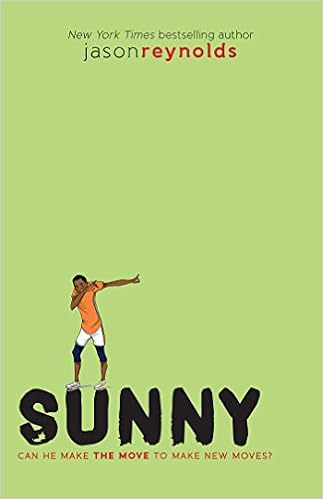
Sunny by Jason Reynolds

Part three in the four part Track Series by Jason Reynolds, Sunny  just came out at the beginning of April. That makes this unusually fresh read for me. I generally wait with great patience for prices to come down, but this one was a media center purchase and I swiped it. In my defense I waited a whole three weeks.

Each of the four books follows a different character and is named for that character. These four kids are the new members of the community track team. I have to admit, of the four characters I was least looking forward to Sunny. I mean Ghost starts it all off and he's an amazingly compelling and sympathetic character. Patina comes next and she's super sassy coupled with an interesting home situation. But Sunny.

Sunny is just weird. He's this super smiley kid who seems to react weirdly to the events in the other two books. There's just something off about him.

To give Reynolds credit, he really works with that for this book. Sunny is written as a series of diary entries but I swear the kid is suffering from synesthesia. He interprets everything as sound, but it does enliven the diary entries.

Sunny also has an interesting back story. His mom died giving birth to him and he lives in a giant house with his father, Darryl. He's also home schooled. (I'm not inherently opposed to the idea of homeschooling but I have to admit that as it is described here I have to wonder what the kid is actually learning.) All of this accounts some for his weird affect.

This is a good quick read. The diary entries are short providing a lot of breaks and the subject matter is relatable.I'll be interested in how Reynolds closes out the series.

Saturday, April 7, 2018

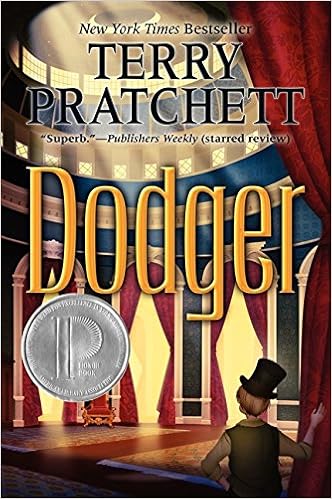
Dodger by Terry Pratchett

I admit to being slightly fascinated to find this other side of Terry Pratchett. I'm so used to associating him with  Discworld that these YAs are an interesting change. While less all out zany, there is still a surfeit of tongue-in-cheek humor in Pratchett's YAs.

Dodger is what Pratchett calls a historical fantasy. It is set in early Victorian England when conditions for the poor in London was scarily awful. The Dodger is a sort of sewer scavenger called a tosher albeit one who is unusually clever and quick thinking. Things change for him when during a storm he hears a woman's screams and rushes to her rescue. Successfully, I might add.

The woman ends up being more than she seems, of course, and things get complicated.

In a way the appeal to this book for me, an adult, is how it works on a meta level. Pratchett uses a large number of real historical figures in his narrative. One of these figures is Charles Dickens. This leads one to the natural connection from this Dodger to the Artful Dodger in Oliver Twist. Of course, this is all pure fiction, but it's amazing who knowing that influences the read of the story even for me who's never actually read the Dickens novel.

Also present is Queen Victoria (of course), Prince Albert, Sir Robert Peel, Henry Mayhew, and Benjamin Disraeli among others. While Pratchett is pretty clear about what is and is not historically based, his writing is so natural and convincing that it's easy to take it all as historical. I find that I want to read more on this age of British history.

Monday, March 19, 2018

An Abundance of Katherines by John Green

Ever since my childhood, being stuck home sick meant one thing... reading. I used to read Alice's Adventures in Wonderland over and over when I was sick. Something about reading surreal literature while suffering a fever is pleasurable. I read other things now. Sometimes I manage some really excellent insights. Maybe it's the boredom.

I finished off An Abundance of Katherines today.

Colin Singleton was a child prodigy and has date (and been dumped by) 19 Katherines. After the most recent dumping tosses Colin into a morass of existential despair, his friend Hassan decides the best cure is an aimless road trip. Colin agrees and so off they go.

They leave Chicago and end up in Tennessee, so they didn't get very far. However, they get unlikely jobs recording the stories of the citizens of Gutshot, Tennessee and living in their bosses mansion.

Colin's a strange kid. He's incredibly morose for a main character and obsessed with anagrams and "being somebody." Having been a prodigy, he now wants to be a genius and create something with a lasting value. I can sympathize. However, he's so obsessed that he could easily become an irritation, if it weren't for the footnotes. A lot of the novel's humor is in the footnotes which are entirely in Colin's voice. Apparently, in this book prodigy means font of interesting facts and statistics.

My grand insight for An Abundance of Katherines is that John Green seems to really like the idea of a road trip as a plot device. Both An Abundance of Katherines and Paper Towns feature a road trip of some sort and there's a lot of travel by car in his other books as well. I suppose metaphorically a road trip could represent a break with the status quo or from old patterns. Symbolically, the act of leaving one's home (or childhood) could be a literal trip or voyage. Most of Green's novels can be read as coming of age stories, so perhaps that last one is the most valid.

Tuesday, March 6, 2018

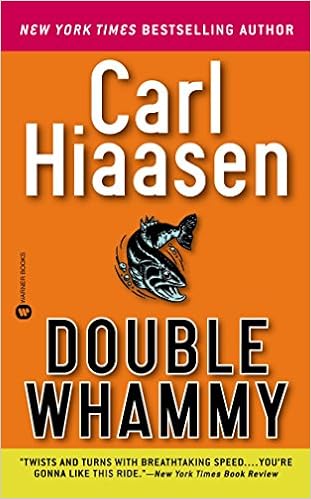
Double Whammy by Carl Hiaasen

Carl Hiaasen is one of those authors that Ryan has been trying to get me to read virtually since the day we met. I've picked up his first book, Tourist Season, several times, but haven't been able to get traction on it. Hiaasen's YA material, however, is another story. I love it all. It's fast paced, features engaging characters, and deals with environmental issues in a savvy responsible way. One of those, Skink: No Surrender, features a character that started out in his non-YA books. So, this is backtracking to the first appearance of Skink.

Double Whammy is about bass fishing. No, really. Bass fishing. I know know more about bass fishing than I ever wanted to. R.J. Decker is a down on his luck private eye with an anger issue. He's hired by a sportsman named Gault to catch some cheaters in the act. This isn't an amorous thing, this is about cheating at big fishing tournaments. It's weird, but pretty straightforward. At least it is until dead bodies start showing up.

Decker meets up with Skink as a sort of local guide. Skink is big, hairy, and slightly crazy, but he has a nice smile and a quick mind. As odd-ball as he is, he takes to Decker's case and soon finds reasons of his own to help out.

I've never really understood people who watch fishing shows for entertainment. I get why fishing is appealing, but the idea of watching people fish on T.V. dumbfounds me. This is a view that Hiaasen seems to share. There's a snarky sarcastic angle to all this where the main characters seem to be bemused on some level that anyone would bother this much for sport fishing that appeals to me.

Skink is a draw too. For such a bizarre character, he's fun to watch. It's like watching disaster walking around in human skin. He's a survivalist who seems to live off of fresh road kill and a manic conviction that the world would be better off without humans. I like him.

Obviously, this isn't intended for a young audience, but I can think of plenty of teens that would love this.

Tuesday, February 27, 2018

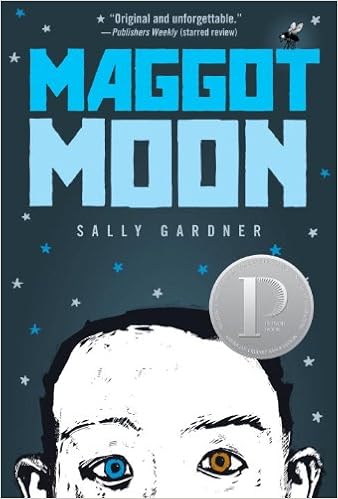
Maggot Moon by Sally Gardner

This another book I found through the Printz Award. I didn't know much about it when I picked it up but, as I've mentioned before, I generally trust the Printz Award.

Maggot Moon seems to be set in an alternate version of England where the Nazi's won world war II. I'm not sure about that, but it seems to be the general feel of it. In this version the Motherland rigidly controls society and schooling. "Impurities" are weeded out at a young age and Standish, the protagonist, has two impurities. The obvious one is that he has one blue eye and one brown. The less obvious impurity is that he appears the be severely dyslexic.

Life is pretty rough for Standish until he meets Hector. Hector is about as different from Standish as possible. He's handsome and has smooth manners. He does well in school and the bullies don't bother him. He and his family moved in next to Standish and his grandfather. The two families quickly become friends and band together. Hector's family has a secret though and one day the family is taken. Taken usually means dead.

Soon, Standish gets wrapped up with the secret and the Motherland's efforts to land men on the moon. Only, it's not what everyone thinks and Standish wants everyone to know.

This was a rough read. It's playing with a lot of difficult themes. Primarily though it's about sacrifice. When people have nothing, they still have something to sacrifice if the reason is important enough. I'm not sure how I feel about ending, but there is no denying that it is a powerful book.


Tuesday, February 13, 2018

Shadow of the Red Moon by Walter Dean Myers

I discovered Walter Dean Myers later than the usual reader. He'd been writing since the early 70's but I didn't discover him until after his death in 2014 when I picked up Monster on a whim. Monster blew me away but it also made it clear to me why I missed out on him when I was younger. Myers's books tend to have male teen-aged protagonists who are often African American. In short, I wasn't in the audience he was aiming for. It's a shame really, because Myers is an excellent writer who tackles difficult subjects with great compassion and sensitivity.

I can't recommend the guys books more. Really. Go read one of his books.

However, Myers is not known as a writer of genre fiction so when I ran across what looked like a fantasy story by him, I snapped it up.

Shadow of the Red Moon is set in a fantasy world after a meteoroid hit the planet sinking it into a ice age. After the ice age abates, the remaining people are hit by a plague. The Okalians are safe behind their crystal walls until they find themselves under siege by the Fen. With things looking dire, the Okalians send out a group of teenagers to try to find the Ancient Lands that their people apparently originally came from. Jon is a member of that group.

He quickly teams up with Lin and Kyra, two siblings on the same mission and they cross territory on foot accompanied by a black unicorn they name Shadow and avoiding groups of Fen. Jon soon finds himself questioning he's peoples cherished beliefs. Are the Okalians really the heroes of their story of exodus or did they run away? Are they better or just luckier? What is it that makes them better?

So, I guess there is a reason that Myers wasn't known for fantasy. This is, by far, not his best book. It's deeply philosophic but the sparse narrative doesn't allow much time or space to really get to know the world. The characters move from one disaster to another and meet other characters that quickly pass back out of the narrative without leaving much of an impression. In general, I just didn't feel very interested or invested in the characters, including the protagonist Jon.

The questions that Jon struggles with are interesting. He's wrestling with what his people believe and discovering that his people's interpretation of events isn't the only possible one. Myths, really. What do you do if the things you believe are true, end up under suspicion?

Despite the interesting philosophic questions, I wouldn't recommend this to anyone. Mind you, I wouldn't try to stop someone from reading it either. I'm pretty ambivalent about the whole experience

Monday, January 22, 2018

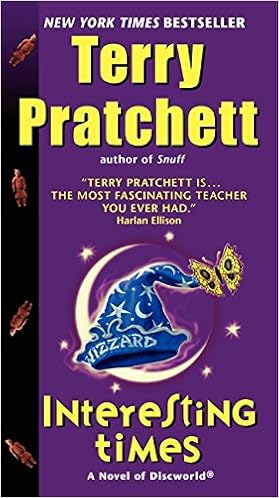
Interesting Times by Terry Prachett

Ok, the time has come. I'm taking a stand. The Discworld series is not YA! (So, now there are a bunch people sputtering in their beverages that anything involving puns, wizards, and self-animated walking luggage has to be YA and a whole other group of people rolling their eyes and saying "well, duh! Of course it isn't")

See this is the problem with classing things by age. What's the cut off and how does one go about defining it?

Here's my reasoning for Discworld. It's really quite simple. When I first read this series I was 16. I didn't hate them, but I also didn't get why they were supposed to be funny. Reading the series was a long boring experiment in cross-cultural befuddlement.  Over the course of a couple years I got about as far as Soul Music before apathetically throwing in the towel. I'm now in my late 30's, more than twice the age I was then, and I love them.

The difference is that now I get the jokes. Part of that is that I'm just older and all the protagonists are fully adults. It resonates more. Part if is that I've watched a great deal more BBC programming. So, I'm more familiar with British humor in general. The biggest reason though is that I've read a great deal more literature and history. Most of the jokes involve a frightening breadth of literature. To get the jokes, one has to be fairly well read and, as much as I read, I think I'm missing things still. What teenager has read more in their less than twenty years than I have in my slightly less than 40 years?

So, NOT YA!

Alright, enough of that.

Interesting Times is a Rincewind book. It starts out with the gods of luck and fate sitting down to play something that seems like chess. The "board" is the empire on the counterweight continent, which is where Twoflower came from in Colour of Magic. Fate has all the noble families of the empire. Luck has Rincewind, Cohen the Barbarian, a horde of geriatric barbarians, and the red army. Things then play out as they often do in Pratchett's books. By which I mean, a string of seemingly unrelated an ridiculous things happen that in the end all come together like the pieces of a puzzle box.

The Agatean Empire is clearly modeled after the imperial Chinese court and so this all made me slightly uncomfortable. Pratchett is a satirist and poking at another culture this way just gives me the willies. That's not to say that it wasn't all very funny, because it was. It just made me squirm a little. It was, however, fun to get all the characters back from the first book for a kind of character reprise.

Good read, but not a quick one. Humor relies on a passing familiarity with Imperial Chinese history and culture and some knowledge of Sun Tzu's The Art of War. The biggest challenge for adolescent readers is the lack of chapter breaks. There are no chapter delineations, just text breaks when Prachett picks up with a different point of view character.

Friday, January 19, 2018

Peeps by Scott Westerfeld

I initially heard of Scott Westerfeld because of his highly popular "Uglies" series. I read all of that series last year. It was a decent dystopian YA, fun but not super impressive. It was good enough that I've been idly keeping an eye out for more of his books. That's how I found Peeps, browsing through the BookNook.

Peeps blew me away. I have to admit, when I read the back cover and it mentioned vampires, I groaned a bit on the inside. I actually like vampire stories, but Twilight deeply scarred me on YA vampires and I just haven't recovered yet. However, Peeps is nothing like Twilight. In fact, there are almost no supernatural elements at all. This is straight up science fiction.

What if all the legends about vampires and werewolves and what not all had a common source. That source would be something like a disease or a parasite that not only changed the victim's physiology but also their cognitive functions. In Peeps, a parasite causes what people think of as vampirism. These victims gradually go insane and shun everything they used to love. They have insatiable hunger and crave meat including the meat of other humans.

However, 1 out of every 100 humans has the capacity to become a carrier. These carriers get several of the perks of the parasite (acute senses, super strength, increased life span, and a diminished capacity for fear) but never get the rest of the symptoms or go insane. These carriers track down the rest of the parasite positives - or peeps - and get them treated.

Enter Cal. Cal's a carrier and 19. He starts the novel in the process of hunting down all the people he accidentally infected before he knew he was a carrier. Once he achieves that, he has to track down the one who infected him, his progenitor. During the search he finds a building with a mysterious iron door sealing a pit into the depths of the city and infested with parasite infested rats.

I really enjoyed this. The story kept me enthralled but I really liked the way Westerfeld structured the book. The odd numbered chapters carry the story, but the even numbered chapters are these little two or three page micro-essays on various topics concerning parasites. They are delivered in Cal's voice and are, as far as I can tell, factually correct. The risk with structure is that it detracts from the story, but the topics are inserted in such a way that they reflect on events happening in the story. It's a fun contrast. Even though parasites are kind of yucky to read about, I wouldn't dream of skipping them. The narrative wouldn't be as strong without them.

Friday, January 12, 2018

Crooked Little Vein by Warren Ellis


Having read and blogged Gun Machine, Ryan reminded me that we also owned Warren Ellis's other novel Crooked Little Vein. Actually it occurs to me that for all that I read voraciously, Ryan and I haven't read many of the same books. It's an oddness. We tracked down Crooked Little Vein for Ryan soon after it came out. He read it and liked it, but I never got around to reading it myself until now.

I expected Crooked Little Vein to feel similar to Gun Machine and it did, to an extent. It's another hard boiled detective novel. Michael McGill is a private detective with incredibly bad luck. He keeps walking into the random, embarrassing and bizarre. When a creepy government type turns up and offers McGill half a million dollars to find an antique book, McGill soon finds himself wandering into every impossible den of depravity and sexual deviancy.

So, if I was mildly shocked by the amount of foul language in Gun Machine, Crooked Little Vein was on a whole different level. It was one awful uncomfortable situation after another. Generally, I would find such a thing gratuitous and it would annoy me, but Ellis found a way to write a story that made all the awful oddly necessary. That's a skill, a very weird and very specialized skill, but a skill none the less.

I think there are two things that make this novel work. First, the search for the missing book is really pretty engaging. The book is an alternate version of the Constitution written in secret by the founding fathers with ability to make anyone who reads it more moral and innocent. What it comes down to is thought control which raises some ethical issues later in the story. Second, Michael McGill is just a really likeable character. He's this strangely normal guy who keeps finding himself in all these bizarre situations. His reactions are genuine and somehow show him it be a really good guy in the midst of it all.

So, I will never ever admit to my students that this book exists. It's that far off the deep end in so many ways. That being said, I enjoyed reading it so much that I finished it in a single afternoon.

Thursday, January 11, 2018

Paper Towns by John Green

John Green is one of those authors. He has a following. His fans are. . . persistent. Just before The Fault In Our Stars was released as a movie, various of my students and friends started pestering me to read the book. They even gave me copies of it. I have five copies of the thing. Now, anyone who knows me, knows that insisting that I read or watch something too persistently tends to backfire. It's a weird perverse impulse, and I get stubborn about it.  However, I really try to read the books that my students recommend so I fought through it and read the book. It was good; it even made me cry.

So, now I'm gradually working through all of Green's books.

At its core Paper Towns is a mystery. It starts with the introduction of Quentin Jacobsen and the enigmatic Margo Roth Spiegelman. When they are 9, they stumble across the dead body of a suicide in a park. The two kids respond to this in very different ways.

Fast forward eight or nine years. Quentin and Margo are both seniors getting ready to graduate. They are not friends. In fact, they haven't really interacted since that fateful discovery in the park, but Quentin is still hopelessly in love with the idea of Margo. So, is anyone really surprised that when she shows up one night with a crazy plan  for a prank rampage that Quentin lets himself get sucked in. I'm not. Sounds like the beginning to a high school romance except that after that crazy night of pranks, Margo disappears.

No one knows where she is, but she left Quentin clues. He becomes obsessed with following those clues

A couple things about this. First, Green has actually made me want to read  Walt Whitman. I do not have fond memories of that man from American Lit, but a substantial section of Paper Towns revolves around "Song of Myself" from Whitman's Leaves of Grass. The sections described were interesting. It's possible that 20 years ago when I had to read it for class, I just wasn't ready for it. Second, for something calling itself YA, Paper Towns is terrifically philosophic.

In the search for Margo, Quentin spends a lot of time thinking about how he never really saw her as a person and that his obsession was with the idea of her. This ties directly into Whitman's "Song of Myself." It comes back again and again this idea of being perceptually trapped behind our own masks and limited in our ability to recognize the reality of others. Perfect idea for teens who are naturally struggling with identity but still. . .heavy stuff.

Monday, January 8, 2018

Gun Machine by Warren Ellis

I love clearance sales. I particularly love clearance sales at used bookstores. 2nd and Charles, both locations near me, have excellent selection and an almost arcane reasoning for placing things in the clearance sections. For example, I found a brand new Meg Rosoff novel and one of Warren Ellis's novels in perfect condition.

I immediately dove into the Ellis novel and couldn't put it down. Warren Ellis is more well known for writing graphic novels such as Transmetropolitan and Fell but he has also written two novels. I tend to appreciate Ellis for his unabashedly brutal treatment of politics and power dynamics. He has a wicked sense of humor that he bends to his subjects and characters. And he has a severe case of potty mouth which I appreciate in certain settings.

Gun Machine is a gritty cop intrigue that borrows heavily from the hardboiled and noir novels of early and mid twentieth century. Detective John Tallow is world weary and disconnected until his partner dies in front of him leading to the discovery of a cache of hundreds of guns that have each been used to kill exactly once. Tallow is deeply intelligent but not in a way that stretches credibility and slightly crazy in damaged by life kind of way. He reminds me both of Dashiell Hammett's Philip Marlow and Ellis's own Spider Jerusalem (albeit more lucid and less insane).

The plot is pure intrigue and conspiracy. Tallow has to figure out the identity of the most successful serial history to prowl the streets of Manhattan.  Question number one is how did this killer manage to escape notice? Who's protecting him and why? The answer to these questions get Tallow deeper into a mess of department infighting and corruption.

This was a fun read. If I have one criticism, it is that they interplay between Tallow and his two CSU sidekicks is highly reminiscent of the relationship between Ellis's three main protagonists in Transmetropolitan: Spider Jerusalem, Yelena, and Channon. It's not much of a criticism really since that was a very fun set of characters too but it all did kinda feel like a lost issue of Transmetropolitan.

Nice quick read with short chapters. There's plenty of action to keep things moving, but Tallow's a thoughtful enough character that there's plenty of solid exposition to ground the narrative.Because of the copious amounts of foul language and violence, I can't put it in my class library, but I would give it to the occasional student.

Sunday, January 7, 2018

Bullyville by Francine Prose

Bullying is one of those hot topic issues right now. Every year we have to do a program with the students about the effects of bullying and the tendency of people to be silent bystanders. It's a good idea and probably a good approach but I'm not sure of the effectiveness of it all. The idea is that successful bullying relies on people not wanting to get involved. So if bystanders speak up for the victims then the bullies are defeated. Huzzah! Except as far as I can tell, it just makes the bullies sneakier or favor things like internet trolling.

When I was a teen/pre-teen I was bullied. Not horribly, but it happened. It's a part of growing up. I dealt with it mostly by ignoring them and getting even in small subtle ways. Mostly, I just holed up in the school library and made it difficult for them to find me. It worked, but it worked because I grew up in an age where they mostly had to physically find me in order to bully me. With the internet and social media, that is no longer the case. No matter how bad it was on a given day, it ended when I got home. That's not true any more.

So, I don't know what the answer is for these kids. My current tactic is to stock my classroom library with stories dealing with bullying as a theme on some level. Bullyville is one of the books I picked up for that. I'd never heard of it or its author, Francine Prose. I am, however, always game for something new.

The main character, Bart Rangely, is a pretty inherently tragic figure. His estranged father dies in the North Tower during 911. As a result, Bart is offered a free ride at a local exclusive prep school. He goes, of course, despite the schools well known reputation for producing bullies. Our boy Bart ends up under the care of the worst bully at the school. Thus begins the absolute worst year of Bart's life.

Bart doesn't just turn into a pile of mush though. He does fight back, and as a result, ends up finding out more about his tormentor and probable motivations.

What I like about this book is that Prose didn't feel the need to tie it all up in the end with a nice bow and a fairy tale ending. It's messy and she lets it be messy. While the situation resolves for Bart, there's no sudden character flips or kumbaya moments. The bully is a bully and he is not redeemed.

This is a good treatment of the themes and a readable book. It's a good addition to my classroom library.

Friday, November 3, 2017

The Seer of Shadows by Avi

There is something fun about a good ghost story. A ghost is a kind of puzzle in literature. They represent unfinished business and hidden nefarious deeds. I love it. It's a little strange to me that they've fallen out of vogue, but I haven't seen too many written just lately. This one, by Avi, is set during the height of spiritism's popularity in 1872 New York City.

Horace Carpetine is fascinated by the science of photography. Accordingly, this enterprising 14 year old gets himself apprenticed to a somewhat dubious photographer: Mr. Middleditch. Mr. Middleditch is lazy but also a good teacher. Horace learns to set up the glass plates and how to develop the negatives and prints. In fact the only thing he hasn't learned to do is snap the shots himself.

All this changes when a high society lady in mourning appears to arrange a photograph of herself for her dead daughter's grave. Mr. Middleditch immediately develops a plan using double exposures to create the image of the daughter's ghost. A hoax, in short.

Things quickly get out of hand and there is more going on than it appears. Are the images a hoax, or a real ghost after all?

This was a good, fast paced book. Chapters were short and first person narration helped the creation of suspense. While this is clearly a ghost story primarily, it also tackles some of the contemporary issues surrounding slavery.

Thursday, July 6, 2017

Booked by Kwame Alexander

I've been delving into this Verse Novel format more. It's a strange way to read a story and not at all like the epics I teach. When I first heard of it, I thought it would be clumsy and difficult for a young audience in the same ways that reading the epics are. I was wrong.

I was wrong because my assumptions were flawed. Epics are difficult for younger readers because of the use of poetic conceits and need for abstraction in approaching even basic plot points on top of overarching difficulty with approaching a fundamentally alien culture that happens with any translated literature. Verse novels are a new format for YA so the text is written with a contemporary YA audience in mind. I'm not sure how well they will wear as time marches on, but for now they are very accessible. The authors have mostly dispensed with poetic conceits by entirely writing in a straightforward blank verse. While descriptive and expressive language is still of primary importance, the use of metaphor and simile tends to be used more sparingly and with more in-text explanation. The result is actually more concrete than prose in some cases because the poetry format allows a more direct description of character emotion without feeling heavy handed. Couple that with the greater amount of whitespace on the page and it explains why this format is so successful with struggling readers.

Of course some examples of the format are better than others. After reading The Crossover,  I immediately picked up Alexander's other verse novel: Booked. It's an excellent book, but not as emotionally devastating as The Crossover.

Nick Hall is a middle school soccer star. His dad is a linguistics professor and his mother is an out of work horse trainer. All Nick wants to do is play soccer, but when his mom leaves the house to take a job, Nick's relationship with his dad gets strained. Add on top of that a couple of neighborhood bullies and Nick is having a rough year.

I liked how intelligent Nick was. His voice felt appropriate for a 13 year old boy, but his approach to issues was more than usually thoughtful and his expression more articulate (thanks to his father's word obsession). While he rebels a little at the academic expectations, he also revels in his use of words which is a lot of fun to read.

The bully angle is not the primary focus of the book, but the subplot is well handled and resolves well. Overall, it's a good read.

Wednesday, July 5, 2017

Chomp by Carl Hiaasen

Once I read one of the Hiaasen YAs, I had to go looking for the rest of them. Mainly, I wanted to make sure they were stand alone novels and not part of some series. Turns out that they are all stand alones, which for my purposes, is a good thing.

Chomp is about Wahoo Cray, the son of a professional animal wrangler. Apparently, this is a real thing. Animal wranglers are professionals who work with non domesticated animals by removing them from inappropriate locations and, in some cases, rehabilitating injured animals and training them. These animals are then sometimes used as stand ins for their wild counterparts in nature shows and documentaries. Who knew? I learn something new every day and from the strangest places.

Anyway, Wahoo's father gets hired to wrangle for a reality tv show reminiscent of "Crocodile Hunter."  The difference is that Steve Irwin was actually a fairly competent wrangler himself. Derek Badger, the TV personality in Chomp is a egotistical and generally useless person who I pretty much immediately wanted to punch in the face. Wahoo's dad seems to agree with me. 

Wahoo and his dad have to keep this yahoo alive in the Florida Everglades as everything proceeds to go wrong.

This is a fast paced book. As always with Hiaasen's YA, ecological concerns are front and center but not the main thrust of the plot. There were two things that I found particularly interesting. First, apparently Burmese Pythons have become a major invasive species in southern Florida. I used to keep a ball python when I was younger. However, I lived in Michigan so if my python got away from me, it was unlikely that it was going to have much of an environmental impact. South Florida however has a very hospitable climate to a python's way of thinking. The problem is that the Burmese Pythons get big enough to successfully kill a human and have no natural predators in the Florida everglades so they are pretty much running rampant. There is an actual campaign to exterminate them. Interesting stuff.

Second, Chomp really got me thinking about nature programming and reality tv. The line between educational/informational programming and entertainment has become blurred in recent years. This is having many deleterious effects.  Nature shows, like the one described in Chomp, encourage a certain contempt for the natural world. I think when they started, the idea was to educate and raise awareness, but somewhere along the way, they turned into idiots doing stupid dangerous things and surviving it. I'm not opposed to entertainment, but when it's presented as fact oriented educational programming, people believe it's real.  This is a problem and it's one that Chomp obliquely addresses.


Tuesday, July 4, 2017

The Crossover by Kwame Alexander

I have Richie, our school's athletic director and varsity basketball coach, to thank for finding this one. He got our librarian to buy a couple of copies for his basketball team. I'm not sure how that worked out for him, but I'm glad he got the books into our collection. I've found this an invaluable text for my athletic boys and yet, I hadn't actually read it. Until now.

I think most people when they are just learning to be a reader self choose texts that have characters they can identify with in some way. It doesn't have to be as simple as gender, age, or ethnicity. It can be something nebulous like a personality quirk, but no matter how small, some sense of commonality with the characters draws in the readers. Later, as a reader develops, they become more adept at finding points of connection with the literature. Everything gets easier with practice.

That being said, reading literature with protagonists who are very different from oneself, can be draining even if you enjoy the story. This is why I can only read a few sport boy books in a row. I very much enjoy them because they remind me of my students, but I don't tend to have many points of commonality with athletic teenage boys. As a result, I have to spend more time thinking about what's happening in the story which keeps me from fully immersing in the text.

The Crossover was surprisingly easy to immerse in. Josh and Jordan Bell are twins who both have a passion for basketball. The story is told through Josh's poetry. Being twins they have a close relationship but things begin to change as they look towards beginning high school. They growing apart.

I always worry that the verse format will be distancing. Poems are lovely, but they often require a focus on the words to decipher the meaning. However, Alexander's poetry has the opposite effect, it draws the reader in.  Because they are poems, the writing is closer to Josh's emotions without feeling overblown.

I see why my boys are so enamored of the book: lots of white space on the page, fast paced, yet sophisticated themes.

Monday, July 3, 2017

Skink: No Surrender by Carl Hiaasen

There is this crazy subgenre of gonzo crime caper novels mostly set in Florida. These books are brutal and absolutely enthralling. While they are no more violent or bloody than other books in the horror or crime genres, I find them much more disturbing for the bizarre inventiveness of the crimes. For example, in one book a woman is murdered by having fix-a-flat sprayed down her throat and into her lungs which sounds like an awful way to go. There are a handful of authors in this genre. Apparently Florida is a pretty wacky place.

One things I can conclusively say is that this genre of books is not YA. However, one of the authors of the genre, Carl Hiaasen, has written a few highly regarded YA/middle reader books. I was intrigued and picked up Skink: No Surrender for cheap on my recent buy. It was a quick read and indeed totally appropriate for YA/Middle readers.

Skink is apparently a recurring character in some of Hiaasen's nonYA but the main character of this book is actually a kid named Richard. Richard's friend/cousin Malley has run off with some guy she met online. Malley's a bit of a wild child so no one is really surprised that she ran off, but her friends and family are understandably worried. Richard, after doing some online research, becomes increasingly alarmed and eventually goes out to look for her aided by Skink.

Skink is a mentally unhinged ultra moral eco-warrior. A self-styled vigilante who protects Florida's wilderness from litterbugs, poachers, and industrial polluters. Apparently, he's quite out of control in the non-YA books. However, in this book, he serves as a kind of guardian-protector for Richard as he tries to rescue Malley.

This is a fast paced adventure story featuring a series of unlikely but highly amusing events. As bizarre as Skink is, the interaction between him and Richard is not creepy at all. It's a good book to hand teens as it illustrates the dangers of online predators without being at all heavy-handed.

Sunday, July 2, 2017

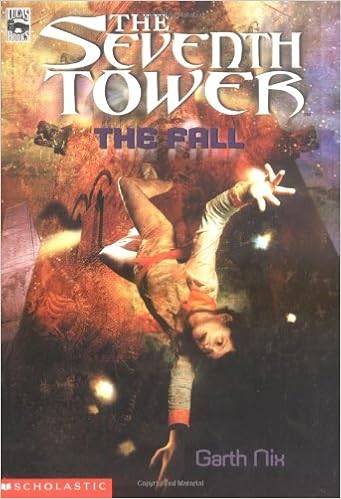
Series Review: The Seventh Tower by Garth Nix

It seems like when I mention Garth Nix to the readers in my sphere, everyone has read a different one of his books. Wilfrid handed me Sabriel. Ben recommended Shade's Children which I'm still trying to find. Jessica handed me these books, "The Seventh Tower" series.

Tal has problems. His father is missing and his mother is sick. In order to get out of his trouble, Tal needs a 'primary sunstone.' In this world, the sunlight is blocked from the surface of the planet by a magical black veil. The sunstones are almost exactly what they sound like, stones that store light in the form of magical energy. Tal's people, the Chosen, have a highly regimented and organized society to manage teaching and using the light-based magic. At the bottom of the organizational ranking are those who cannot use magic at all, the Underfolk. If Tal can't get his sunstone, the whole family will slide down to Underfolk status. So, Tal decides to steal one.

However, it all goes wrong when Tal falls off the tower where the sunstones are grown and ends up on the frozen surface of the world where he meets Milla, a combative member of the Icecarls. Now Tal is stranded on the surface and he still needs a sunstone.

I'm trying to get away from the series review format. I don't think, in general, that I do justice to the books when I'm writing them, even if I really enjoy the series. However, with this series, it really all felt like one very long YA novel that got chopped up into six books. This is not the first time that I've felt this way about a YA series. I think that publishers have imposed a length limitation on individual novels regardless of the size of the story particularly for the younger end of the audience group.

As a side note, since discovering Garth Nix in February of this year, I've now read a total of 20 Garth Nix novels. I've enjoyed it, but I think it's time for Garth Nix break.

Friday, June 23, 2017

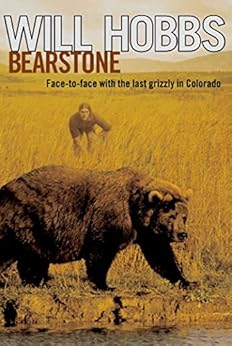
Bearstone by Will Hobbs

Sometimes I pick up a book because I need it to fill a gap. That's how I found this book. Next year, the reading challenge is going to have a tile about reading books about, by, or featuring an indigenous people. The obvious pick for us in the States is to read something by or about Native Americans but it really could be any displaced or, for lack of a better word, conquered extant people.

 I've actually read a fair bit in this area but not much that would be inherently appealing to teens. So, to avoid stocking the section entirely with books by Sherman Alexie and Chinua Achebe (both excellent authors) I've started casting about for options. That's how I tripped across Bearstone.

Cloyd Atcitty is a "troubled teen." His mom is dead and dad disappeared.He's run away, skipped school for years, and basically run wild in the canyons around his grandmother's home. So, his tribe decides to send him to a boys group home where he does not improve. The woman who runs the group home sends him into the mountains of Colorado to work the farm of a friend named Walter.

Up in the mountains, Cloyd has the opportunity to work hard and explore the mountain wilderness and comes to some realizations about himself and the nature of family.

I have mixed feelings. It was a very good story but the writing was a little clunky and many of the situations were implausible at best. I guess it's hitting me square in the educator button. I don't know much about tribal organizations but I don't think they would remove a kid from his home simple truancy. Additionally, assuming he's been removed, I have a hard time believing a state run facility would ship a kid up to some guy's farm even if they are an old friend of the director. The book was written in the 80's so maybe things were different. I don't know.

Aside from those issues, I think the emotional journey Cloyd undertakes in an interesting one. His reactions to situations reads true to me and reminds me of several kids I've taught over the years. Walter's capacity for forgiveness is a little unbelievable, but he's an amazing character who I wish we were given more information on.