Showing posts with label mathematics. Show all posts

Monday, March 19, 2018

An Abundance of Katherines by John Green

Ever since my childhood, being stuck home sick meant one thing... reading. I used to read Alice's Adventures in Wonderland over and over when I was sick. Something about reading surreal literature while suffering a fever is pleasurable. I read other things now. Sometimes I manage some really excellent insights. Maybe it's the boredom.

I finished off An Abundance of Katherines today.

Colin Singleton was a child prodigy and has date (and been dumped by) 19 Katherines. After the most recent dumping tosses Colin into a morass of existential despair, his friend Hassan decides the best cure is an aimless road trip. Colin agrees and so off they go.

They leave Chicago and end up in Tennessee, so they didn't get very far. However, they get unlikely jobs recording the stories of the citizens of Gutshot, Tennessee and living in their bosses mansion.

Colin's a strange kid. He's incredibly morose for a main character and obsessed with anagrams and "being somebody." Having been a prodigy, he now wants to be a genius and create something with a lasting value. I can sympathize. However, he's so obsessed that he could easily become an irritation, if it weren't for the footnotes. A lot of the novel's humor is in the footnotes which are entirely in Colin's voice. Apparently, in this book prodigy means font of interesting facts and statistics.

My grand insight for An Abundance of Katherines is that John Green seems to really like the idea of a road trip as a plot device. Both An Abundance of Katherines and Paper Towns feature a road trip of some sort and there's a lot of travel by car in his other books as well. I suppose metaphorically a road trip could represent a break with the status quo or from old patterns. Symbolically, the act of leaving one's home (or childhood) could be a literal trip or voyage. Most of Green's novels can be read as coming of age stories, so perhaps that last one is the most valid.

Sunday, March 11, 2018

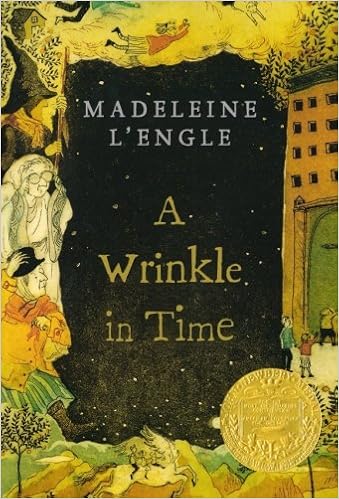
A Wrinkle in Time by Madeleine L'Engle

I read the entire Time Quintet, which is begun with A Wrinkle in Time, when I was a kid. I know that I did, but I can't remember exactly when. I know that most of it was before middle school, because I was surprised when I discovered the fourth book, Many Waters, on a shelf in the middle school library.

Some how the memories linked with A Wrinkle In Time are tied up with my memories of the first grade and Mrs. Brodie's class, but that can't be right because even though I was a little precocious in how I learned to read, I can't have been that advanced. At a guess, I must have been around 8 or 9 which explains some things about my memories of the book. Specifically, I couldn't remember anything about it except that I loved it.

I think I must have been too young for a lot of the concepts to stick despite being drawn in by the characters of Meg and Charles Wallace.

Meg struggles in school. She's smart but she can't seem to do things the way her teachers expect...even though she comes up with the right answers. She gets in trouble and she gets in fights. Many of these fights are in defense of her baby brother, Charles Wallace. Charles Wallace is odd. He's four but he speaks like an adult and seems to be able to read the minds of both Meg and her mother.

Charles Wallace and Meg live with their mother and twin brothers. Dad has disappeared mysteriously which is another cause for friction. One dark and stormy night the mysterious Mrs. Whatsit appears which leads the two kids along with their friend Calvin on a journey to rescue their father from a world consumed by an evil shadow.

This is a supremely cool book for kids. Meg is one of those universal characters. I think every kid, girl or boy, at some point feels out of step with the rest of the world and gets angry. That's probably what drew me in at such a young age, but the narrative encourages young readers to think about things like theoretical physics and what the consequences would be. It's just really cool; there is a reason it's survived with young readers for over 50 years and hasn't somehow become dated.

Sunday, June 18, 2017

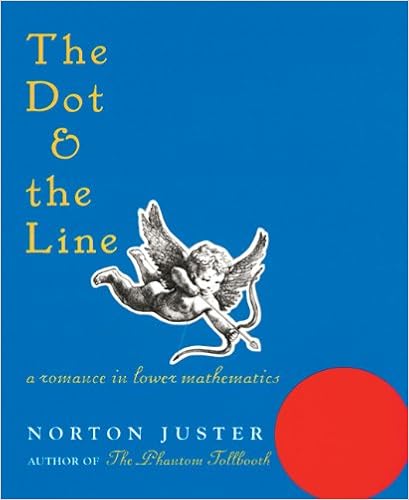
The Dot & the Line: A Romance in Lower Mathematics by Norman Juster

Ok, I admit it. This one feels like a little bit of a cheat. It's only 80 pages long and mostly pictures. However, I needed something with a non-human protagonist for the summer reading challenge, Ryan recommended it, and I'm trying to shed some of my book-snob habits. Additionally, I know Norman Juster from The Phantom Tollbooth which, if you've never read, you should give it a gander. (It's good stuff in Children's Lit)

The Dot & the Line isn't really children's lit even though it's presented that way. There are actually some meaty themes in there about the difference between looking interesting and actually being interesting. And, of course, it is an ode to the coolness of Math. In any case, I'm not going to be one of those people who write reviews longer than the work that I'm reviewing. Suffice it to say that it was a fun little read and worthwhile despite of, or even because of, its length. What do you really have to lose,  after all?

Friday, June 9, 2017

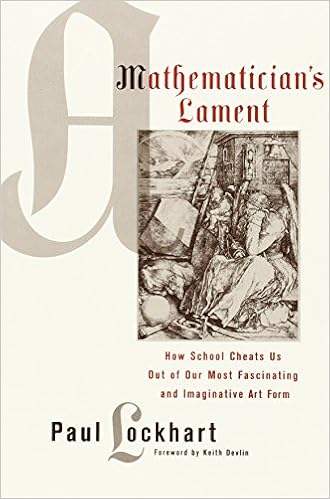
A Mathematician's Lament by Paul Lockhart

Ryan recommended this book to me. Actually, I discovered the title at last year's NCTE conference when one of the speakers mentioned in an off-hand kind of way during the last panel I went to. It's about math education and sounded interesting so I ordered it off Amazon for Ryan's Christmas present. I was expecting some sort of weighty tome, what came was a slim little white book of about 140 pages. 

Ryan, being Ryan, was enthusiastic about it and read it over a couple of days. He loved it, and immediately handed back to me as a recommendation. 

I picked it up as a break from fiction. I really only expected to skim the first few pages and then put it aside to read later, but what happened was that I found myself a few hours later still curled into a corner of the couch and turning the last page. It is very readable.

Essentially, this is a polemic. Lockhart states a problem: that the current organization of math education saps the creativity out of mathematics. He defines the problem well and even describes what his ideal of math education is. However, he doesn't really have a solution. Lockhart readily recognizes the limitations of the individual teacher in the current educational climate. 

So, as an English instructor, it may come as a shock that I got as enthralled in a math text as I did. I'm pretty mathy, actually. However, my interest in the text has more to do with the sort of universal issue with today's education. As long as we are, as educators, beholden to these bizarre standardized tests, education is only ever going to cater to the tests. We've all become SAT tutors instead of doing what educators are supposed to be about: guiding and honing the native curiosity of our students. 

The issues that Lockhart mentions are issues in every subject. The problem is that education shouldn't be about memorizing facts (that only helps in team trivia), it should be about teaching students to approach problems with logic and discernment. Anyone can memorize facts at any point of their life. Learning to think, though, is about a pattern of responses that can help a person throughout the entire course of their lives and that is what Lockhart is actually talking about. Stop making it about the subject and start making it about the problems we encounter as part of our everyday lives.

I can't give an overall opinion about this little tome, however I can say that it has me reevaluating how I teach. Maybe that is conclusion enough.