Showing posts with label poetry. Show all posts

Tuesday, July 3, 2018

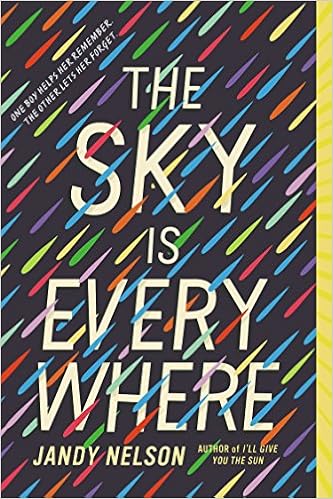
The Sky is Everywhere by Jandy Nelson

When I'm impressed by an author, I have a tendency to gather up all of that author's books so that I can read them. This can be a bit of a challenge when I'm catching a writer at the end of their career. In this case, I found Jandy Nelson on her second book, I'll Give You the Sun, because it won a Printz award in 2015. The Sky is Everywhere is her first book. I'm all caught up at this point, at least until she publishes her next book.

Lennon begins the book grieving the loss of her elder sister, Bailey, who dies of a freak fatal arrhythmia. She's 17 and her sister was 19. Both children were abandoned by their mother and are being raised by their grandmother and uncle. Every character in this book is what we used to call flaky when I was a kid. Gram is a master gardener who paints portraits of women only using the color green. Big, the uncle, is a massive Casanova arborist who's been married (and divorced) five times. Bailey was a free-spirited actress diva. Lennon is a master clarinetist who's read Wuthering Heights thirty some odd times. All of them are a little off, but they are all just really nice and sympathetic people.

Everyone's sad and trying to recover, but Lennon and Toby (Bailey's boyfriend) seem to be drowning in their grief. Lennon and Toby get closer due to their shared grief. When Lennon returns for the end of school, she meets the new guy Joe fresh in from Paris. Joe is obviously intrigued by her. Soon Lennon finds herself stuck between these two boys.

There is a heavy romance angle to this one. This book is drowning in hormones. While no actual sex, or really anything approaching sex, happens, there is a lot of very intense kissing and making out. Really. Very intense. However, that's not really what the book is about. This is not a romance novel. Ultimately this is a book about getting through grief and the kinds of mixed up emotions that happen as part of the grief process. Everything that happens between Lennon and Toby makes sense in the context of the novel. If anything, the relationship between her and Joe seems the more off key. That being said, I found the resolution touching and spent the whole last third of the book crying.

Jandy Nelson specializes in making me cry. Both her books have had me sobbing at some point during the read and it's not cheap emotion. She has a knack for creating sympathetic characters who are struggling with situations that most of us can relate to. Result = sob fest.

Sunday, June 10, 2018

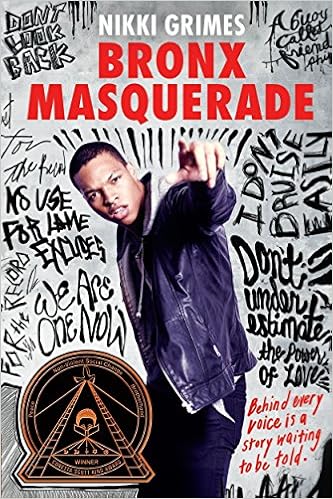
Bronx Masquerade by Nikki Grimes

Sometimes I feel like a shelter for lost books. They appear in stacks on my desks or in boxes left outside my door. Sometimes people tell me excuses: "I bought this, but I can't find time to read it" or "Someone gave it to me, but it's not really my thing." As if the excuse matters or is needed. Sometimes there is no note at all and I'm left to wonder if this orphaned book is now mine or is someone missing it? I get a small but sizable percentage of my collection this way.

I got Bronx Masquerade through Lydia's shelter for lost and abandoned books. I'd never heard of it before though Nikki Grimes is a familiar children's book author. Apparently, despite my ignorance of it, Bronx Masquerade created a bit of sensation when it came out and is even taught as a class text in places. It appeared on my desk as part of a stack that Nathan put up for adoption.

The format is a mix of short, personal first person commentary and poetry. The story is that a group of kids in a Bronx high school all fall into the idea of open mike poetry after one kid writes a poem about Langston Hughes. There are eighteen kids in the class, they are not all friends with each other, and they all have something to say through their poetry. Each of the poems expresses some sort of inner truth or personal observation and the through the first person essays we get to hear some of the reactions of the other students to the poems/ideas.

Over the course of the semester, the students begin to revise their opinions of each other and become more sensitive to each other's experiences. The Open Mike phenomenon spreads in popularity until a local paper comes out cover them.

There is something about this book that feels raw and thrown together. The ideas don't always meld together or flow well from one to the next. In a way, it looks like what a teacher would cobble together as a class project from student poetry and reflections. That is possibly part of it's strength. The lack of polish lends verisimilitude. 

 I didn't find this a transcendent experience, but it did give me a lot to think about.


Friday, February 2, 2018

Milk and Honey by Rupi Kaur

This book has started a small controversy at my school. In August, one of my seniors chose Milk and Honey as her independent reading book. Coincidentally, a different student requested our media center specialist buy a copy for the school. Since, it was a best seller and appeared on several lists, she bought a copy without thinking much about it.

My student, when she realized that she would have to do a book talk on it, alerted me to some concerns about how to present on it appropriately. I flipped through her copy and immediately saw the issue, but she and I talked it through and she successfully (and appropriately) presented it to the class. Less than a day later, the media center specialist called me over to ask about the book. In the way these things tend to happen, the book had first been delivered to the middle school by mistake. So by the time it made it up to the high school, both principals at the middle school had flipped through it and had grave concerns. These concerns were shared with the High School principal and the media center specialist. At this point, it was time to ask the resident bibliovore for an opinion and that's me.
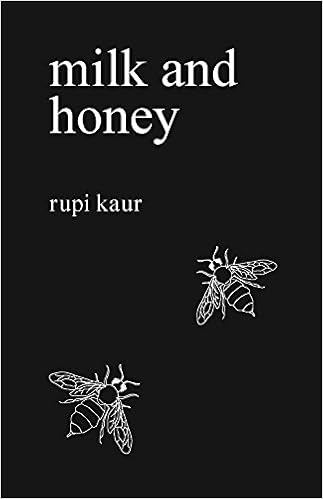
Milk and Honey is a collection of diary style poetry and prose having to do with the Kaur's first 21 years. She had a rough time of it. She experienced abuse and pain, but she also experienced love and healing. There are many references to sex and some of the line drawings are a bit suggestive. In several places Kaur expresses her experiences graphically.

There's nothing wrong with this book. It's memoir. These poems are this woman's experiences. It might make me wince in places but it didn't feel like shock value to me, just the expression of a woman who refuses to feel shame for what happened to her. In terms of theme, this is an excellent book for young women to read as it is very much a book about healing and finding strength in experience.

The problem, as far as I can tell, is that there is a sizable group of people out there that insist this is a YA title. It isn't. Just because the author was of the same age as the YA set while going through the events of the memoir doesn't mean that it's aimed at the YA audience. Conversely, that also doesn't mean young adults in their late teens and up shouldn't read it either. There is value in texts like this in that it models response to horrible situations and provides insight. We could all do with more insight.

I am uncomfortable with the idea of censorship which is why I worked with my student so that she could present Milk and Honey to the class. Censorship empowers the thing that is censored. If an idea is seen as dangerous that makes it more appealing to most people. That is just human nature. I'd rather face such things head on and talk them through. I am however sensitive to the position of parents and school administrators.

Our media center serves both the high school and middle school. A book like this is not appropriate for younger audiences, and I support the decision to keep it off the media center shelves. However, as a compromise she gave the book to me for my classroom collection. My collection is something that I have more control over. I have a collection of books that I keep separate from my main collection that I give to students if they ask for them and I think they are mature enough. In some cases, I call home and explain the book to the parents and ask them to decide if they want their child to read it.

In the case of Milk and Honey, I admit to some ambivalence. I will happily support a student's desire to read difficult material even if the ideas make me uncomfortable. There is a lot of buzz about Milk and Honey and it keeps coming up in my conversations with my students because it was a recent best seller. It'll take time for the buzz to die, and until it does, it is best that we have a copy so that we know what is floating around the student body. On the other hand, I don't relish the conversations with the parents. While I believe there is nothing wrong with the book, I also don't think it's some sort of transcendental reading experience.
Monday, January 15, 2018

Pop Sonnets by Erik Didriksen

So, the whole point of the book talks that I make my students do in class is that it starts the conversation. Many of my students can't conceive of having a meaningful conversation about a book which means that even if they enjoy what they read, they are isolated and the experience is disconnected from the rest of their lives. Therefore, the book talk. In an ideal world the kid does a book talk and some other kid says something like "hey, that sounds, cool can I borrow it." In all honesty, it takes a while before it starts to happen, but at this point in the school year, I have observed some books traveling around between students.

Often, it all starts by the students publicly offering me the book or by me asking to borrow it. I get a small percentage of my yearly reading that way. Pop Sonnets is an example of that. Alex did his book talk on it Thursday and it sounded so amusing that I asked to borrow it. It's a collection of sonnets written that adapt popular song lyrics into Shakespearean style sonnets; Didriksen even tries to mimic Shakespearean diction.

The range is pretty impressive. In there is Beyonce, Chuck Berry, Outkast, even Rick Astley and Rebecca Black (that girl who's birthday vanity video went viral online). Apparently, this all started as a tumblr blog.

My thought was that Ryan would really enjoy them and I was right. We read them over the course of the weekend and he's started writing his own. I think he's done three of them so far. It's all a lot of fun and I think I need to buy a copy to keep in a classroom for when I teach my seniors Shakespeare's sonnets.

Tuesday, February 14, 2017

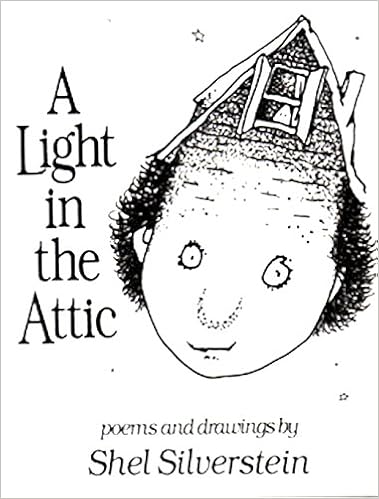
A Light In the Attic by S. Silverstein

I admit it, this is a pure nostalgia based reread. I have a co-worker that absolutely hates Silverstein and I can acknowledge his point. Much of it is not great poetry. Silverstein plays fast and loose with metrical construction and many lines are awkward. However, I love how he plays with language.

When I was younger I read and reread Silverstein's books. I loved the pictures and the rhymes. I get obsessive easily. Now that I'm an adult, I see other things. It's clear to me that Silverstein was either a parent or a teacher (or both). Too many of his poems reveal that experience.

In any case, this book deserves to be a modern classic. I was trying to read the poems to Thomas, in fact. It didn't go well. But then he's in a phase where he just doesn't want to sit still. He'll get there.