Showing posts with label Death. Show all posts

Wednesday, August 15, 2018

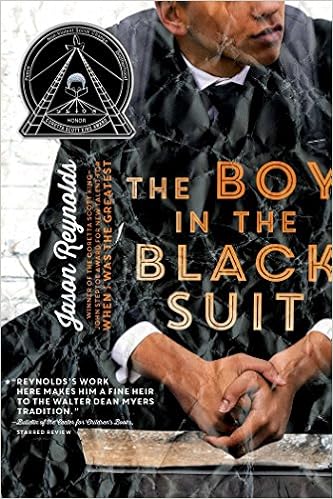
The Boy in the Black Suit by Jason Reynolds

Susan brought this title into library and I pounced. I even retro-added it to the August list so I could dive right in. It took me about two days to plow through it. Jason Reynolds is a good writer. I first became aware of him at a NCTE conference where I saw him talk about his book All American Boys. He's a tall man and soft spoken. When he talked, it was clear how much he cared about the story. I was impressed.

The Boy In the Black Suit is about grief primarily. Matt's mother has died and his dad is in the process of climbing into a bottle. Matt's a mess. He's trying to finish school and he needs to find a job for his co-op. So he goes to the local fast food restaurant to apply. Only he ends up taking a job with the local funeral director, Mr Ray, instead.

Working with Mr. Ray, Matt has the opportunity to observe how others grieve and so he begins to heal.

I've read books about grief before or at least where the major theme was a grieving character. It's surprising to read a book like this that is so overwhelmingly upbeat. There is a love story wrapped up in it all, but that's not what makes it upbeat. It's the characters. Each has experienced loss. Each is at a different stage of the grieving process, and it's like they help each other along.

This isn't the kind of book I would ever reread, but it was an excellent book and I would recommend it to my students.

Wednesday, August 8, 2018

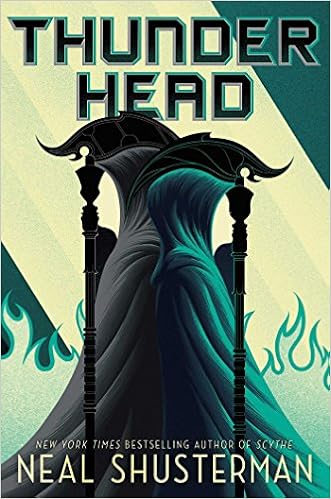
Thunderhead by Neal Shusterman

Have I ever expressed how frustrating I find reading a book and then having to wait for the next one to be written? Darn you Shusterman! (rending of hair and clothes will now commence)

Not really.

However, he really kicked over the hornet's nest at the end of this one and, dash it all, I want to know what happens. I have to wait for book three to come out: The Toll. I'm not even sure there is a release date yet. I hate waiting.

Alright, so, I got into the series as part of my larger mission to read all the Printz prize books. Scythe won a Printz honor. Then I found out that it was the beginning of a series and here we are. The thing is, it is probably worth the suspense. Shusterman has a knack for creating interesting worlds and working through interesting philosophical questions.

In the Arc of the Scythe series, Shusterman is working through two philosophical questions. 1. What would humanity be like if individuals did not face death? 2. What would a benevolent AI be like? In Thunderhead, he seems to be working on the character of the world controlling AI, Thunderhead. The AI only barely shows up in the first book.

In Thunderhead it becomes clear that the AI is, in its way, trying to do its best to protect humanity. However, because it is constrained by rules and because it is a computer and must follow its rules, it comes into conflict. This causes it to play an elaborate game of chess for high stakes and its pawns aren't generally aware they are being played.

This was a disturbingly good read. The interplay between the narratives for Citra, Rowan, and Greyson (new character) contrasts well with the snippets of editorial from the Thunderhead's point of view. Shusterman does an excellent job balancing the multiple view points and plot lines.

Worth the read.

Tuesday, July 3, 2018

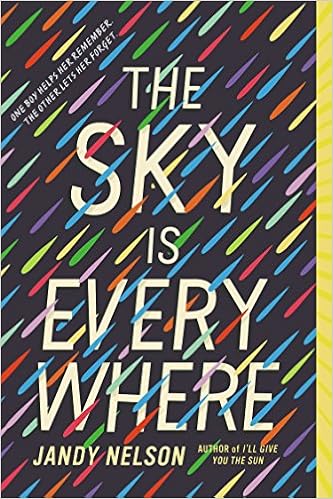
The Sky is Everywhere by Jandy Nelson

When I'm impressed by an author, I have a tendency to gather up all of that author's books so that I can read them. This can be a bit of a challenge when I'm catching a writer at the end of their career. In this case, I found Jandy Nelson on her second book, I'll Give You the Sun, because it won a Printz award in 2015. The Sky is Everywhere is her first book. I'm all caught up at this point, at least until she publishes her next book.

Lennon begins the book grieving the loss of her elder sister, Bailey, who dies of a freak fatal arrhythmia. She's 17 and her sister was 19. Both children were abandoned by their mother and are being raised by their grandmother and uncle. Every character in this book is what we used to call flaky when I was a kid. Gram is a master gardener who paints portraits of women only using the color green. Big, the uncle, is a massive Casanova arborist who's been married (and divorced) five times. Bailey was a free-spirited actress diva. Lennon is a master clarinetist who's read Wuthering Heights thirty some odd times. All of them are a little off, but they are all just really nice and sympathetic people.

Everyone's sad and trying to recover, but Lennon and Toby (Bailey's boyfriend) seem to be drowning in their grief. Lennon and Toby get closer due to their shared grief. When Lennon returns for the end of school, she meets the new guy Joe fresh in from Paris. Joe is obviously intrigued by her. Soon Lennon finds herself stuck between these two boys.

There is a heavy romance angle to this one. This book is drowning in hormones. While no actual sex, or really anything approaching sex, happens, there is a lot of very intense kissing and making out. Really. Very intense. However, that's not really what the book is about. This is not a romance novel. Ultimately this is a book about getting through grief and the kinds of mixed up emotions that happen as part of the grief process. Everything that happens between Lennon and Toby makes sense in the context of the novel. If anything, the relationship between her and Joe seems the more off key. That being said, I found the resolution touching and spent the whole last third of the book crying.

Jandy Nelson specializes in making me cry. Both her books have had me sobbing at some point during the read and it's not cheap emotion. She has a knack for creating sympathetic characters who are struggling with situations that most of us can relate to. Result = sob fest.

Saturday, March 10, 2018

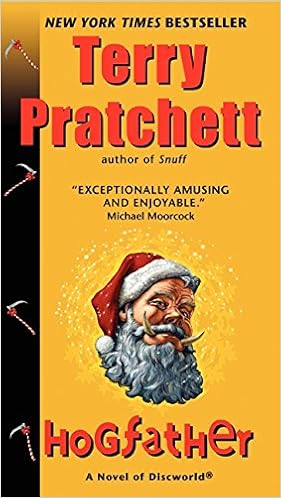
Hogfather by Terry Pratchett

I've known that this existed for a long time and I've been dreading it a little. It seems like any T.V. show, if it lasts long enough, must do a Christmas episode. Usually this just means that the action happens among tinsel and Christmas carols. The wrap is usually has one of the approved Christmas themes of love or miracles.

The same idea holds true for long book series, but with book series, I find it annoying generally. If a series goes long enough, eventually there will be a Christmasy one...even if set in a fantasy world that doesn't have Christmas properly. Some Christmas analog is created and continue as planned.

*insert annoyed rant about a religious holiday (which stole a solar observance anyway) being secularized in order to turn a profit*

So, the Hogfather is an analog to Father Christmas and Hogswatch is Christmas. He flies around in a sleigh pulled by eight giant pigs dispensing gifts and consuming sherry and pork pies left out by the kiddies. By Jove, I believe we've stumbled across the Discworld Christmas novel. *sigh*


Alright, I should have trusted Pratchett a little more than I did walking in. Yes, it is a Christmas novel. However Pratchett plays with all the things about Christmas that I find annoying so it had some fun points too.

In Hogfather mysterious figures called The Auditors have hired the assassins guild to kill the Hogfather. The assassin Teatime, who's a little batty, develops a plan to kill an imaginary being by invading the realm of the Tooth Fairy. This plan works.

Without the Hogfather, the world is out of whack. Death steps into the sleigh to keep the Hogfather's place open. Household gods start popping into being because of the unused free floating belief which gets the wizards involved. Susan StoHelit (granddaughter of Death) gets involved by trying to figure out what her grandfather is up to.

Over the course of the novel Pratchett not only examines the human tendency to create  monsters and bogeymen but also the general evolution of these myths. It's interesting stuff if looked at from a distance. While there is the occasional gushy Christmas moment, on the whole this is more of a romp. I particularly enjoy Susan who just desperately wants to be normal despite her special death related powers. She works as a governess who can actually see the monsters hiding under the bed and gets them out by pounding them with a poker. I hope there is more of her.

Monday, January 22, 2018

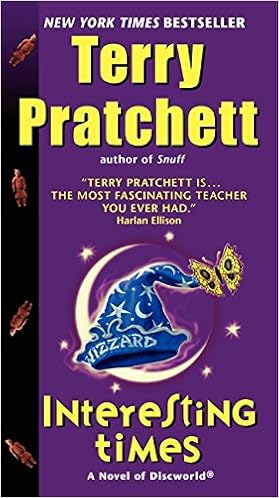
Interesting Times by Terry Prachett

Ok, the time has come. I'm taking a stand. The Discworld series is not YA! (So, now there are a bunch people sputtering in their beverages that anything involving puns, wizards, and self-animated walking luggage has to be YA and a whole other group of people rolling their eyes and saying "well, duh! Of course it isn't")

See this is the problem with classing things by age. What's the cut off and how does one go about defining it?

Here's my reasoning for Discworld. It's really quite simple. When I first read this series I was 16. I didn't hate them, but I also didn't get why they were supposed to be funny. Reading the series was a long boring experiment in cross-cultural befuddlement.  Over the course of a couple years I got about as far as Soul Music before apathetically throwing in the towel. I'm now in my late 30's, more than twice the age I was then, and I love them.

The difference is that now I get the jokes. Part of that is that I'm just older and all the protagonists are fully adults. It resonates more. Part if is that I've watched a great deal more BBC programming. So, I'm more familiar with British humor in general. The biggest reason though is that I've read a great deal more literature and history. Most of the jokes involve a frightening breadth of literature. To get the jokes, one has to be fairly well read and, as much as I read, I think I'm missing things still. What teenager has read more in their less than twenty years than I have in my slightly less than 40 years?

So, NOT YA!

Alright, enough of that.

Interesting Times is a Rincewind book. It starts out with the gods of luck and fate sitting down to play something that seems like chess. The "board" is the empire on the counterweight continent, which is where Twoflower came from in Colour of Magic. Fate has all the noble families of the empire. Luck has Rincewind, Cohen the Barbarian, a horde of geriatric barbarians, and the red army. Things then play out as they often do in Pratchett's books. By which I mean, a string of seemingly unrelated an ridiculous things happen that in the end all come together like the pieces of a puzzle box.

The Agatean Empire is clearly modeled after the imperial Chinese court and so this all made me slightly uncomfortable. Pratchett is a satirist and poking at another culture this way just gives me the willies. That's not to say that it wasn't all very funny, because it was. It just made me squirm a little. It was, however, fun to get all the characters back from the first book for a kind of character reprise.

Good read, but not a quick one. Humor relies on a passing familiarity with Imperial Chinese history and culture and some knowledge of Sun Tzu's The Art of War. The biggest challenge for adolescent readers is the lack of chapter breaks. There are no chapter delineations, just text breaks when Prachett picks up with a different point of view character.

Thursday, December 28, 2017

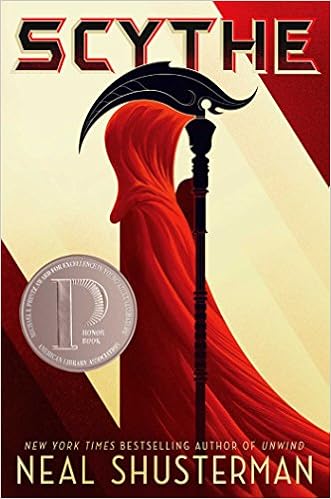
Scythe by Neal Shusterman

I have to admit, I've been lusting after this book since I saw the cover art a year ago. Books shouldn't be about good cover design but sometimes the right cover art does half the work of promoting. What can I say, sometimes I can be a little shallow. My usual modus operandi is to wait for a used copy to come along, but when it won a Printz Award Honor, I knew my wait was going to be a long one. Eventually, I caved and bought a new copy when I saw it on sale.

To be clear, I'm a fan of people buying new books. Really, I am. That's how authors make their livings, however new books are often priced in such a way that it simply isn't feasible to buy my reading load new, which is a shame. Assume that I read 120 books. If each book costs a minimum of $10 on average new (most are much more), than I'm looking at a minimum of $1,200 a year. That's a lot of money. Now granted, I'm in the top few percentiles for books read in a year, but it still makes me wonder at the cost of the books themselves especially in the case of digital media which is not resalable. I wonder if the cost of new books were less, would people read (or at least buy) more of them? It's not a question I have an answer for, but I do think digital copies should cost less than they do.

Anyway, I digress.

Scythe is about a far future where humanity has solved most of it's social ills. No poverty or starvation. There is no war because there are no national governments and everything is controlled and maintained by an AI. There is very little crime and no sickness or, in fact, naturally caused death. The biggest problem humanity has is stagnation, and they are stagnating.

This world still has problems, of course. In order to stem the explosion of population and fight against some of the stagnation, there are a group of people called scythes who deal out death to the otherwise immortal. While they are terrifying figures, they are also highly regarded. In some ways it feels reminiscent of the medieval orders of knights. All high ideals and susceptible to corruption.

Two youths, Citra and Rowan, are chosen to be apprentice Scythes and quickly get wrapped up in events bigger than themselves.

This was a quick read appropriate for High School. There are a lot of philosophical ideas hidden in here about the nature of mortality and its influence on human creativity. Also, big themes on the nature of power to corrupt.

Sunday, June 4, 2017

Looking For Alaska by John Green

I regularly ask my students to recommend books to me. There are a couple of reasons I do this. The sneaky teacher reason is that it tells me the last book that the student really enjoyed which usually gives me some insight into them as readers. It's a good indication of reading level, reading preference, and, in some cases, personality quirk. For example, if a student tells me that the class novel from the previous year is their favorite book ever, chances are pretty good that I'm going to have to work at establishing trust with the kid because they are probably giving me a 'safe' choice.

The other reason is that I'm genuinely interested in talking to people about books. A person really lights up when they talk about a book that they actually enjoyed. A significant portion of my reading during the school year is driven by student and friend recommendations. When the same book gets recommended by multiple sources, I really take note.

John Green gets recommended to me a lot. As a general rule girls tend to recommend The Fault in Our Stars to me, boys tend to recommend Looking for Alaska. Also, as an interesting point, the boys who recommended Looking for Alaska to me tended to be students I would otherwise describe as struggling readers. I really wanted to read the book; any book that can get my boys to read is worth checking out. However, I couldn't get it through the school library because our copies kept disappearing (another good sign) and the waiting list through my county library was about 30 people deep. I finally got my own copy in my latest mass book buy. (2nd & Charles is selling them for about $2 a copy and they have about 15 copies sitting on the shelf) I devoured it in about a day.
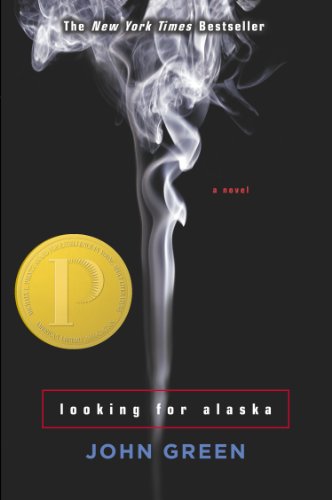
Miles Halter decides to go to boarding school to look for the 'Great Perhaps.' He's an odd kid really. He's obsessed with the last words of famous people and starts the beginning of the novel fighting against a sense of existential ennui which fuels his decision to attend Culver Creek Boarding School. He is quickly immersed in the strange social world of the school and given the ironic nickname of Pudge. His roommate, the Colonel, serves as a guide and friend as he folds him into his social scene with Alaska (her actual name) and Takumi.

Alaska is the this strange free spirit who shifts rapidly between intense free-spirited hijinks, feminist anger, and despair. She's broken and the boys are each in love with her in their own ways. She seems like an analog for Janis Joplin or Grace Slick honestly.

The whole novel is organized in two sections: 'Before' and 'After.' Obviously, something big happens and given that it won a Printz award, it's a safe bet that it's something tragic. It's an interesting format choice actually because it sets up the expectation of the reader for the big event. In the 'Before' section, the tone is mostly humorous and lighthearted. 'After' is much more grim and downbeat. The shift is a big jarring but the setup makes it work.

I like the way Green handles grief in this. There is no simple solution and there is no pat reasoning. This is a book that embraces the ambiguity of sudden tragedy and acknowledges that truth that even if we can answer all the 'whys' of an event, we still will be no closer to really understanding.

Clearly oriented towards a more male audience, there are things in here that some parents may object to including substance abuse and sexuality. However, I believe these things are in service to the plot and, for me at least, Green's treatment of the greater themes outweighs that concern. I would recommend this book to many of my students.
Saturday, March 18, 2017

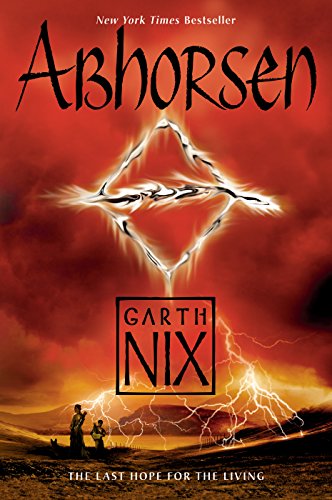
Abhorsen by Garth Nix

This is the last in the original Abhorsen trilogy by Garth Nix and follows very closely the events in Lirael. Actually, this is sort of a weird series. Sabriel, the first book, feels like a stand alone. Lirael and Abhorsen really feel like one book chopped in two which was probably done to keep the page count down. Generally, each book in a trilogy should have a complete plot arc and a common through line that links the books together. Think J.R.R. Tolkien's "Lord of the Rings." The Abhorsen trilogy reads more like an open-ended series which tends to feature discrete plot arcs with shared characters but where to main character can shift from book to book. This is more similar to Mercedes Lackey's "Valdemar" series or Terry Pratchett's "Discworld."

Anyway, Abhorsen concludes the events started in Lirael. Lirael and Sam continue their journey with Mogget and the Disreputable Dog to Red Lake in an effort on rescue Sam's friend Nick and stop an ancient evil from being unearthed. Things in Ancelstierre have completely destabilized and the book begins with an assassination attempt on King Touchstone and Queen/Abhorsen Sabriel.

This book features a more extensive description of nine precincts of death as well as a return of the enigmatic Wall Builder bloodline. The mystery surrounding both Mogget and the Disreputable Dog is finally resolved. The end reads as final as though Nix didn't envision writing any more in the world. While it was a pretty excellent way to close out the trilogy, I'm glad he decided to write more.

Thursday, January 12, 2017

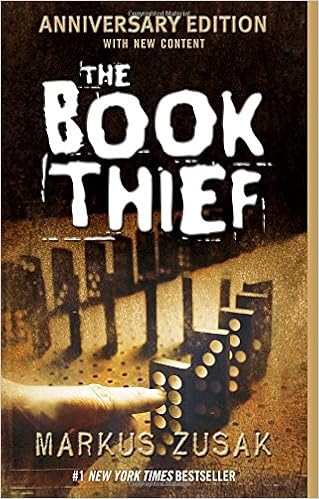
The Book Thief by Markus Zusak

So Holocaust lit. I've said it before, this isn't my favorite genre. However, in the last few years I've had at least four students read The Book Thief for their independent reading. And... *sigh* ... I made a commitment to read what my kids are interested in.

So, I read it over the break.  It took me a total of eight days to get through. Now, I realize that sounds fast to most people. Let me put it in context. I read 160 (ish) books last year. That means that on average I read a book every other day or so. Realistically, an average nonfiction book will take me around five days, a novel takes about three usually, a YA novel in about a day, and I can usually read two middle readers in a day and still get other things done. So, for something billing itself as a YA novel to take me eight days is...odd.

The main character,  Liesel, is a lutheran but her parents are communists and after her father dies, her mother takes Liesel to a little town outside of Munich to be cared for by a foul-mouthed laundress and her gentle husband. Liesel eventually understands that this was done to protect her, but she's a kid and feelings of abandonment are inevitable.

She eventually adjusts, but she's a little girl living in Nazi Germany and things are complicated. The Book Thief's plot spans the war following Liesel's life. Oh, and it's narrated by Death who seems to have a soft spot for her.

Honestly, I don't think this is really YA lit. I'm not saying that it's inappropriate for a high schooler to read. It's a good book. It's just really dense, and while it has a youthful protagonist, that doesn't necessarily make it YA.

Every few chapters I found myself having to put it down to process the material and read something a little lighter. It's a worthwhile read but be prepared to process a lot of complicated and thorny issues. Zusak is unflinching in his depiction.