Showing posts with label grief. Show all posts

Wednesday, August 15, 2018

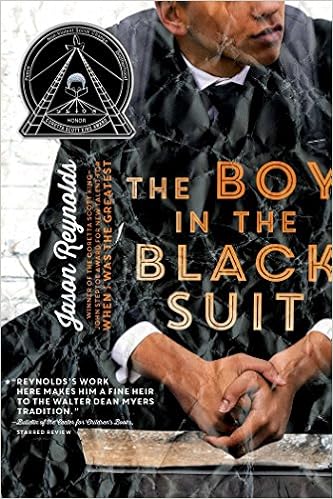
The Boy in the Black Suit by Jason Reynolds

Susan brought this title into library and I pounced. I even retro-added it to the August list so I could dive right in. It took me about two days to plow through it. Jason Reynolds is a good writer. I first became aware of him at a NCTE conference where I saw him talk about his book All American Boys. He's a tall man and soft spoken. When he talked, it was clear how much he cared about the story. I was impressed.

The Boy In the Black Suit is about grief primarily. Matt's mother has died and his dad is in the process of climbing into a bottle. Matt's a mess. He's trying to finish school and he needs to find a job for his co-op. So he goes to the local fast food restaurant to apply. Only he ends up taking a job with the local funeral director, Mr Ray, instead.

Working with Mr. Ray, Matt has the opportunity to observe how others grieve and so he begins to heal.

I've read books about grief before or at least where the major theme was a grieving character. It's surprising to read a book like this that is so overwhelmingly upbeat. There is a love story wrapped up in it all, but that's not what makes it upbeat. It's the characters. Each has experienced loss. Each is at a different stage of the grieving process, and it's like they help each other along.

This isn't the kind of book I would ever reread, but it was an excellent book and I would recommend it to my students.

Tuesday, July 3, 2018

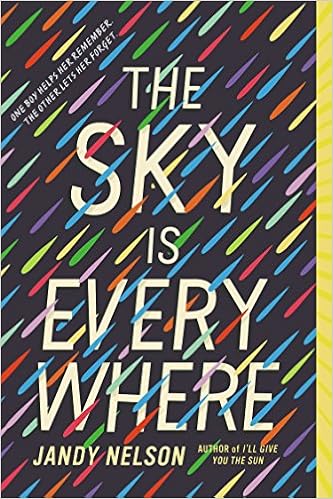
The Sky is Everywhere by Jandy Nelson

When I'm impressed by an author, I have a tendency to gather up all of that author's books so that I can read them. This can be a bit of a challenge when I'm catching a writer at the end of their career. In this case, I found Jandy Nelson on her second book, I'll Give You the Sun, because it won a Printz award in 2015. The Sky is Everywhere is her first book. I'm all caught up at this point, at least until she publishes her next book.

Lennon begins the book grieving the loss of her elder sister, Bailey, who dies of a freak fatal arrhythmia. She's 17 and her sister was 19. Both children were abandoned by their mother and are being raised by their grandmother and uncle. Every character in this book is what we used to call flaky when I was a kid. Gram is a master gardener who paints portraits of women only using the color green. Big, the uncle, is a massive Casanova arborist who's been married (and divorced) five times. Bailey was a free-spirited actress diva. Lennon is a master clarinetist who's read Wuthering Heights thirty some odd times. All of them are a little off, but they are all just really nice and sympathetic people.

Everyone's sad and trying to recover, but Lennon and Toby (Bailey's boyfriend) seem to be drowning in their grief. Lennon and Toby get closer due to their shared grief. When Lennon returns for the end of school, she meets the new guy Joe fresh in from Paris. Joe is obviously intrigued by her. Soon Lennon finds herself stuck between these two boys.

There is a heavy romance angle to this one. This book is drowning in hormones. While no actual sex, or really anything approaching sex, happens, there is a lot of very intense kissing and making out. Really. Very intense. However, that's not really what the book is about. This is not a romance novel. Ultimately this is a book about getting through grief and the kinds of mixed up emotions that happen as part of the grief process. Everything that happens between Lennon and Toby makes sense in the context of the novel. If anything, the relationship between her and Joe seems the more off key. That being said, I found the resolution touching and spent the whole last third of the book crying.

Jandy Nelson specializes in making me cry. Both her books have had me sobbing at some point during the read and it's not cheap emotion. She has a knack for creating sympathetic characters who are struggling with situations that most of us can relate to. Result = sob fest.

Friday, May 4, 2018

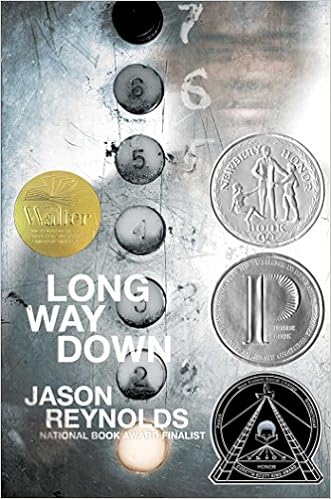
Long Way Down by Jason Reynolds

I actually finished my read of this a couple days ago, but I couldn't quite get my thoughts together on it. Some books read like a punch to the gut and when you finish you are helpless to get a breath. I've been a fan of Reynolds for a full year. I first read his book American Boys which is about the beating of a black boy by a police officer and witnessed by a white kid who had connections to both the black boy and the police officer. What impressed me at the time was that the book was set up in alternating chapters from the points of view of the two young men. I felt that the feelings and conflicting issues were handled with equal sensitivity. As a result it felt like a fair-minded examination of the issues at hand. That's not an easy thing to manage.

Long Way Down takes on similarly difficult material. In this case, Reynolds tells the story of Will, a young man who's older brother just got gunned down in a part of a cycle of gang retribution. Will wakes up in the morning and decides to take his brother's gun and shoot the boy he's sure killed his brother, Shawn. He gets into the elevator on the seventh floor and it takes an unusual amount of time to make it down to the lobby. At every floor, the car stops and a different person affected by gang violence steps on to talk to Will about his decision.

This is a book about gang violence. Yes. Really though, it's about the cycle of retribution. How violence begets violence and revenge is a self perpetuating goal. It's about gangs but it's really just about the nature of revenge.

Long Way Down is a novel in verse told in the close perspective of Will. His reactions and feelings are raw and well expressed. This book gave me chills and despite the subject matter, I would hand it to virtually any of the boys I teach (with varying amounts of preparation). I continue to be a fan of Reynolds.

Monday, February 12, 2018

I'll Give You the Sun by Jandy Nelson

Sometimes I think I should spend more time reading non-genre fiction. I don't know why I'm so drawn by fantasy and science fiction. Maybe it's the world that draws me in which is easier to convey in a back panel blurb. I just have a hard time getting the gumption up to start reading a mainstream novel. All the same, when I do manage to get into a mainstream narrative, I generally fall in love with them.

I've been working my way through all the Printz award winners and honor books, so I've been reading a lot more mainstream fiction albeit mainstream fiction for young adults. I found Laurie Halse Anderson that way and John Green too. I liked their books well enough that I'm in an extended project to read all of their books. Which brings me to I'll Give You the Sun by Jandy Nelson. I've had this book out from the school library since last June. I kept picking it up, reading a few pages, and putting it back down. I had every intention of reading it and getting it back to the library with no one the wiser but I instead accidentally held it hostage for most of a year. (Bad English teacher, no treat for you)

Noah and Jude are twins. Their mother is a crazy free spirit art history professor. Their dad is a scientist who researches parasites. The siblings are both incredible artists: Noah draws and Jude sculpts. The twins are close as twins tend to be but something happens the year before entering high school that drives a wedge between the siblings that neither seems to be able remedy.

The story is told alternating between Noah and Jude as protagonists but Noah's sections are told from before the cataclysmic event when they are 13 or 14 and Jude's are all told from after the event when they are 16. Each twin is fully defined with their own host of difficulties. Noah sees everything in snapshots like paintings waiting to happen. Oh, and he's gay but not out yet and struggling with all of that. Jude thinks in terms of superstitions and arbitrary rules she creates to avoid disaster on a metaphysical level. It's clear that both teens are in crisis but how these crises fit together is the compelling mystery of the narrative.

As is usually the case, once I really started reading it, I couldn't put it down. I was supposed to be grading today, in fact. So much for that idea. I instead spent the day alternating between wanting to cry for these characters and laughing loudly and unabashedly. While, I figured out most of the plot twists early on, the delightful humor in the character voices and the characters kept me reading.

Excellent book for teens looking for a more challenging read. The chapters are very long (up to 100 pages) but there are sub breaks in the chapters that give plenty of places to pause.

Tuesday, July 4, 2017

The Crossover by Kwame Alexander

I have Richie, our school's athletic director and varsity basketball coach, to thank for finding this one. He got our librarian to buy a couple of copies for his basketball team. I'm not sure how that worked out for him, but I'm glad he got the books into our collection. I've found this an invaluable text for my athletic boys and yet, I hadn't actually read it. Until now.

I think most people when they are just learning to be a reader self choose texts that have characters they can identify with in some way. It doesn't have to be as simple as gender, age, or ethnicity. It can be something nebulous like a personality quirk, but no matter how small, some sense of commonality with the characters draws in the readers. Later, as a reader develops, they become more adept at finding points of connection with the literature. Everything gets easier with practice.

That being said, reading literature with protagonists who are very different from oneself, can be draining even if you enjoy the story. This is why I can only read a few sport boy books in a row. I very much enjoy them because they remind me of my students, but I don't tend to have many points of commonality with athletic teenage boys. As a result, I have to spend more time thinking about what's happening in the story which keeps me from fully immersing in the text.

The Crossover was surprisingly easy to immerse in. Josh and Jordan Bell are twins who both have a passion for basketball. The story is told through Josh's poetry. Being twins they have a close relationship but things begin to change as they look towards beginning high school. They growing apart.

I always worry that the verse format will be distancing. Poems are lovely, but they often require a focus on the words to decipher the meaning. However, Alexander's poetry has the opposite effect, it draws the reader in.  Because they are poems, the writing is closer to Josh's emotions without feeling overblown.

I see why my boys are so enamored of the book: lots of white space on the page, fast paced, yet sophisticated themes.

Sunday, June 4, 2017

Looking For Alaska by John Green

I regularly ask my students to recommend books to me. There are a couple of reasons I do this. The sneaky teacher reason is that it tells me the last book that the student really enjoyed which usually gives me some insight into them as readers. It's a good indication of reading level, reading preference, and, in some cases, personality quirk. For example, if a student tells me that the class novel from the previous year is their favorite book ever, chances are pretty good that I'm going to have to work at establishing trust with the kid because they are probably giving me a 'safe' choice.

The other reason is that I'm genuinely interested in talking to people about books. A person really lights up when they talk about a book that they actually enjoyed. A significant portion of my reading during the school year is driven by student and friend recommendations. When the same book gets recommended by multiple sources, I really take note.

John Green gets recommended to me a lot. As a general rule girls tend to recommend The Fault in Our Stars to me, boys tend to recommend Looking for Alaska. Also, as an interesting point, the boys who recommended Looking for Alaska to me tended to be students I would otherwise describe as struggling readers. I really wanted to read the book; any book that can get my boys to read is worth checking out. However, I couldn't get it through the school library because our copies kept disappearing (another good sign) and the waiting list through my county library was about 30 people deep. I finally got my own copy in my latest mass book buy. (2nd & Charles is selling them for about $2 a copy and they have about 15 copies sitting on the shelf) I devoured it in about a day.
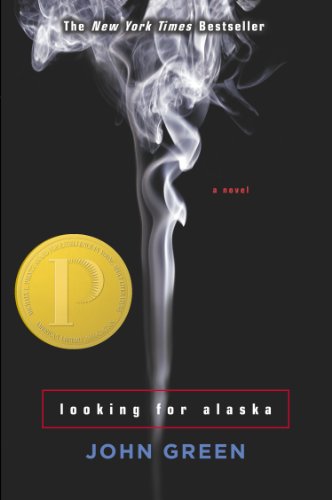
Miles Halter decides to go to boarding school to look for the 'Great Perhaps.' He's an odd kid really. He's obsessed with the last words of famous people and starts the beginning of the novel fighting against a sense of existential ennui which fuels his decision to attend Culver Creek Boarding School. He is quickly immersed in the strange social world of the school and given the ironic nickname of Pudge. His roommate, the Colonel, serves as a guide and friend as he folds him into his social scene with Alaska (her actual name) and Takumi.

Alaska is the this strange free spirit who shifts rapidly between intense free-spirited hijinks, feminist anger, and despair. She's broken and the boys are each in love with her in their own ways. She seems like an analog for Janis Joplin or Grace Slick honestly.

The whole novel is organized in two sections: 'Before' and 'After.' Obviously, something big happens and given that it won a Printz award, it's a safe bet that it's something tragic. It's an interesting format choice actually because it sets up the expectation of the reader for the big event. In the 'Before' section, the tone is mostly humorous and lighthearted. 'After' is much more grim and downbeat. The shift is a big jarring but the setup makes it work.

I like the way Green handles grief in this. There is no simple solution and there is no pat reasoning. This is a book that embraces the ambiguity of sudden tragedy and acknowledges that truth that even if we can answer all the 'whys' of an event, we still will be no closer to really understanding.

Clearly oriented towards a more male audience, there are things in here that some parents may object to including substance abuse and sexuality. However, I believe these things are in service to the plot and, for me at least, Green's treatment of the greater themes outweighs that concern. I would recommend this book to many of my students.
Tuesday, May 30, 2017

Hope Was Here by Joan Bauer

I've been reading a lot of fantasy literature lately and I picked up this in attempt to get a break from magic and fantastic critters. I don't read many books that could be labeled mainstream, YA or otherwise so it was a nice change of pace.

Hope Was Here is about Hope Yancey, a 16 year old girl who's moving with her Aunt to Wisconsin to take up a position at a diner. Hope is a girl who has already had to deal with some pretty rough things, her mom abandoned her to her Aunt for one thing, but moving to a new town the summer before her junior year in high school feels like just one more hardship. However, Hope soon finds herself involved in the campaign for a new mayoral candidate in her small town's election for mayor.

There are a lot of things going on in here. There are themes of alienation, loss, grief, and abandonment. There's also a throughline of dealing with cancer and political involvement for teenagers. It is, overall, an empowering book for the young adult that underscores the power of the individual, even the individual teen, in the machine of politics.

This book is a Newbery Honor book, won a Christopher Prize,  was an ALA Notable book for the year, and appeared on the ALA's list for Best YA Books of the year. All and all, it's a rather impressive haul of awards which has opened it up to a couple of scathing reviews on Goodreads. Most of the negativity seems to be people enjoying being negative and critical.

It does seem a strange Newbery pick to me as the protagonist is so much older than the usual focus of the prize, but that's hardly the book's fault. The only criticism that seemed particularly valid was that the book had a somewhat overly rosy view of political process. Things worked out a little too neatly given the situation outlined in the beginning, however I don't think that detracts. I think the point is people, young people too, can band together to effect change despite of, or perhaps because of, the struggles they face in their personal lives. I think that's a valuable message for our young people these days.

Sunday, December 4, 2016

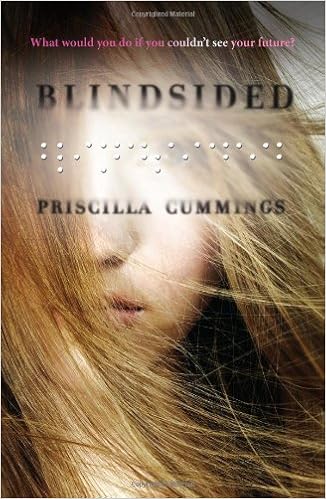
Blindsided by Priscilla Cummings

Just before my grandfather died, his eyes finally gave out and he could no longer read. I remember thinking at the time, how awful that would be. My grandfather and I shared a passion for reading. We didn't read the same books, by any means, but we both really loved the written word. I can't imagine losing that capacity.

(Audio books are, by the way, not the same. They'd be better than nothing, but I just can't get lost in the story by listening the way I do reading.  Maybe I'd have to figure out braille. Oh god, maybe I should go ahead and learn braille just in case. Although, braille editions are massive. hmmmm)

Blindsided is about a girl, Natalie, who was born without irises. It's a pretty rare condition and can incidentally lead to blindness because the irises act like a light filter. Natalie has been losing her sight for years. She's a sophomore at the beginning of the book. They've done surgeries. They've tried everything. She's going to lose the rest of her sight, and soon. So, her parents send her to a blind school in Baltimore to learn the skills she'll need to function.

Natalie is not pleased. She's angry and prefers to live in denial. So this book is really about grief and adjustment. It's really a sweet little story.

Wednesday, November 2, 2016

Counting By 7's by Holly Goldberg Sloan

The first reading ladder I'm putting together is thematically organized around protagonist types. My first ladder all has protagonists with some form of learning disability. When I finish it, I'll blog it out for y'all. However, I have some gaps so I'm doing a lot of research and reading to find books that can fill it in. 

Counting by 7's was my first attempt. Willow Chance is 12, freakishly smart, and almost completely unconcerned with what teen-age culture says "fitting in" looks like. She is highly knowledgeable in botany, almost encyclopedic on medical knowledge, and learned vietnamese for fun. Willow is smart. She's probably meant to be autistic. She is also adopted, and, when her adoptive parents die in a horrific car crash, her world is turned upside down.

Willow has to navigate the world of California's Child Services. All she has going for her is her incredible intelligence, her friend Mai (who lends her her family), and a semi-competent school counselor named Del. Del, incidentally, is a woeful case of the blind leading the blind. 

Every character is flawed but well meaning and if it all falls together a little too easily, it is also a good quick read with some beautiful moments. There's some good contemplation on the meaning and nature of grief and on what 'family' really means. 

This is a good solid read for a precocious middle schooler. The reading level is solidly in the middle range but the ideas are pretty sophisticated. Thematically, I don't think it's a good fit for my LD ladder, but it's definitely worthy of inclusion on a ladder...maybe about coping with loss or cross cultural friendship.