Showing posts with label Printz Honor Book. Show all posts

Friday, June 29, 2018

Repossessed by A.M. Jenkins

So in my continuing quest to track down and read the Printz and Printz Honor books, I ran across Repossessed which is the story of Kiriel, the demon. Kirial is not happy with his job in Hell as a low level tormentor and decides to take a vacation by possessing the body of Shaun, a 17 year old of low ambition, at the moment when he was supposed to die. Kiriel then spends the entirety of the book experiencing physical sensation and the complexities of the human condition. In many places Kiriel is almost embarrassingly hedonistic.

Shot through the book is Kiriel's examination of what I've always considered a central inconsistency in the Bible: if God is perfect and all knowing, then the only way for the devil to rebel is if God intended it. Kiriel is tortured by this. As a fallen angel, he's one of the punished, but why is he punished for being what he was created to be. It goes round and round and is an interesting introduction on the paradox for a teen audience.

I'm not sure what I expected when I picked up the book, but this wasn't it. On one level, this has a sizable amount of fairly crude imagery. On another, this is a deeply philosophical read. Kirial is almost better at being human than Shaun was and is deeply sympathetic. There are shades of Milton's "Paradise Lost" going on here as well as a healthy dose of C.S. Lewis's Screwtape Letters. Come to think of it...I should reread both of those.

I sense a themed month of reading coming up. hmmmmm

Friday, May 11, 2018

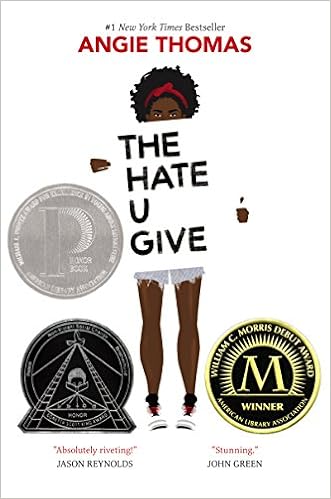
The Hate U Give by Angie Thomas

This is a book that has created a lot of buzz. It was published in 2017 and almost immediately started winning awards. Part of the buzz had to do with its subject matter; it is a YA book very much about the Black Lives Matter movement. In my experience, books focused on a single main social issue are either a real slog or absolutely brilliant. In this case, it's brilliant.

Starr is a 16 year old African-american girl living in Garden Heights (a.k.a the Ghetto) but she goes to a private prep school across town. She lives in two worlds with two languages, two cultures, and two sets of behavior standards. This, of course, causes conflict. Her friends from Garden Heights think she's ashamed of them and the kids at school never get to see the real her, not even Chris, her white boyfriend.
The novel opens on a party in Garden Heights where Starr sneaks out of the house to go to. While she's there, feeling awkward, she runs into Khalil who is a boy she's grown up with and is very close to. While they are talking, a gun is fired at the party. Khalil whisks Starr away to his car to take her home. On the way home, they are pulled over by a white police officer and Khalil ends up dead. They didn't do anything wrong really, there was no real reason to shoot him. The rest of the book is about what Starr does and what she experiences.

To say that this is a powerful book is an understatement. It's thought provoking which is even better. I'm white, which I mention because it's relevant to my experience. I don't think of myself as racist and I don't think I am racist, but I know I've been guilty of saying or being insensitive. I'm human, it happens. It's true I don't know what it's like to be black which is something that Starr says to Chris in the book. That's why books like this are important, I think. I still don't really know what it's like to be black, but books like this give me a little more insight than I had before I read them.

It's also true though that a black person doesn't know what it's like to be white. I think the core of the problem is a whole base of assumptions. We are all, regardless of skin color, raised with certain assumptions. Some of them are right most of the time, some of them a right part of the time, and some of them are only rarely correct.

It all reminds me of when I worked back at the library. One of the policies was a bag check before exiting. That was because there were a number of incredibly rare books floating around the collection at the time which was a problem, particularly because the security stripping didn't always work. I applied the policy evenly and without regard to anything. I checked professors, students, visitors, and personal friends. It didn't matter who, the policy was the policy and I did my best to enforce it. I'm not sure everyone did, but I know that I did. So when I got called racist several times it made me a little indignant. I wasn't checking their bag because of skin color, I checked everyone's bag, but then I suppose they had no real way of knowing that. They made an assumption about me probably at least partly based on the color of my skin. The problem wasn't my skin or theirs...the problem is in the assumption and the assumptions run both ways.

It seems that Thomas is cognizant of this, though, in the way she handles the two white characters Hailey and Chris. While this isn't the main thrust of the book, I found that the handling of those two side characters was masterful. I also really enjoyed the analysis of Tupac lyrics, lol.

Clearly, I'm still processing...but seriously guys, read the book.

Friday, May 4, 2018

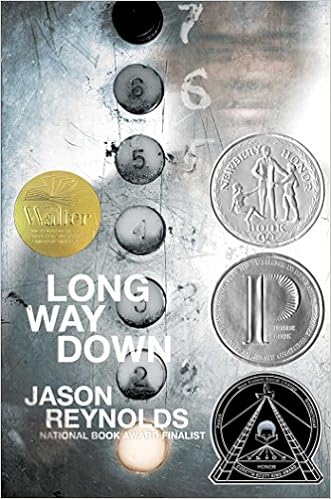
Long Way Down by Jason Reynolds

I actually finished my read of this a couple days ago, but I couldn't quite get my thoughts together on it. Some books read like a punch to the gut and when you finish you are helpless to get a breath. I've been a fan of Reynolds for a full year. I first read his book American Boys which is about the beating of a black boy by a police officer and witnessed by a white kid who had connections to both the black boy and the police officer. What impressed me at the time was that the book was set up in alternating chapters from the points of view of the two young men. I felt that the feelings and conflicting issues were handled with equal sensitivity. As a result it felt like a fair-minded examination of the issues at hand. That's not an easy thing to manage.

Long Way Down takes on similarly difficult material. In this case, Reynolds tells the story of Will, a young man who's older brother just got gunned down in a part of a cycle of gang retribution. Will wakes up in the morning and decides to take his brother's gun and shoot the boy he's sure killed his brother, Shawn. He gets into the elevator on the seventh floor and it takes an unusual amount of time to make it down to the lobby. At every floor, the car stops and a different person affected by gang violence steps on to talk to Will about his decision.

This is a book about gang violence. Yes. Really though, it's about the cycle of retribution. How violence begets violence and revenge is a self perpetuating goal. It's about gangs but it's really just about the nature of revenge.

Long Way Down is a novel in verse told in the close perspective of Will. His reactions and feelings are raw and well expressed. This book gave me chills and despite the subject matter, I would hand it to virtually any of the boys I teach (with varying amounts of preparation). I continue to be a fan of Reynolds.

Saturday, April 7, 2018

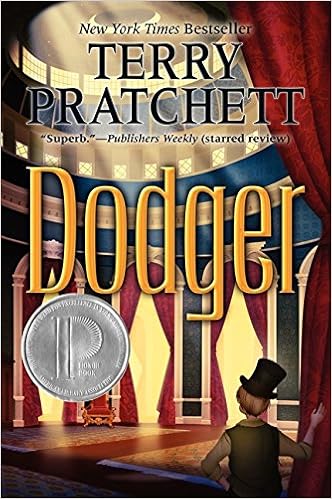
Dodger by Terry Pratchett

I admit to being slightly fascinated to find this other side of Terry Pratchett. I'm so used to associating him with  Discworld that these YAs are an interesting change. While less all out zany, there is still a surfeit of tongue-in-cheek humor in Pratchett's YAs.

Dodger is what Pratchett calls a historical fantasy. It is set in early Victorian England when conditions for the poor in London was scarily awful. The Dodger is a sort of sewer scavenger called a tosher albeit one who is unusually clever and quick thinking. Things change for him when during a storm he hears a woman's screams and rushes to her rescue. Successfully, I might add.

The woman ends up being more than she seems, of course, and things get complicated.

In a way the appeal to this book for me, an adult, is how it works on a meta level. Pratchett uses a large number of real historical figures in his narrative. One of these figures is Charles Dickens. This leads one to the natural connection from this Dodger to the Artful Dodger in Oliver Twist. Of course, this is all pure fiction, but it's amazing who knowing that influences the read of the story even for me who's never actually read the Dickens novel.

Also present is Queen Victoria (of course), Prince Albert, Sir Robert Peel, Henry Mayhew, and Benjamin Disraeli among others. While Pratchett is pretty clear about what is and is not historically based, his writing is so natural and convincing that it's easy to take it all as historical. I find that I want to read more on this age of British history.

Monday, March 19, 2018

An Abundance of Katherines by John Green

Ever since my childhood, being stuck home sick meant one thing... reading. I used to read Alice's Adventures in Wonderland over and over when I was sick. Something about reading surreal literature while suffering a fever is pleasurable. I read other things now. Sometimes I manage some really excellent insights. Maybe it's the boredom.

I finished off An Abundance of Katherines today.

Colin Singleton was a child prodigy and has date (and been dumped by) 19 Katherines. After the most recent dumping tosses Colin into a morass of existential despair, his friend Hassan decides the best cure is an aimless road trip. Colin agrees and so off they go.

They leave Chicago and end up in Tennessee, so they didn't get very far. However, they get unlikely jobs recording the stories of the citizens of Gutshot, Tennessee and living in their bosses mansion.

Colin's a strange kid. He's incredibly morose for a main character and obsessed with anagrams and "being somebody." Having been a prodigy, he now wants to be a genius and create something with a lasting value. I can sympathize. However, he's so obsessed that he could easily become an irritation, if it weren't for the footnotes. A lot of the novel's humor is in the footnotes which are entirely in Colin's voice. Apparently, in this book prodigy means font of interesting facts and statistics.

My grand insight for An Abundance of Katherines is that John Green seems to really like the idea of a road trip as a plot device. Both An Abundance of Katherines and Paper Towns feature a road trip of some sort and there's a lot of travel by car in his other books as well. I suppose metaphorically a road trip could represent a break with the status quo or from old patterns. Symbolically, the act of leaving one's home (or childhood) could be a literal trip or voyage. Most of Green's novels can be read as coming of age stories, so perhaps that last one is the most valid.

Tuesday, February 27, 2018

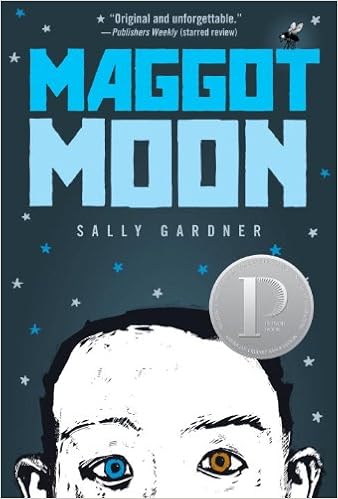
Maggot Moon by Sally Gardner

This another book I found through the Printz Award. I didn't know much about it when I picked it up but, as I've mentioned before, I generally trust the Printz Award.

Maggot Moon seems to be set in an alternate version of England where the Nazi's won world war II. I'm not sure about that, but it seems to be the general feel of it. In this version the Motherland rigidly controls society and schooling. "Impurities" are weeded out at a young age and Standish, the protagonist, has two impurities. The obvious one is that he has one blue eye and one brown. The less obvious impurity is that he appears the be severely dyslexic.

Life is pretty rough for Standish until he meets Hector. Hector is about as different from Standish as possible. He's handsome and has smooth manners. He does well in school and the bullies don't bother him. He and his family moved in next to Standish and his grandfather. The two families quickly become friends and band together. Hector's family has a secret though and one day the family is taken. Taken usually means dead.

Soon, Standish gets wrapped up with the secret and the Motherland's efforts to land men on the moon. Only, it's not what everyone thinks and Standish wants everyone to know.

This was a rough read. It's playing with a lot of difficult themes. Primarily though it's about sacrifice. When people have nothing, they still have something to sacrifice if the reason is important enough. I'm not sure how I feel about ending, but there is no denying that it is a powerful book.


Saturday, February 17, 2018

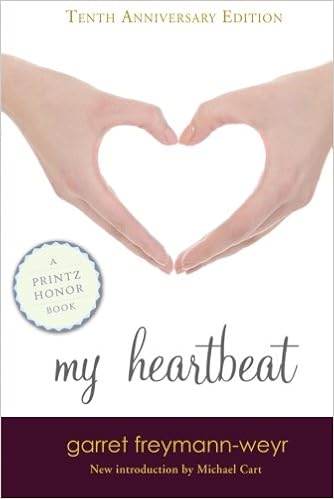
My Heartbeat by Garret Freymann-Weyr

Printz award winners and honor books all tend to deal with an issue that they are trying to explore relevant to teens. Some of my favorite books in the last few years have been Printz books. These books tend to be well written with an engaging narrative voice, likable characters, and an unflinching eye for plot. Usually, they don't feel like transparent "issue books".

My Heartbeat is the story of Ellen, a fourteen year old girl iving in Manhattan. She is madly and deeply in love with her brother, Link's, best friend, James. All that goes about the way one expect until someone suggests to Ellen that maybe James and Link are a couple. This opens a discussion on sexual politics for the teenager set.

Link and James implode leaving Ellen to figure out what being gay is or isn't. I like that Freymann-Weyr avoided overly simple categories and embraced the idea that it's possible not to know for oneself the answer to the question, "are you gay?" Neither James nor Link really know if they are gay or not. Definitely they are more than just friends but past that definitions are fluid. James is comfortable with the ambiguity. Link is not.

Ultimately, James and Ellen end up together which further complicates things.

On another level, this is a story about a young woman figuring out what's important to her and defining her identity as separate from her parents.

Something about My Heartbeat felt a little transparent though. Freymann-Weyr is taking on teenage sexuality and sexual identity issues. Both are worthy topics. Her characters are all likeable and the premise is solid, I just came away feeling like it fell flat. For one thing, these characters all come from a very privileged world. I'm not sure that should make a difference but I have a hard time believing that these kids can do all they do in the book. For example, Ellen picks up drawing with no effort over what seems like a couple of weeks and is suddenly accomplished. James and Link perform similar feats. 

There are many things to like about this book, but I feel that it might very well alienate many teens who are living more normal and average lives.

Thursday, December 28, 2017

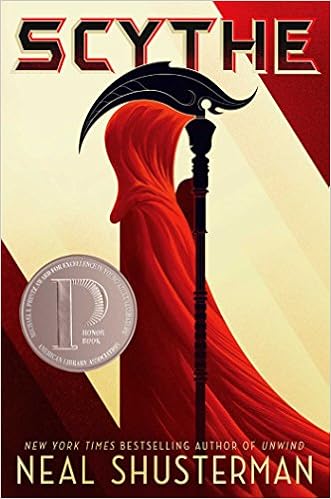
Scythe by Neal Shusterman

I have to admit, I've been lusting after this book since I saw the cover art a year ago. Books shouldn't be about good cover design but sometimes the right cover art does half the work of promoting. What can I say, sometimes I can be a little shallow. My usual modus operandi is to wait for a used copy to come along, but when it won a Printz Award Honor, I knew my wait was going to be a long one. Eventually, I caved and bought a new copy when I saw it on sale.

To be clear, I'm a fan of people buying new books. Really, I am. That's how authors make their livings, however new books are often priced in such a way that it simply isn't feasible to buy my reading load new, which is a shame. Assume that I read 120 books. If each book costs a minimum of $10 on average new (most are much more), than I'm looking at a minimum of $1,200 a year. That's a lot of money. Now granted, I'm in the top few percentiles for books read in a year, but it still makes me wonder at the cost of the books themselves especially in the case of digital media which is not resalable. I wonder if the cost of new books were less, would people read (or at least buy) more of them? It's not a question I have an answer for, but I do think digital copies should cost less than they do.

Anyway, I digress.

Scythe is about a far future where humanity has solved most of it's social ills. No poverty or starvation. There is no war because there are no national governments and everything is controlled and maintained by an AI. There is very little crime and no sickness or, in fact, naturally caused death. The biggest problem humanity has is stagnation, and they are stagnating.

This world still has problems, of course. In order to stem the explosion of population and fight against some of the stagnation, there are a group of people called scythes who deal out death to the otherwise immortal. While they are terrifying figures, they are also highly regarded. In some ways it feels reminiscent of the medieval orders of knights. All high ideals and susceptible to corruption.

Two youths, Citra and Rowan, are chosen to be apprentice Scythes and quickly get wrapped up in events bigger than themselves.

This was a quick read appropriate for High School. There are a lot of philosophical ideas hidden in here about the nature of mortality and its influence on human creativity. Also, big themes on the nature of power to corrupt.

Thursday, January 12, 2017

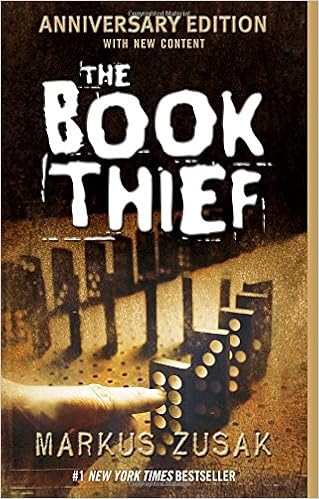
The Book Thief by Markus Zusak

So Holocaust lit. I've said it before, this isn't my favorite genre. However, in the last few years I've had at least four students read The Book Thief for their independent reading. And... *sigh* ... I made a commitment to read what my kids are interested in.

So, I read it over the break.  It took me a total of eight days to get through. Now, I realize that sounds fast to most people. Let me put it in context. I read 160 (ish) books last year. That means that on average I read a book every other day or so. Realistically, an average nonfiction book will take me around five days, a novel takes about three usually, a YA novel in about a day, and I can usually read two middle readers in a day and still get other things done. So, for something billing itself as a YA novel to take me eight days is...odd.

The main character,  Liesel, is a lutheran but her parents are communists and after her father dies, her mother takes Liesel to a little town outside of Munich to be cared for by a foul-mouthed laundress and her gentle husband. Liesel eventually understands that this was done to protect her, but she's a kid and feelings of abandonment are inevitable.

She eventually adjusts, but she's a little girl living in Nazi Germany and things are complicated. The Book Thief's plot spans the war following Liesel's life. Oh, and it's narrated by Death who seems to have a soft spot for her.

Honestly, I don't think this is really YA lit. I'm not saying that it's inappropriate for a high schooler to read. It's a good book. It's just really dense, and while it has a youthful protagonist, that doesn't necessarily make it YA.

Every few chapters I found myself having to put it down to process the material and read something a little lighter. It's a worthwhile read but be prepared to process a lot of complicated and thorny issues. Zusak is unflinching in his depiction.