Showing posts with label family. Show all posts

Friday, June 29, 2018

Repossessed by A.M. Jenkins

So in my continuing quest to track down and read the Printz and Printz Honor books, I ran across Repossessed which is the story of Kiriel, the demon. Kirial is not happy with his job in Hell as a low level tormentor and decides to take a vacation by possessing the body of Shaun, a 17 year old of low ambition, at the moment when he was supposed to die. Kiriel then spends the entirety of the book experiencing physical sensation and the complexities of the human condition. In many places Kiriel is almost embarrassingly hedonistic.

Shot through the book is Kiriel's examination of what I've always considered a central inconsistency in the Bible: if God is perfect and all knowing, then the only way for the devil to rebel is if God intended it. Kiriel is tortured by this. As a fallen angel, he's one of the punished, but why is he punished for being what he was created to be. It goes round and round and is an interesting introduction on the paradox for a teen audience.

I'm not sure what I expected when I picked up the book, but this wasn't it. On one level, this has a sizable amount of fairly crude imagery. On another, this is a deeply philosophical read. Kirial is almost better at being human than Shaun was and is deeply sympathetic. There are shades of Milton's "Paradise Lost" going on here as well as a healthy dose of C.S. Lewis's Screwtape Letters. Come to think of it...I should reread both of those.

I sense a themed month of reading coming up. hmmmmm

Wednesday, June 6, 2018

The Sun Is Also a Star by Nicola Yoon

I am swiftly becoming a Nicola Yoon fan. It started when Bella, a student of mine, read Everything Everything. She gave such a compelling book talk that I asked to borrow her copy. I read it in about a night and if I wasn't blown away, I was at least deeply impressed. I made acquiring a copy of Yoon's only other book, The Sun Is Also a Star, a priority.

Well I did it, I found a copy at Half Price Books in Decatur. I read it last night and today and it is clear that Yoon is developing as a writer. Much like her previous book, this is a love story. Daniel, who is first generation born American from Korean parents, is at a weird turning point in his life. His parents want him to be a doctor. Daniel may just want to be a poet. He takes a day to wander around New York City as a last day of freedom/childhood. Natasha is Jamaican. She was born there but her parents immigrated with her illegally when she was eight. The day the book begins is her last day in the US. At 10 P.M. she and her family are being deported. She spends her last day looking for a last chance way to stay. Daniel and Natasha meet, both hurtling toward their individual destinies, but their attraction to each other is immediate and overwhelming.

Daniel and Natasha are a case of opposites attracting that rings true to me, which says something. Usually, I just sort of scoff at those things. While there is a high potential for sap, Yoon manages to avoid nearly all of it. Natasha spends most of the book pushing against this relationship with Daniel. She's smart, into science, and prides herself on her realism. She's also very private with her business, which creates a lot of narrative tension. Daniel ends up being like this being like a large and over exuberant puppy. He's looking for a sign from the universe, Natasha is it, and he's more than happy to fall. Natasha's realism balances Daniel's optimism and vice versa. Even so, it much get to be a bit much except that the almost the entire action of the book happens over the course of one day.

In her previous book, Yoon stuck very close to one point of view. In this book, she preserves that intimate first person narrative, but she alternates between Natasha's point of view and Daniels. Periodically she dials out into a third person omniscient to comment on her two characters or describe the background of one of the several side characters and family members. The result is a complex rube goldberg machine of a plot that demonstrates the interconnectivity in the lives of strangers.

It's interesting and it's sentimental. I think my dad should read it. I enjoyed my read very much and found myself near tears by the end.

Thursday, January 18, 2018

Ironside by Holly Black

So, changelings. I've always been fascinated and creeped out by the idea of changelings. The idea is that the faeries come and steal a baby away and leave something behind in its place cloaked in glamour (illusion). The thing they leave behind might be a log or bundle of straw and then the illusion either wears off and reveals what is underneath or the baby seems to die before the magic dissipates. Sometimes though they leave a faerie baby behind and the magic never wears off but the babies are difficult and sickly. As they grow they develop into wild cantankerous children who act out and run away. From a pragmatic view this is an early explanation for difficult children that absolves the parents of responsibility.

The thing is that these stories always focus on the human parents or sometimes the human baby...but they are always human-centric. Ironside focuses on the faerie child instead as a protagonist which is an interesting  perspective. After all, what must it be like to realize that your parents aren't your parents and that you aren't even human?

Even though the first two books in the series have little in the way of shared characters, this third book in the series brings most of the main characters from both of the earlier books back. Roiben is about to be crowned; Kaye is still in love with him and insecure about it. Corney is dealing with his trauma from the first book and looking for ways to protect himself from the fey. Val and Ravus are making a go of the whole human & troll love match thing, but don't turn up much. Dave is still broken and burned out from his drug overdose, but Luis features more in this last book and finally gets some resolution.

The plot picks up a couple of months after the second book with the coronation of Roiben as the unseelie king. Kaye declares her love to him publicly and receives a seemingly impossible quest which she takes as a rejection. Casting about for a path, she decides to tell her human family the truth and gets wrapped up in the seelie queen's plot to take over the unseelie court.

In some ways, I think this the best of the three books. The first two were fun reads but there is a better balance to the story in Ironside. The intrigue means that this isn't just a teen romance which is nice. I'm sad that there aren't any more books in the series, the world is a lot of fun.

Thursday, July 6, 2017

Booked by Kwame Alexander

I've been delving into this Verse Novel format more. It's a strange way to read a story and not at all like the epics I teach. When I first heard of it, I thought it would be clumsy and difficult for a young audience in the same ways that reading the epics are. I was wrong.

I was wrong because my assumptions were flawed. Epics are difficult for younger readers because of the use of poetic conceits and need for abstraction in approaching even basic plot points on top of overarching difficulty with approaching a fundamentally alien culture that happens with any translated literature. Verse novels are a new format for YA so the text is written with a contemporary YA audience in mind. I'm not sure how well they will wear as time marches on, but for now they are very accessible. The authors have mostly dispensed with poetic conceits by entirely writing in a straightforward blank verse. While descriptive and expressive language is still of primary importance, the use of metaphor and simile tends to be used more sparingly and with more in-text explanation. The result is actually more concrete than prose in some cases because the poetry format allows a more direct description of character emotion without feeling heavy handed. Couple that with the greater amount of whitespace on the page and it explains why this format is so successful with struggling readers.

Of course some examples of the format are better than others. After reading The Crossover,  I immediately picked up Alexander's other verse novel: Booked. It's an excellent book, but not as emotionally devastating as The Crossover.

Nick Hall is a middle school soccer star. His dad is a linguistics professor and his mother is an out of work horse trainer. All Nick wants to do is play soccer, but when his mom leaves the house to take a job, Nick's relationship with his dad gets strained. Add on top of that a couple of neighborhood bullies and Nick is having a rough year.

I liked how intelligent Nick was. His voice felt appropriate for a 13 year old boy, but his approach to issues was more than usually thoughtful and his expression more articulate (thanks to his father's word obsession). While he rebels a little at the academic expectations, he also revels in his use of words which is a lot of fun to read.

The bully angle is not the primary focus of the book, but the subplot is well handled and resolves well. Overall, it's a good read.

Tuesday, January 24, 2017

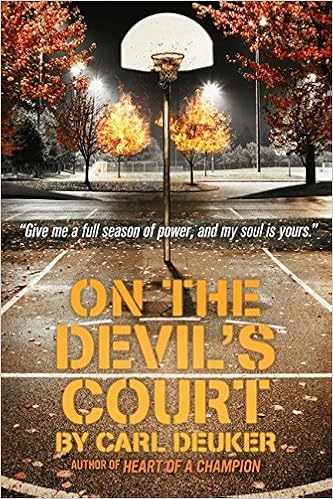
On the Devil's Court by Carl Deuker

The way we find books is interesting. In this case, I have a student who more or less refuses to find his own books and more or less refuses to read the book I find for him. He's very picky. So, I found this title through research, our librarian bought it for him and I gave it to him to read. He took it for three days and then handed it back me saying that he read it. He even said he liked it. However, that is exactly all he'll say about it and since I haven't read it, I'm having a hard time pressing him on it.
The problem is that I suspect he's lying to me. He might of read it though, and the only way I'll find out is to read it myself so I know what questions to ask. So, even though it is yet another sports book, even though it is firmly aimed at a male audience, and even though it is aimed strongly at teenagers, I read it.

I expected to have to slog through it. It was not a slog. I devoured it in a matter of hours because it is a very good book.

"Dr. Faustus" is an Elizabethan play written by Christopher Marlowe. It used to be, way back in the day, part of the high school canon. It more or less got dropped from the canon before even I went through high school. Which is a shame because it is an interesting story with excellent themes worthy of consideration. However it's also dense, fairly cerebral, and the language is hard for the average high schooler to interpret.

On the Devil's Court is almost written as a companion piece to the play "Dr. Faustus." The main character, Joe Faust, is reading the play in class while the events of the larger story unfold. Because of this, he actively considers, and attempts, to sell his soul to the devil for one perfect season of basketball. He doesn't really believe in the devil, so he doesn't really believe that he can sell his soul to him. But then, everything starts going eerily right.

The book does an excellent job of examining the classic themes present in the play while making them more approachable for a modern high school audience. I'm really seriously considering On the Devil's Court as a classroom text for next year which would, I think, allow us to read Marlowe's play as well.

Wednesday, January 4, 2017

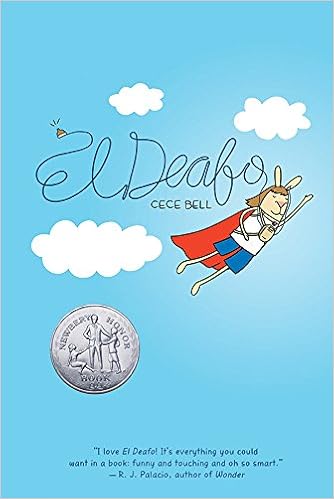
El Deafo by Cece Bell

I'll admit it, I deliberately started off the year with two graphic novels in order to get a quick jump on my reading list. In my defense, I don't read that many graphic novels in proportion to my general reading, and both books had been languishing in my stack since early December. They would soon need to be returned to the library.

El Deafo was discovered as part of the glut of titles I researched for my fiction involving disability reading ladder. When I originally grabbed it, I had no idea it was a graphic novel. It came as a little bit of a shock actually to open it up and be confronted with page after page of long eared bunnies.

In any case, this is the story of Cece who lost her hearing as a result of an illness while she was very young. Mostly, it's about adjusting to the disability and finding her place in a hearing community. It was surprising how much the book focused on how other people interacted with her. Specifically, how much well meaning people either did things that made it harder for her or even made her feel more isolated.

I have to admit, I didn't really connect to this one. It's nothing against the writing, but I just am not the intended audience and didn't get drawn in. However, it's a good book for young people, it conveys the feeling of isolation and frustration well, and does a lot to explain what it's like coping with a world filtered through a hearing aide.

Friday, December 30, 2016

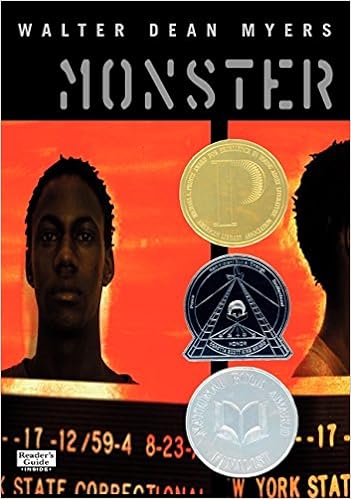
Monster by Walter Dean Myers

Walter Dean Myers has been writing YA Literature since the mid 80's and so he's part of my childhood. I was definitely familiar with his name. However, what he writes tends to be oriented to a more male audience. Monster is the first of his books I've read. I became aware of the title through a NCTE reading list on culturally diverse literature.

Monster is amazing. It won a ridiculous number of awards including the Michael L. Printz Award and the National Book Award Honor for Young People's Literature. Awards aren't everything, but I'm really beginning to trust the Printz award. Everything I've read that won that award is just amazing.

So. Monster is about Steven Harmon, 16 years old, and his experience on trial for felony murder. The writing alternates between journal entries and a hypothetical screenplay of Steven's experience written by Steven. It's an incredibly powerful strategy the effectively conveys this kid's terror of his experience of prison (the journal entries) in contrast with his weird dissociation of his experience at trial (the screenplay.)

Here's a kid who, despite being very different from me, I could see myself in. I remember being that age and wanting desperately to seem tough, or worldly, or something indefinably adult. I think it must be a pretty universal experience, however, many of us stay clear of actual legal repercussions. So, it's easy to sympathize with this kid who clearly just got sucked into something way over his head.

By the way, felony murder is a death that happens as a result, direct or indirect, of the commission of another felony. So, if a guy drops dead of a heart attack during a bank heist, everyone involved in the heist in any way is suddenly on the hook for murder. This is something we actually teach our kids once per year because LD/ADHD kids are higher than normal risk for impulsive decisions that lead to this kind of thing.

Steven's trial, for most of the book, leaves it pretty unclear just how involved he actually was. However, his ruminations on responsibility and human nature are very mature without being overly cerebral.

Excellent, quick read.

Friday, December 2, 2016

Rules by Cynthia Lord

So, in my efforts to fill the gap in my reading ladder, I've discovered enough books with autistic main characters to make an entirely separate ladder.

Catherine has an autistic brother, David. In families, when there is a disabled or chronically ill child, all the focus tends to go to that child. It's a natural thing and the siblings, in my experience, understand. However, it's got to be tough for the non-disabled child to be held to different standards and feel like their needs for attention are over looked. I'm an only child, so I have not personally experienced this, but I have had several close friends who grew up in this situation and I've taught several students with this family situation. Listening to them is interesting. It seems like few families manage the balance well and often that non-disabled kid ends up acting out because it's the only way they get attention. The other side of the coin, are the kids who end up holding themselves to impossibly perfect standards. One of my roommates in college was like that. They never get to be kids and make mistakes like other kids. Imagine the pressure of making a mistake when your parents are already so stressed out on behalf of your sibling. It's rough.

Mind you, I am absolutely not criticising these families. I cannot imagine dealing with what they have to on a day in/day out basis. I just feel for the "normal" sibling. That's what Rules is about. Catherine knows that David has more needs and she really tries to do her share, but shes still a teenage girl and craves those normal teenage experiences. When she meets a CP kid named Jason and helps him with his communication board she really has to struggle with who she is. Jason has no normal teenager words, and Catherine helps him with that. She helps him feel more normal, but how does she get to feel more normal. Who can help her with that?

The blurbs all say that this book is about acceptance and that angle is there. However, I think the most important aspect is that sibling perspective.