Showing posts with label disability. Show all posts

Sunday, January 28, 2018

Girls Like Us by Gail Giles

I avoided reading this book for almost a whole year. It fell somehow into a class of fiction that I know is good for me, but that I also know is going to tear me up inside. In this case, the whole premise made me a little uncomfortable.

Girls Like Us is a story told through the audio journals of two girls: Biddy and Quincy. Both girls are special ed and wards of the state. Biddy didn't get enough oxygen when she was born and so is physically normal but has pervasive intellectual and learning disability. Quincy was born neurotypical but received a traumatic brain injury when she was six and her mom's boyfriend hit her with a brick. She was left with facial disfigurement and learning disabilities specifically in the area of processing it seems. Quincy's actual IQ seems to be in the normal range to me, but the learning issues are substantial.

Both Quincy and Biddy are wards of the state and, when they graduate from high school, are placed together in a special work program. They live together and share expenses but have different jobs and a social worker checks in on them regularly.

Quincy starts the book as an abrasive and judgemental figure. She is quick to take offense and isn't afraid to speak her mind. If the story weren't told through journal entries, she would be completely intolerable, but because we get to see her thought process, it softens her some. Biddy comes across as almost achingly naive. She's been treated shabbily her whole life and seen very little love, but she accepts that as normal. It's pretty obvious from the start of the book that something bad wrong happened in her past.

On the surface, they aren't a good pair for roommates. In fact, Quincy starts the book with a horrible opinion of Biddy. It is a triumph of Giles's writing that she gives both girls amazing and believable character arcs that set them on a equal level to each other.

I also very much like Miss Lizzie, Biddy's boss and their landlord.

This book is clearly intended for a YA audience, but it was a difficult read. On top of the obvious issues of these kinds of special needs narrators, both girls had awful childhoods. Additionally, Giles confronts the sad truth that the intellectually disabled are are a much higher risk for all forms of abuse head on. While I find her treatment of the issue appropriate and even sensitive, it was difficult and heartrending.

I think highly of this book, but I wouldn't recommend it to just anyone.

Wednesday, January 4, 2017

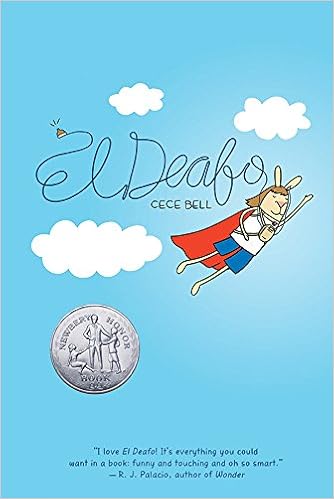
El Deafo by Cece Bell

I'll admit it, I deliberately started off the year with two graphic novels in order to get a quick jump on my reading list. In my defense, I don't read that many graphic novels in proportion to my general reading, and both books had been languishing in my stack since early December. They would soon need to be returned to the library.

El Deafo was discovered as part of the glut of titles I researched for my fiction involving disability reading ladder. When I originally grabbed it, I had no idea it was a graphic novel. It came as a little bit of a shock actually to open it up and be confronted with page after page of long eared bunnies.

In any case, this is the story of Cece who lost her hearing as a result of an illness while she was very young. Mostly, it's about adjusting to the disability and finding her place in a hearing community. It was surprising how much the book focused on how other people interacted with her. Specifically, how much well meaning people either did things that made it harder for her or even made her feel more isolated.

I have to admit, I didn't really connect to this one. It's nothing against the writing, but I just am not the intended audience and didn't get drawn in. However, it's a good book for young people, it conveys the feeling of isolation and frustration well, and does a lot to explain what it's like coping with a world filtered through a hearing aide.

Sunday, December 4, 2016

Blindsided by Priscilla Cummings

Just before my grandfather died, his eyes finally gave out and he could no longer read. I remember thinking at the time, how awful that would be. My grandfather and I shared a passion for reading. We didn't read the same books, by any means, but we both really loved the written word. I can't imagine losing that capacity.

(Audio books are, by the way, not the same. They'd be better than nothing, but I just can't get lost in the story by listening the way I do reading.  Maybe I'd have to figure out braille. Oh god, maybe I should go ahead and learn braille just in case. Although, braille editions are massive. hmmmm)

Blindsided is about a girl, Natalie, who was born without irises. It's a pretty rare condition and can incidentally lead to blindness because the irises act like a light filter. Natalie has been losing her sight for years. She's a sophomore at the beginning of the book. They've done surgeries. They've tried everything. She's going to lose the rest of her sight, and soon. So, her parents send her to a blind school in Baltimore to learn the skills she'll need to function.

Natalie is not pleased. She's angry and prefers to live in denial. So this book is really about grief and adjustment. It's really a sweet little story.

Wednesday, November 23, 2016

The Five Flavors of Dumb by Anthony John

Yet another discovery in my quest to fill in the gaps on my LD Reading Ladder. And an another great book that doesn't quite fit. Maybe I need to rethink my theme.

The premise of The Five Flavors of Dumb is that Piper, who happens to be deaf, somehow ends up managing a rock band her High School. This is challenging for a number of reasons that have nothing to do with her deafness. I have to admit, I thought this was a ridiculous premise and, as a consequence, didn't expect much.  I was pleasantly surprised.

Of all the disabilities I work with in my job, deafness confounds me the most. It affects a surprising number of people. There is a strong genetic component and as a result there are whole multi-generational deaf families. Many of these people don't view it as a disability and a whole "deaf culture" has sprung up. I have to admit that I have a hard time viewing the lack of an ability that most other people possess as anything but a disability. It's hard to wrap my head about. On the other hand, I don't necessarily view dwarves as disabled just because they "lack height." Disability is a mind-set after-all and who am I to judge?

The reason for this reflection, however, is that functioning in society and the nature of deaf culture is one of the underpinning themes of the novel. On the surface it's about these five musicians, one of which is a complete rancid jerk, being dysfunctional while a deaf girl tries to hold them together. And that's a good story, but the more subtle lines about disability and family are way more compelling.

This book features a strong female protagonist struggling less with her disability, and more with getting to know her own feelings about how she fits into her family and the rest of the world. The plot line is strictly linear and chapters are relatively short. The author is british, which means much of the humor tends towards the dry and subtle. All and all a solid read.


Sunday, November 20, 2016

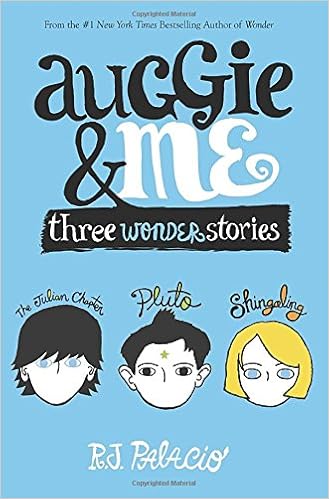
The Wonder World - Palacio

Every once and a while I finish a stand alone novel and wish there were more. It's not an uncommon thing for writers to write additional short stories and vignettes in a beloved world. However, they often go unpublished or languish in some collection somewhere that only printed 200 copies. Palacio made it easy, she published them...or at least three of them. None of them stand well on their own, but they are great supplements to Wonder once you've read that.

Julian - is a lost chapter from the perspective of the bully. Julian is the kid who just can't adjust to the way Auggie looks and lashes. Most of the real action of the chapter happens after Wonder concludes when Julian is in France with his grandmother. I liked this chapter because, while it didn't excuse Julian's actions, it went a good ways into offering an explanation for why bullies do what they do.

Pluto - is about Auggie's oldest friend Chris. Oddly enough, while Auggie is definitely a part of Chris's story, this chapter is really entirely about Chris. What does it mean to be a friend of someone living with disfigurement? How do you protect them? Should you? These are tough questions for adults. Being a middle schooler and having to figure them out is probably tougher

Shingaling - is about Charlotte. Charlotte, like Julian and Jack Will, was made a welcome buddy to Auggie at the beginning of the school year. I think that Charlotte tends to represent how most people respond to these sorts of issues. She is not cruel to Auggie the way Julian is, but she also doesn't really befriend him either the way Jack Will and Summer do. She sort of hovers in a vaguely genial neutrality which is what I think most people end up doing. She's not a bad person at all, she just gets uncomfortable and doesn't know what to do. So, she does nothing really. I think most of us find ourself there. It takes courage to invite attention and comment by befriending the uncomfortable. That's what makes Shingaling such an important addition to the Wonder collection.

All three chapters have since been collected into a single volume called Auggie & Me. They are all a worthwhile read.

Monday, November 14, 2016

Kissing Doorknobs by Terry Spencer Hesser

Tara Sullivan can't explain why she does the things she does. She can't explain why she has to count cracks or line up grains of rice before eating them. She doesn't know why she has to confess every sin or pray every time someone swears. She knows it's weird and that no one else has to do it. Maybe she's crazy. Her parents certainly seem to think so and she can't really argue.

Things get worse and worse until a family friend finally steps in.

Published in 1998, the public was much less aware of OCD so reading this was a little weird. It's not really a novel that focuses on story. It reads more like a fictionalized diary or personal testimony. I suspect the author wrote it as an educational tool, in fact. Window into the Obsessive-Compulsive mind, or some such.

It's only about 150 pages in hardcover so it's a quick read. It's an interesting voice and it definitely conveys the helplessness of dealing with these compulsions. However, it's jarring the way the book assumes that most people are completely unaware of what OCD is.

In a post-Monk world, I think everyone has a passing familiarity with what OCD is. It leaked into our language, and we self apply it when we are being super detail oriented about something. It's lazy language and most people don't fully understand the horror of it, but at least they are aware of it as a thing that happens.

Eh. It's a decent book, but I can't think of who I would recommend it to.

Tuesday, October 4, 2016

Out of my Mind by Sharon Draper

One of my primary sources of book recommendations for YA fiction is the students I teach. I try to pay attention to what they are reading and when they tell me something is good, I try to read it. Sometimes it goes a step further and a student brings me in a book to read; those I really hustle to get through.

Out of my Mind was brought to me by a very enthusiastic student, Ansley. When she handed it to me in class a couple weeks ago a handful of other students spotted it and chimed in on how awesome it is. So I read it yesterday. It took me about four hours to get through so it's a very quick read, but also I got through it so quickly simply because it sucked me in.

Melody, the main character and point of view, was born with cerebral palsy. She can't communicate much and she can't do anything for herself that involves more than the use of her thumbs. Yet she is extremely intelligent and has an eidetic memory. She's trapped in a self-contained classroom with other cases of extreme disability with teachers who mostly don't even try to really reach her.

Things change in her fifth grade year with a new teacher who "gets it," new inclusion classes with regular kids, and a new para-pro who comes to assist her communication. Once the gate opens, Melody communicates better and better. However, not everything changes, she still has CP after all.

This book made me cry and it made me angry. On of the teachers pissed me right off. I don't know, as a teacher, how I would have handled the situation. I probably would not have handled it perfectly either but I know I wouldn't have been so senselessly cruel.

Ack, anyway it's a great book. I'm going to have to track down a couple copies for the school.