Showing posts with label Learning disability. Show all posts

Tuesday, February 27, 2018

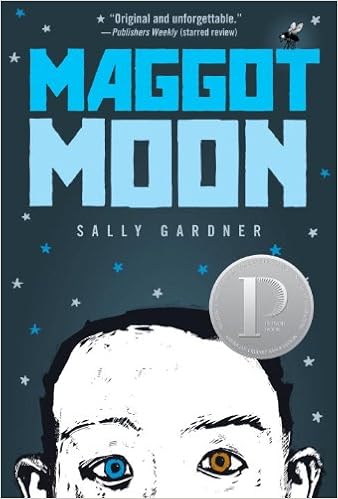
Maggot Moon by Sally Gardner

This another book I found through the Printz Award. I didn't know much about it when I picked it up but, as I've mentioned before, I generally trust the Printz Award.

Maggot Moon seems to be set in an alternate version of England where the Nazi's won world war II. I'm not sure about that, but it seems to be the general feel of it. In this version the Motherland rigidly controls society and schooling. "Impurities" are weeded out at a young age and Standish, the protagonist, has two impurities. The obvious one is that he has one blue eye and one brown. The less obvious impurity is that he appears the be severely dyslexic.

Life is pretty rough for Standish until he meets Hector. Hector is about as different from Standish as possible. He's handsome and has smooth manners. He does well in school and the bullies don't bother him. He and his family moved in next to Standish and his grandfather. The two families quickly become friends and band together. Hector's family has a secret though and one day the family is taken. Taken usually means dead.

Soon, Standish gets wrapped up with the secret and the Motherland's efforts to land men on the moon. Only, it's not what everyone thinks and Standish wants everyone to know.

This was a rough read. It's playing with a lot of difficult themes. Primarily though it's about sacrifice. When people have nothing, they still have something to sacrifice if the reason is important enough. I'm not sure how I feel about ending, but there is no denying that it is a powerful book.


Sunday, January 28, 2018

Girls Like Us by Gail Giles

I avoided reading this book for almost a whole year. It fell somehow into a class of fiction that I know is good for me, but that I also know is going to tear me up inside. In this case, the whole premise made me a little uncomfortable.

Girls Like Us is a story told through the audio journals of two girls: Biddy and Quincy. Both girls are special ed and wards of the state. Biddy didn't get enough oxygen when she was born and so is physically normal but has pervasive intellectual and learning disability. Quincy was born neurotypical but received a traumatic brain injury when she was six and her mom's boyfriend hit her with a brick. She was left with facial disfigurement and learning disabilities specifically in the area of processing it seems. Quincy's actual IQ seems to be in the normal range to me, but the learning issues are substantial.

Both Quincy and Biddy are wards of the state and, when they graduate from high school, are placed together in a special work program. They live together and share expenses but have different jobs and a social worker checks in on them regularly.

Quincy starts the book as an abrasive and judgemental figure. She is quick to take offense and isn't afraid to speak her mind. If the story weren't told through journal entries, she would be completely intolerable, but because we get to see her thought process, it softens her some. Biddy comes across as almost achingly naive. She's been treated shabbily her whole life and seen very little love, but she accepts that as normal. It's pretty obvious from the start of the book that something bad wrong happened in her past.

On the surface, they aren't a good pair for roommates. In fact, Quincy starts the book with a horrible opinion of Biddy. It is a triumph of Giles's writing that she gives both girls amazing and believable character arcs that set them on a equal level to each other.

I also very much like Miss Lizzie, Biddy's boss and their landlord.

This book is clearly intended for a YA audience, but it was a difficult read. On top of the obvious issues of these kinds of special needs narrators, both girls had awful childhoods. Additionally, Giles confronts the sad truth that the intellectually disabled are are a much higher risk for all forms of abuse head on. While I find her treatment of the issue appropriate and even sensitive, it was difficult and heartrending.

I think highly of this book, but I wouldn't recommend it to just anyone.

Friday, December 2, 2016

Rules by Cynthia Lord

So, in my efforts to fill the gap in my reading ladder, I've discovered enough books with autistic main characters to make an entirely separate ladder.

Catherine has an autistic brother, David. In families, when there is a disabled or chronically ill child, all the focus tends to go to that child. It's a natural thing and the siblings, in my experience, understand. However, it's got to be tough for the non-disabled child to be held to different standards and feel like their needs for attention are over looked. I'm an only child, so I have not personally experienced this, but I have had several close friends who grew up in this situation and I've taught several students with this family situation. Listening to them is interesting. It seems like few families manage the balance well and often that non-disabled kid ends up acting out because it's the only way they get attention. The other side of the coin, are the kids who end up holding themselves to impossibly perfect standards. One of my roommates in college was like that. They never get to be kids and make mistakes like other kids. Imagine the pressure of making a mistake when your parents are already so stressed out on behalf of your sibling. It's rough.

Mind you, I am absolutely not criticising these families. I cannot imagine dealing with what they have to on a day in/day out basis. I just feel for the "normal" sibling. That's what Rules is about. Catherine knows that David has more needs and she really tries to do her share, but shes still a teenage girl and craves those normal teenage experiences. When she meets a CP kid named Jason and helps him with his communication board she really has to struggle with who she is. Jason has no normal teenager words, and Catherine helps him with that. She helps him feel more normal, but how does she get to feel more normal. Who can help her with that?

The blurbs all say that this book is about acceptance and that angle is there. However, I think the most important aspect is that sibling perspective.

Wednesday, November 23, 2016

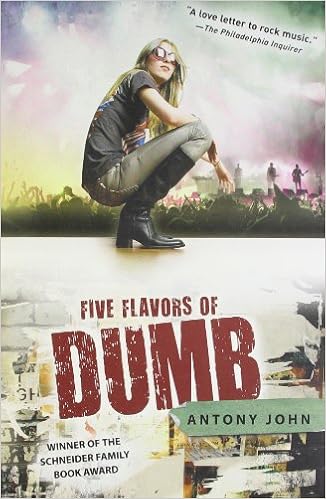
The Five Flavors of Dumb by Anthony John

Yet another discovery in my quest to fill in the gaps on my LD Reading Ladder. And an another great book that doesn't quite fit. Maybe I need to rethink my theme.

The premise of The Five Flavors of Dumb is that Piper, who happens to be deaf, somehow ends up managing a rock band her High School. This is challenging for a number of reasons that have nothing to do with her deafness. I have to admit, I thought this was a ridiculous premise and, as a consequence, didn't expect much.  I was pleasantly surprised.

Of all the disabilities I work with in my job, deafness confounds me the most. It affects a surprising number of people. There is a strong genetic component and as a result there are whole multi-generational deaf families. Many of these people don't view it as a disability and a whole "deaf culture" has sprung up. I have to admit that I have a hard time viewing the lack of an ability that most other people possess as anything but a disability. It's hard to wrap my head about. On the other hand, I don't necessarily view dwarves as disabled just because they "lack height." Disability is a mind-set after-all and who am I to judge?

The reason for this reflection, however, is that functioning in society and the nature of deaf culture is one of the underpinning themes of the novel. On the surface it's about these five musicians, one of which is a complete rancid jerk, being dysfunctional while a deaf girl tries to hold them together. And that's a good story, but the more subtle lines about disability and family are way more compelling.

This book features a strong female protagonist struggling less with her disability, and more with getting to know her own feelings about how she fits into her family and the rest of the world. The plot line is strictly linear and chapters are relatively short. The author is british, which means much of the humor tends towards the dry and subtle. All and all a solid read.


Wednesday, November 2, 2016

Counting By 7's by Holly Goldberg Sloan

The first reading ladder I'm putting together is thematically organized around protagonist types. My first ladder all has protagonists with some form of learning disability. When I finish it, I'll blog it out for y'all. However, I have some gaps so I'm doing a lot of research and reading to find books that can fill it in. 

Counting by 7's was my first attempt. Willow Chance is 12, freakishly smart, and almost completely unconcerned with what teen-age culture says "fitting in" looks like. She is highly knowledgeable in botany, almost encyclopedic on medical knowledge, and learned vietnamese for fun. Willow is smart. She's probably meant to be autistic. She is also adopted, and, when her adoptive parents die in a horrific car crash, her world is turned upside down.

Willow has to navigate the world of California's Child Services. All she has going for her is her incredible intelligence, her friend Mai (who lends her her family), and a semi-competent school counselor named Del. Del, incidentally, is a woeful case of the blind leading the blind. 

Every character is flawed but well meaning and if it all falls together a little too easily, it is also a good quick read with some beautiful moments. There's some good contemplation on the meaning and nature of grief and on what 'family' really means. 

This is a good solid read for a precocious middle schooler. The reading level is solidly in the middle range but the ideas are pretty sophisticated. Thematically, I don't think it's a good fit for my LD ladder, but it's definitely worthy of inclusion on a ladder...maybe about coping with loss or cross cultural friendship.